USD/JPY surges as Takaichi pushes back on BoJ rate hikes
- Japanese Yen sells off after reports PM Takaichi voiced opposition to further tightening in meeting with BoJ's Ueda.
- PM Takaichi reportedly took a tougher stance against further BoJ rate hikes in a meeting with Governor Ueda last week, complicating the central bank's tightening timeline.
- January FOMC minutes showed several Fed officials discussed the possibility of raising rates if inflation stays above target, reinforcing the extended pause at 3.50% to 3.75%.

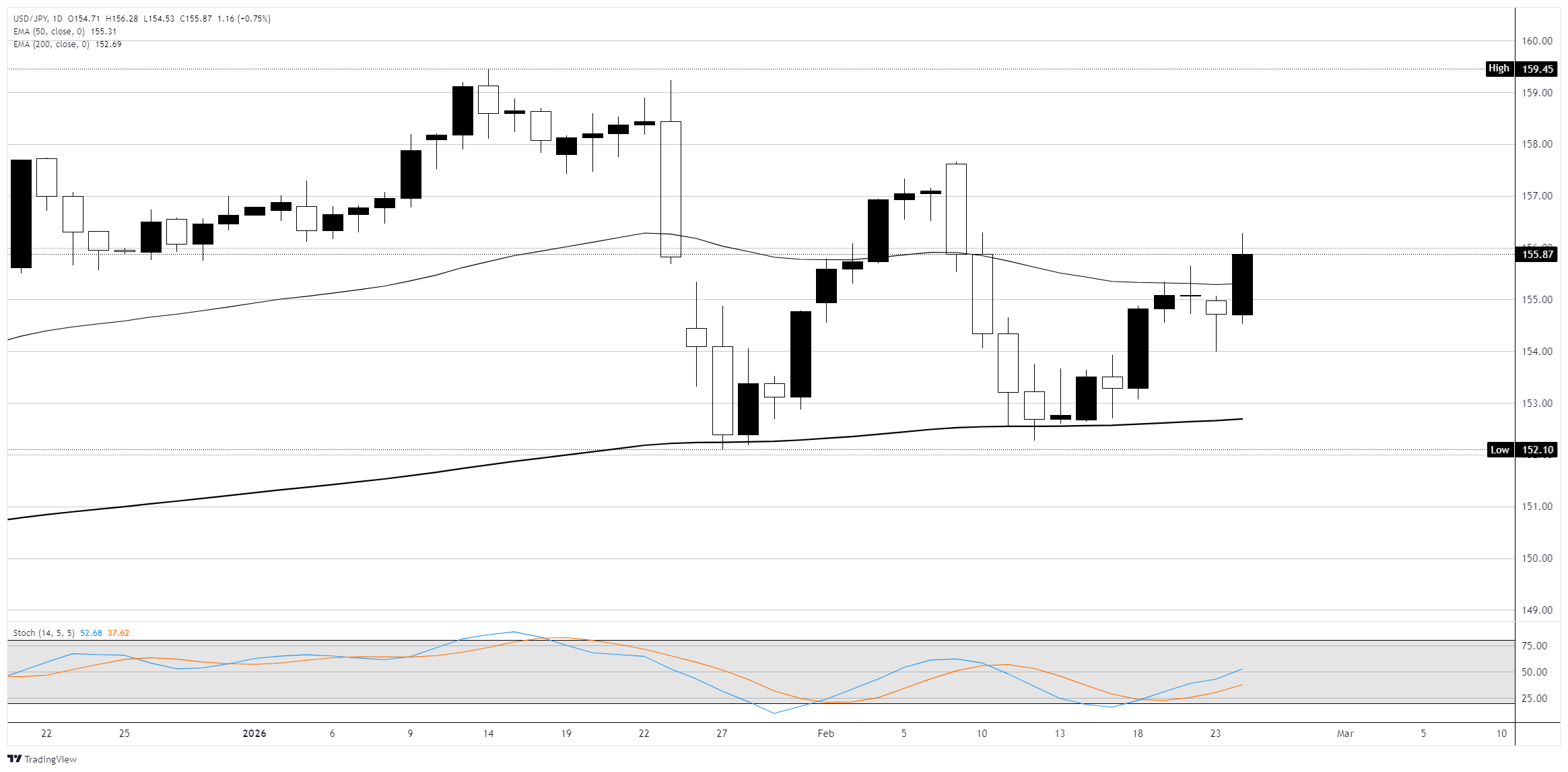
USD/JPY jumped about 0.7% on Tuesday, rallying sharply to around 155.86 in a session driven almost entirely by Japanese Yen weakness. The pair has been chopping in a wide range between about 152.00 and 157.00 since late January, with alternating large-bodied bullish and bearish candles pointing to a tug-of-war between opposing forces. Tuesday's strong bullish candle pushed price back into the upper half of that range after last week's pullback toward the 153.000 area.
Reports from the Japanese newspaper Mainichi Shimbun that Prime Minister Sanae Takaichi voiced concern about further Bank of Japan (BoJ) rate hikes during her February 16 meeting with Governor Kazuo Ueda sent the Japanese Yen lower across the board. Prior to the report, a majority of economists polled by Reuters had expected the BoJ to raise its policy rate to 1% by the end of June, with markets pricing roughly 70% odds of a hike by April. Takaichi's pro-stimulus stance, now backed by a landslide election victory, raises the risk that the BoJ's tightening path could be delayed despite underlying inflation (excluding fresh food and energy) still running at 2.6%.
On the US Dollar (USD) side, the Federal Reserve (Fed) held rates at 3.50% to 3.75% in January, but the minutes released last week showed several participants discussing the possibility of rate hikes if inflation remains above target. US consumer confidence ticked up to 91.2 in February, though the expectations component has now spent 13 consecutive months below the 80 recession-warning threshold. Trump's new 15% global tariffs following the Supreme Court ruling continue to cloud the broader risk outlook.
Price recovers above the 50-day EMA as Stochastic crosses bullish in neutral territory
The pair reclaimed the 50-day Exponential Moving Average (EMA) near 155.30 on Tuesday's rally, while the 200-day EMA around 152.70 continues to rise and provided a floor during the early-February pullback toward the 152.100 low. The Stochastic Oscillator has crossed bullish and is drifting higher through neutral territory, suggesting upside momentum is rebuilding after the recent pullback from the January highs close to 159.450. A sustained push above the 157.00 area would open a path toward the 158.000 round number, while a failure to hold above the 50-day EMA would shift focus back toward the 153.00 zone and the 200-day EMA.
USD/JPY Daily chart
Japanese Yen FAQs
The Japanese Yen (JPY) is one of the world’s most traded currencies. Its value is broadly determined by the performance of the Japanese economy, but more specifically by the Bank of Japan’s policy, the differential between Japanese and US bond yields, or risk sentiment among traders, among other factors.
One of the Bank of Japan’s mandates is currency control, so its moves are key for the Yen. The BoJ has directly intervened in currency markets sometimes, generally to lower the value of the Yen, although it refrains from doing it often due to political concerns of its main trading partners. The BoJ ultra-loose monetary policy between 2013 and 2024 caused the Yen to depreciate against its main currency peers due to an increasing policy divergence between the Bank of Japan and other main central banks. More recently, the gradually unwinding of this ultra-loose policy has given some support to the Yen.
Over the last decade, the BoJ’s stance of sticking to ultra-loose monetary policy has led to a widening policy divergence with other central banks, particularly with the US Federal Reserve. This supported a widening of the differential between the 10-year US and Japanese bonds, which favored the US Dollar against the Japanese Yen. The BoJ decision in 2024 to gradually abandon the ultra-loose policy, coupled with interest-rate cuts in other major central banks, is narrowing this differential.
The Japanese Yen is often seen as a safe-haven investment. This means that in times of market stress, investors are more likely to put their money in the Japanese currency due to its supposed reliability and stability. Turbulent times are likely to strengthen the Yen’s value against other currencies seen as more risky to invest in.
Author

Joshua Gibson
FXStreet
Joshua joins the FXStreet team as an Economics and Finance double major from Vancouver Island University with twelve years' experience as an independent trader focusing on technical analysis.