S&P 500 rallies as markets digest soft US jobs data, Fed rate hike pause
- S&P 500 ended the week up by 0.9%, with the Nasdaq and Dow Jones also posting significant gains, reflecting a positive shift in investor sentiment.
- U.S. labor market data showing a slowdown in job growth fueled speculation that the Federal Reserve may halt rate hikes.
- Fed officials Thomas Barkin and Neil Kashkari highlighted the uncertainty about the future path of interest rates, emphasizing the need to remain data-dependent.
Wall Street finished the week with gains on Friday, following a turbulent week that witnessed the US Federal Reserve (Fed) decision to hold rates, while traders priced in the Fed finished its tightening cycle. Consequently, US stocks rose, the Greenback dropped, and US bond yields plunged.
S&P 500 caps off a volatile week with gains as investors adjust to the prospect of a pause in the Fed's tightening cycle
The US equity benchmark, the S&P 500, advanced 0.9%, finishing at 4,356.34, posting 5.9% weekly gains. The Nasdaq Composite jumped 1.4% and ended at 13,478.28, and the Dow Jones Industrial climbed 200 points or 0.66%, clinging above the 34,000 mark.
Macroeconomic data from the US revealed the jobs market is cooling, sparking speculation that Fed Chair Jerome Powell and Co. would not raise rates. October Nonfarm Payrolls rose 150K, below the 180K expected, and trailed the prior month’s reading of 290K. Digging deeper into the report of the US Department of Labor, the unemployment rate climbed to 3.9%, while average hourly earnings decreased to 4.1 from 4.3%.
Later, S&P Global and the Institute of Supply Management (ISM) revealed that business activity in the services segment is slowing, displaying October’s data. Given the backdrop, money market futures traders slashed the odds for further tightening by the Fed and instead increased the odds for 100 bps of rate cuts for the next year, according to the CME FedWatch Tool data.
Sector-wise, the gainers were Real Estate, Materials, and Communication Services, each added 2.35%, 1.55%, and 1.39%, respectively. The only loser was Energy, 1.01% below its opening price, weighed by falling Oil prices, as the Middle East conflict extended for the fourth straight week.
On Friday, the Greenback posted losses of more than 1%, as the US Dollar Index (DXY) ended at the brisk the 104.00 handle, around 105.06. US Treasury bond yields dropped, with the US 10-year Treasury bond yield dropping eight basis points to 4.57%.
Meanwhile, Federal Reserve officials crossed newswires, led by Richmond Fed’s President Thomas Barkin. He said that risks of over and under-tightening exist and mentioned that he’s unsure if the Fed has reached peak rates. Meanwhile, Minnesota’s Fed President Neil Kashkari said they must keep watching data, adding that “it’s too soon to call” if another rate hike is needed.
The next week, the US economic docket would feature Fed speakers led by Chair Jerome Powell, Lisa Cook, Christopher Waller, Philip Jefferson, and some Fed Regional Bank Presidents. On the data front, Initial Jobless Claims and the University of Michigan (UoM) Consumer Sentiment are the primary data points to be released.
S&P 500 Price Chart – Daily
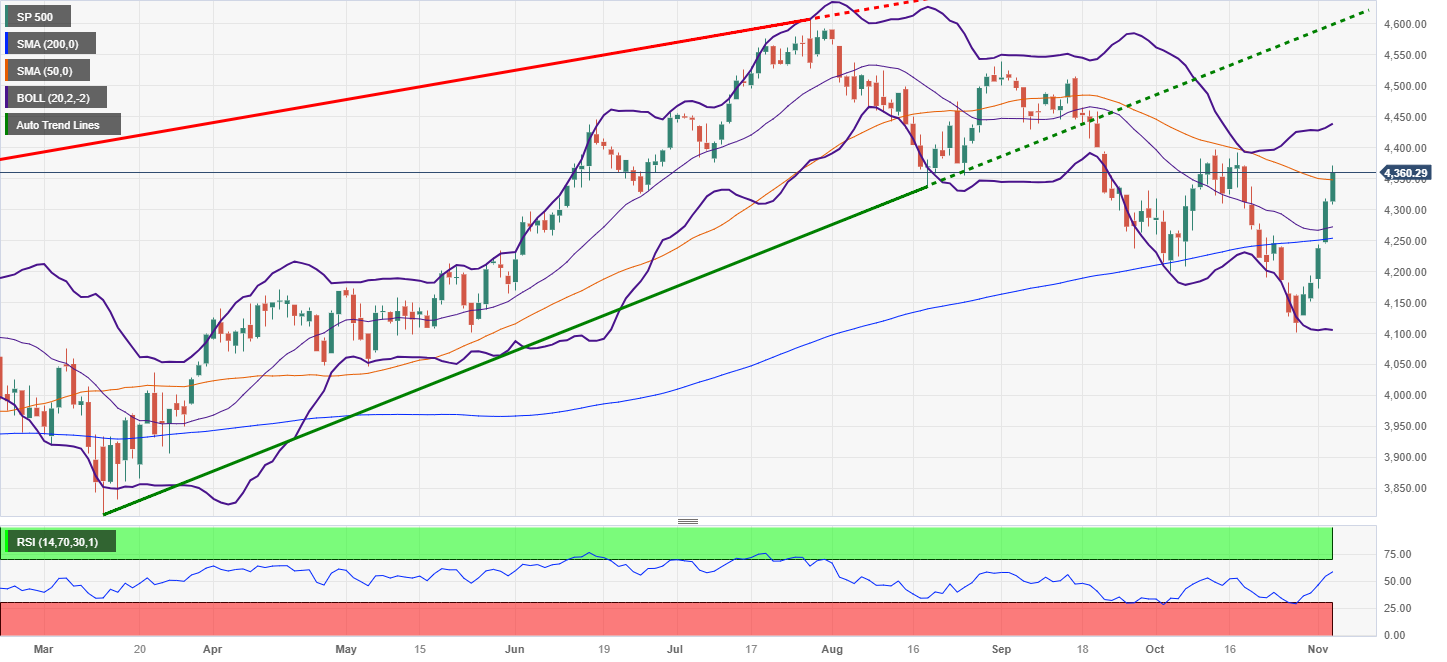
S&P 500 Key Technical Levels
Author

Christian Borjon Valencia
FXStreet
Markets analyst, news editor, and trading instructor with over 14 years of experience across FX, commodities, US equity indices, and global macro markets.
















