|

Silver Price Forecast: Correction deeper than expected, questions uptrend

  • Silver corrects back more deeply than was expected. 
  • The market is balanced, the correction is questioning the dominant uptrend. 
  • RSI is diverging bearishly suggesting potential underlying weakness. 

Silver (XAG/USD) has corrected back after posting higher highs of $30.19 on August 26. During the pull back, the pair broke below key support at $29.23 (August 2 high) and this brought the short-term uptrend into doubt. 

That said, given the price overall continues posting higher highs and higher lows the trend is probably still, on balance, probably still bullish – if weaker than it was.  

Silver 4-hour Chart 
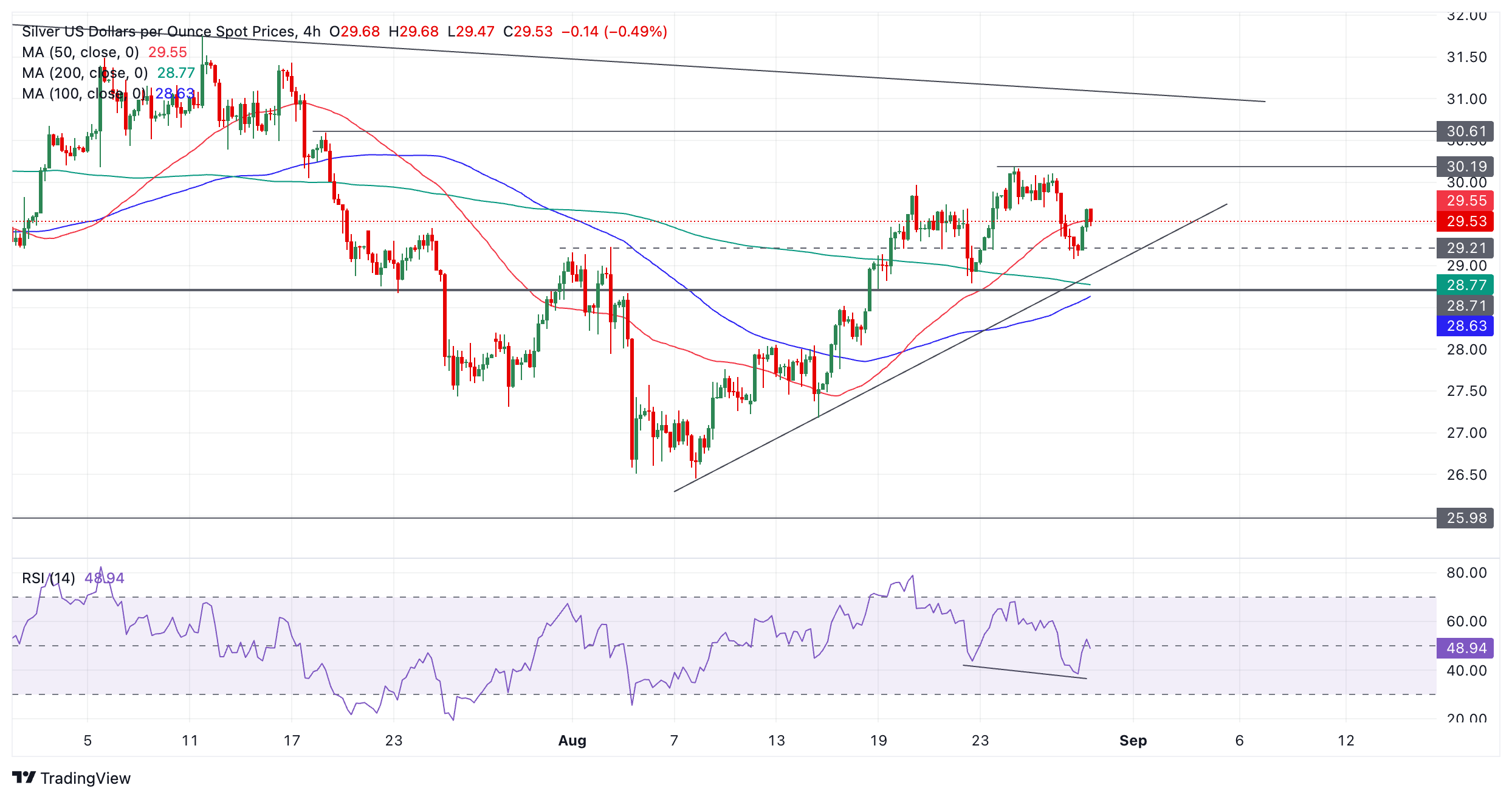
A break above the August high at $30.19 would confirm more upside and the continuation of the bull trend, with the next target coming into view at $30.61 the July 18 swing high. 

A break below the August 22 swing low at $28.79, however, would indicate a break in the sequence of rising peaks and troughs. This could indicate a reversal in the short-term uptrend and more downside on the horizon. 

The Relative Strength Index (RSI) momentum indicator is diverging bearishly with price when comparing the August 22 and August 28 lows. Although the price did not make a lower low on the 28th, the RSI did, suggesting underlying weakness in the price. 

The trend on the medium and longer-term charts is unclear – possibly sideways – indicating little directional bias from higher time frames.

Author

Joaquin Monfort

Joaquin Monfort is a financial writer and analyst with over 10 years experience writing about financial markets and alt data. He holds a degree in Anthropology from London University and a Diploma in Technical analysis.


More from Joaquin Monfort
Share:

Editor's Picks

GBP/USD defends 1.3300 after strong UK PMI data

Following Thursday's sharp decline, GBP/USD clings to small gains above 1.3300 in the American session on Friday, supported by the upbeat UK Retail Sales and July PMI data. Nevertheless, the pair's upside remains capped as investors cling to a cautious stance amid a further escalation of tensions in the Middle East. The US July PMI data failed to trigger relevant price action.

EUR/USD remains below 1.1400 after mixed US PMIs

EUR/USD pressures daily lows below the 1.1400 mark in the American session on Friday. Mixed S&P Global PMIs, as manufacturing output contracted while services activity expanded in July, triggered no relevant market reaction. The focus remains in Middle East developments and inflation-related concerns.

Gold reclaims $4,100 os Iran diplomacy hopes temper Fed hike bets and weigh on USD

Gold looks set to build on a modest bullish gap-up opening on Monday, beyond $4,100, as hopes of US-Iran peace talks weigh heavily on crude oil prices, easing inflation fears and tempering Fed rate-hike bets. Moreover, the optimism drags the safe-haven US Dollar away from a one-month top, touched on Friday, and supports the non-yielding bullion. The focus now shifts to the crucial FOMC policy meeting this week.

Week ahead: Fed, BoE and BoJ face inflation test as markets reprice interest rate paths
The US dollar gained against the other major currencies this week amid the escalating tensions in the Middle East as well as US President Trump’s decision to proceed with a new round of tariffs after previously imposed levies expired.
Australian Dollar outlook: Chances of another rally won’t be decided in Canberra, but in Washington

The Australian Dollar rode a rollercoaster in the first half of the year, hitting a four-year high and then correcting. The currency enters the second half with an outlook full of uncertainty due to renewed hostilities in the Middle East, which clouds the inflation outlook and interest rates.

US Dollar mid-year outlook: Exceptional currency, exceptional risks?
The US Dollar enters the second half of 2026 in a markedly different position from a year ago. The King currency has recovered, reflecting persistent US inflation, changing expectations for Fed policy, geopolitical tensions and renewed demand for defensive assets.