Palantir Stock Forecast: PLTR closes just below key $18 level after 20% day
- PLTR stock has surged as much as 22% on Thursday following its Q3 earnings beat.
- Revenue and adjusted earnings in the quarter both beat consensus by a slight margin.
- Q4 outlook entices traders as revenue forecast is raised to a midpoint above $600 million.
- The artificial intelligence platform company grew its customer base by 34% from a year ago.

Palantir Technologies (PLTR) gained 20.1% on Thursday, its third-highest advance of 2023. The price surge resulted from the artificial intelligence (AI) software firm slightly topping Wall Street consensus for the third quarter and issuing an upbeat forecast for the fourth quarter.
PLTR was not able to close above the significant $18 resistance level, ending the day at $17.92. That will give bulls another goal on Friday, when the market hinges on October Nonfarm Payrolls data.
The price action is certainly upsetting some short sellers as Palantir stock was named by Goldman Sachs in mid-October as one of the most shorted stocks heading into earnings season. CEO Alex Karp said during the earnings call that Palantir is now eligible for inclusion in the S&P 500 since it has maintained four straight quarters of profitability.
The market on Thursday is continuing this week’s theme of a rebound following three months of a broad downtrend. The S&P 500, Dow Jones and NASDAQ Composite have each advanced more than 1.5% in the last hour of trading.
Palantir stock earnings: Revenue outlook raised for Q4
Palantir earned $0.07 per adjusted share in the third quarter. That amounted to one penny above the Wall Street consensus.
Revenue also beat estimates at $558 million in the quarter, $2 million higher than the general forecast.
For the third quarter, Palantir witnessed a 23% YoY growth in revenue from commercial operations, its smaller segment. Its primary government business registered a more steady 12% sales growth figure.
The Colorado-based company raised its customer count by 34% from a year ago, demonstrating that its AI products are still seeing major uptake among new clients.
Palantir also raised its forecast for the fourth quarter, which is probably the primary reason the stock has rallied so much. The AI-inflected firm’s management said it expects revenue between $599 and $603 million, with the midpoint nearly $2 million above the prior consensus. Adjusted income from operations is expected to clock in at a midpoint of $186 million.
For the full year, Palantir expects revenue between $2.216 billion and $2.22 billion and adjusted income from operations at a midpoint of $609 million.
Nonfarm Payrolls FAQs
What are Nonfarm Payrolls?
Nonfarm Payrolls (NFP) are part of the US Bureau of Labor Statistics monthly jobs report. The Nonfarm Payrolls component specifically measures the change in the number of people employed in the US during the previous month, excluding the farming industry.
How does Nonfarm Payrolls influence the Federal Reserve monetary policy decisions?
The Nonfarm Payrolls figure can influence the decisions of the Federal Reserve by providing a measure of how successfully the Fed is meeting its mandate of fostering full employment and 2% inflation.
A relatively high NFP figure means more people are in employment, earning more money and therefore probably spending more. A relatively low Nonfarm Payrolls’ result, on the either hand, could mean people are struggling to find work.
The Fed will typically raise interest rates to combat high inflation triggered by low unemployment, and lower them to stimulate a stagnant labor market.
How does Nonfarm Payrolls affect the US Dollar?
Nonfarm Payrolls generally have a positive correlation with the US Dollar. This means when payrolls’ figures come out higher-than-expected the USD tends to rally and vice versa when they are lower.
NFPs influence the US Dollar by virtue of their impact on inflation, monetary policy expectations and interest rates. A higher NFP usually means the Federal Reserve will be more tight in its monetary policy, supporting the USD.
How does Nonfarm Payrolls affect Gold?
Nonfarm Payrolls are generally negatively-correlated with the price of Gold. This means a higher-than-expected payrolls’ figure will have a depressing effect on the Gold price and vice versa.
Higher NFP generally has a positive effect on the value of the USD, and like most major commodities Gold is priced in US Dollars. If the USD gains in value, therefore, it requires less Dollars to buy an ounce of Gold.
Also, higher interest rates (typically helped higher NFPs) also lessen the attractiveness of Gold as an investment compared to staying in cash, where the money will at least earn interest.
Sometimes Nonfarm Payrolls trigger an opposite reaction than what the market expects. Why is that?
Nonfarm Payrolls is only one component within a bigger jobs report and it can be overshadowed by the other components.
At times, when NFP come out higher-than-forecast, but the Average Weekly Earnings is lower than expected, the market has ignored the potentially inflationary effect of the headline result and interpreted the fall in earnings as deflationary.
The Participation Rate and the Average Weekly Hours components can also influence the market reaction, but only in seldom events like the “Great Resignation” or the Global Financial Crisis.
Palantir stock forecast
Palantir stock has made it above the $18 threshold early in the session. This is the price level where PLTR stock began experiencing resistance back in mid-October. A close above this $18 level will give bulls the chance of retesting the $20.24 from August 1.
Previous to August 1, Palantir stock last reached that level in December of 2021 during the covid rally. PLTR stock is still technically in a downtrend until the 9-day Simple Moving Average (SMA) breaks above the 21-day SMA. At the moment, there is a $1 space between the moving averages.
Since June, the $13.50 to $14 region has acted as strong support, so traders should not expect a decline below that price band in the near future.
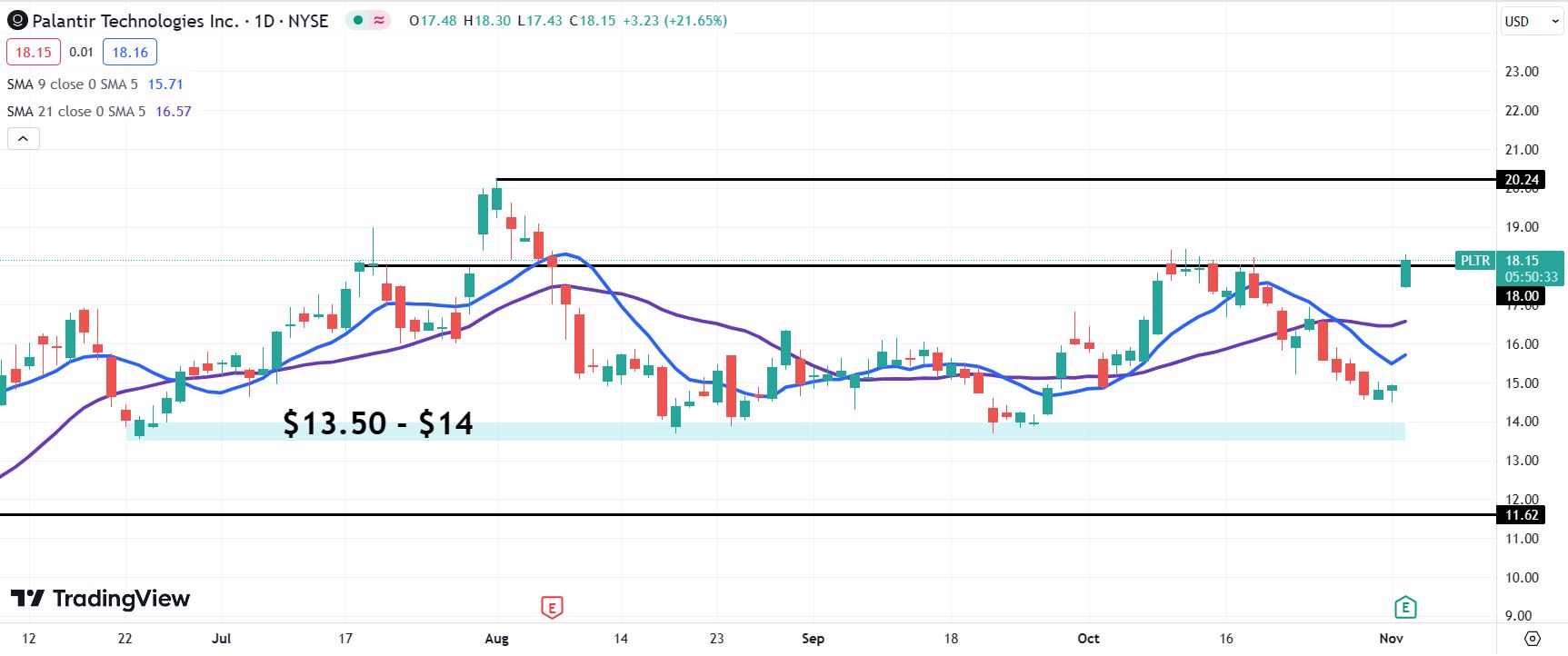
PLTR daily chart
Author

Clay Webster
FXStreet
Clay Webster grew up in the US outside Buffalo, New York and Lancaster, Pennsylvania. He began investing after college following the 2008 financial crisis.