Palantir Stock Forecast: PLTR climbs to new high after winning $250 million US Army contract
- Palantir stock rose 6% on Monday due to Israel-Hamas war.
- Palantir rises again Tuesday after receiving $250 million US Army contract.
- PLTR stock is back above the $17 level, an important resistance level.
- The UK's NHS will supposedly soon announce Palantir as winner of a $579 million contract.

Palantir Stock (PLTR) reached a new high of $18.40 at the start of Tuesday's session after the prominent data miner announced it had received a three-year, $250 million contract from the US Army.
US equity markets are once again advancing on Tuesday, same as Monday, as the Israel-Hamas conflict looks more contained than it did over the weekend. Even Oil prices have returned to their downward trajectory after initially rising more than 3% early on Monday. The Dow Jones, S&P 500 and NASDAQ Composite have all advanced around half a percentage point, with the NASDAQ taking the lead.
Palantir stock news: Army contract follows rumored NHS project
As is usual for top-secret military contracts, the announcement is short on details. What we know is that Palantir was awarded the contract, which runs through 2026, to aid the US Army’s Combatant Commands, or COCOMs in Army parlance, as well as the Armed Services, Intelligence Community and Special Forces.
The contract is worth up to $250 million if a number of performance goals are met and involves helping these segments of the US Army develop their artificial intelligence (AI) and machine learning capabilities. The contract seeks to help integrate informational sharing and AI modeling through the Joint All-Domain Command & Control (JADC2).
"We’re honored to expand our partnership with the Army to continue delivering the most innovative technologies and advanced data applications across the Armed Services," said Akash Jain, President of Palantir USG, the segment of the company that deals with US government contracts. "Maturing new concepts for how we deploy solutions in different contexts is key to maintaining our nation’s competitive advantage, and we appreciate the opportunity to support this mission."
Palantir stock closed 6% higher on Monday as a number of stocks related to the military and defense benefited from US politicians announcing their intention to put together an aid package for Israel in light of its bombing campaign against the Hamas-controlled territory of Gaza. Israel is also readying a ground campaign.
Palantir was rumored last week to have secured a $579 million, multiyear contract with the National Health Service (NHS) of the United Kingdom. Additionally, the company has recently broadened its partnership with PwC to distribute its Foundry and Artificial Intelligence Platform (AIP) to corporate partners of the global accounting firm.
S&P 500 FAQs
What is the S&P 500?
The S&P 500 is a widely followed stock price index which measures the performance of 500 publicly owned companies, and is seen as a broad measure of the US stock market. Each company’s influence on the computation of the index is weighted based on market capitalization. This is calculated by multiplying the number of publicly traded shares of the company by the share price. The S&P 500 index has achieved impressive returns – $1.00 invested in 1970 would have yielded a return of almost $192.00 in 2022. The average annual return since its inception in 1957 has been 11.9%.
How are companies chosen to be included in the S&P 500?
Companies are selected by committee, unlike some other indexes where they are included based on set rules. Still, they must meet certain eligibility criteria, the most important of which is market capitalization, which must be greater than or equal to $12.7 billion. Other criteria include liquidity, domicile, public float, sector, financial viability, length of time publicly traded, and representation of the industries in the economy of the United States. The nine largest companies in the index account for 27.8% of the market capitalization of the index.
How can I trade the S&P 500?
There are a number of ways to trade the S&P 500. Most retail brokers and spread betting platforms allow traders to use Contracts for Difference (CFD) to place bets on the direction of the price. In addition, that can buy into Index, Mutual and Exchange Traded Funds (ETF) that track the price of the S&P 500. The most liquid of the ETFs is State Street Corporation’s SPY. The Chicago Mercantile Exchange (CME) offers futures contracts in the index and the Chicago Board of Options (CMOE) offers options as well as ETFs, inverse ETFs and leveraged ETFs.
What factors drive the S&P 500?
Many different factors drive the S&P 500 but mainly it is the aggregate performance of the component companies revealed in their quarterly and annual company earnings reports. US and global macroeconomic data also contributes as it impacts on investor sentiment, which if positive drives gains. The level of interest rates, set by the Federal Reserve (Fed), also influences the S&P 500 as it affects the cost of credit, on which many corporations are heavily reliant. Therefore, inflation can be a major driver as well as other metrics which impact the Fed decisions.
Palantir stock forecast
Palantir stock broke through an important resistance barrier on Monday and was already in an uptrend. The level worked as support back on May 11, 2021, when the high-growing software provider experienced an extreme sell-off event. More recently, PLTR stock has experienced the $17 level as resistance during June and July of this year.
If bulls turn $17 back into support, an activity it hasn’t seen in two years, then there is further hope that PLTR stock could soon retest the August first swing high at $20.24. Beware of poor macro chatter, however, as despite PLTR’s industry-specific tailwinds, the stock has often been a market trend follower. If Palantir does sell off later this week, expect the support band from $13.50 to $14 to catch it.
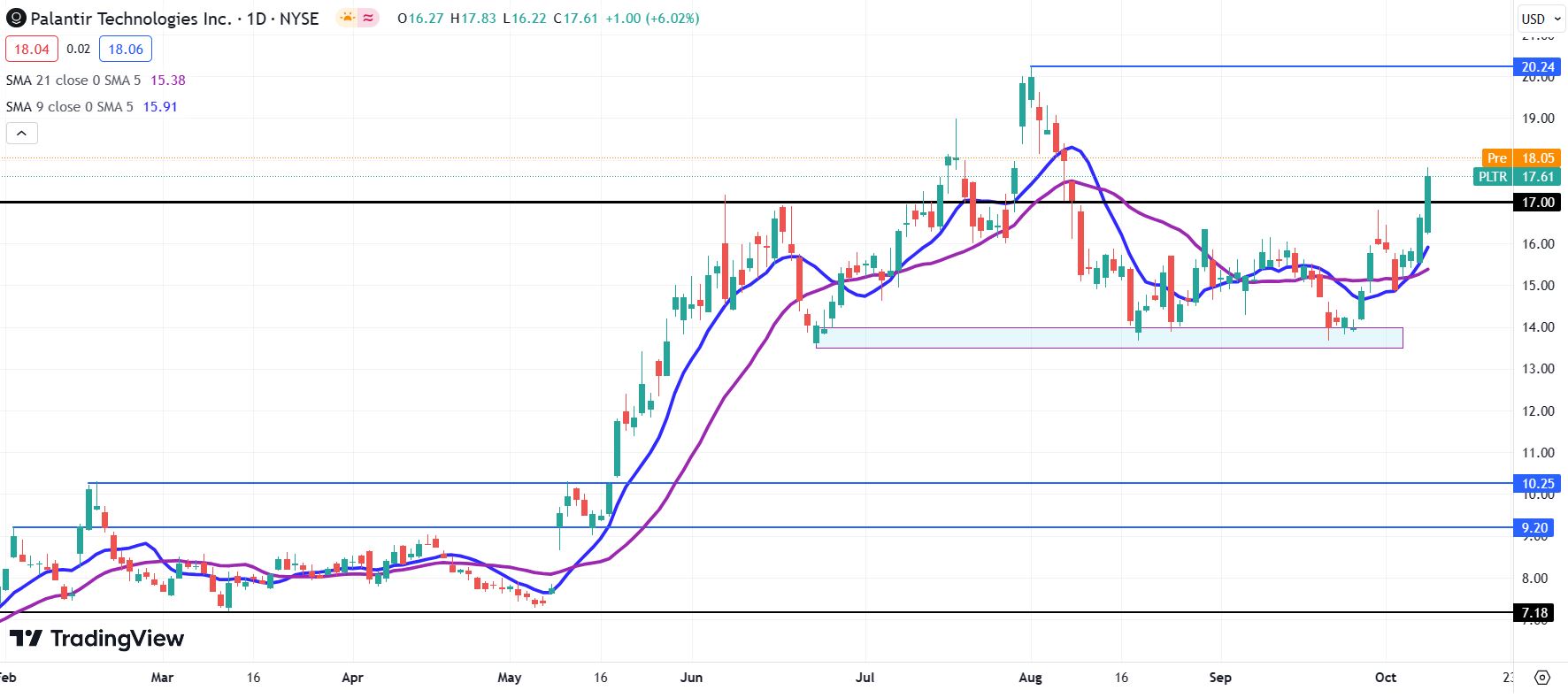
PLTR daily chart
Author

Clay Webster
FXStreet
Clay Webster grew up in the US outside Buffalo, New York and Lancaster, Pennsylvania. He began investing after college following the 2008 financial crisis.