|

NZD/USD rebounds amid upbeat market mood, eyes weekly losses

  • As Wall Street opens positive, NZD/USD rises 0.57% to 0.5907, partially offsetting fears of a global economic slowdown.
  • US Dollar softens after hitting a six-month high, providing a tailwind for NZD/USD amid a lack of fresh US economic data.
  • Traders await key economic indicators next week, including US inflation data and New Zealand Retail Card Spending, for directional cues.
NZD/USD rebounds amid upbeat market mood, eyes weekly losses

The New Zealand Dollar (NZD) stages a rebound against the US Dollar (USD), but it remains set to finish the week with losses. Fears of a global economic slowdown led by Europe and China dented investors’ mood during the European session, but Wall Street opened in the green. This bolstered the NZD/USD, which is trading at 0.5907, a gain of 0.57%.

New Zealand Dollar gains against a softening US Dollar, but concerns over global economic slowdown and upcoming data keep traders cautious

The Greenback (USD) continues to soften after data propelled the buck to a six-month high, according to the US Dollar Index, at 105.057. Nevertheless, the lack of economic data in the US agenda and falling US Treasury bond yields weighed on the USD, a tailwind for the NZD/USD pair.

During the week, US data was positive for the buck, showing the economy’s resilience. Business activity in the services segment picked up, while the jobs market remains tight, as Initial Jobless claims show. However, the NZD/USD was propelled by Federal Reserve officials taking a more cautious stance, particularly Regional Fed Presidents Collins, Williams, and Bostic. Contrarily, the Chicago Fed President, Austan Goolsbee, adopted a more neutral stance, while Lorie Logan from the Dallas Fed said the US central bank needs to be data-dependant but added that more rate hikes are required to curb inflation.

In the meantime, the Kiwi has been influenced by market sentiment and negative data from China. As business activity in the latter struggled, despite Chinese authorities stimulating the economy, the financial markets had not bought that story, as the Chinese stock market was headed for weekly losses.

Aside from this, the NZD/USD would gather direction from next week’s data. The US agenda will feature inflation data, Retail Sales, unemployment claims, Industrial Production, and Consumer Sentiment from the University of Michigan. On the New Zealand front, Retail Card Spending.

NZD/USD Price Analysis: Technical outlook

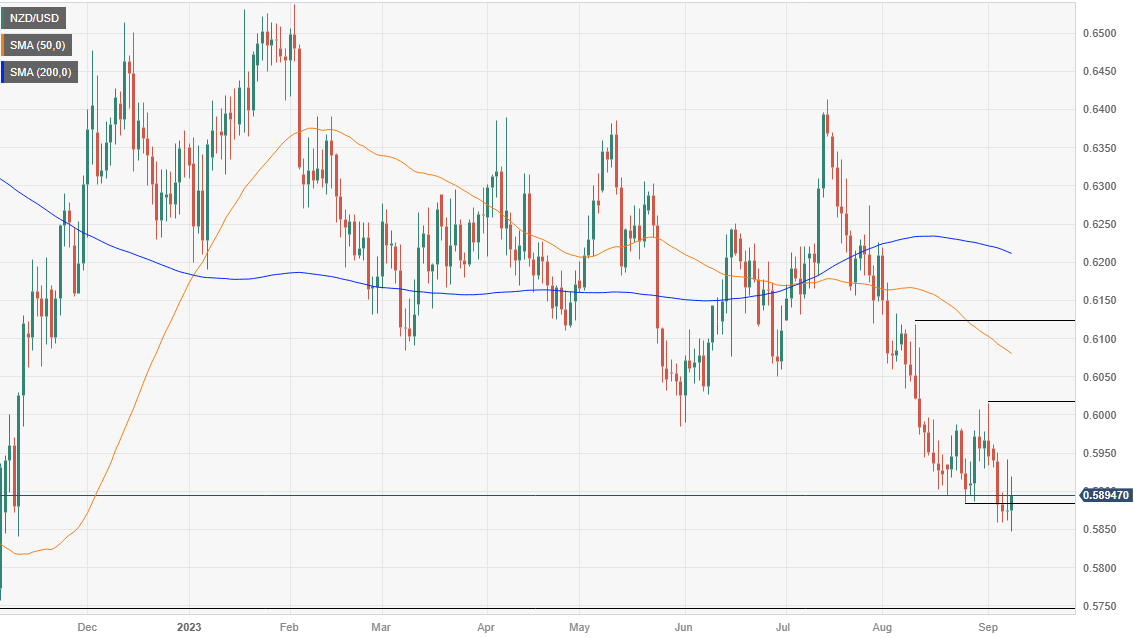
The pair’s rally above the September 6 high of 0.5904 could be seen as an upward correction, but the overall trend remains downward. To shift the bias, buyers must reclaim the September 1 swing high of 0.6015, which would put the 50-day Moving Average (DMA) at 0.6080 in play. If the NZD/USD prints a daily close below 0.5904, sellers could drive the Kiwi/US Dollar pair toward the week’s lows at 0.5859 before challenging 0.5800.
NZD/USD

Overview
Today last price0.5901
Today Daily Change0.0026
Today Daily Change %0.44
Today daily open0.5875
 
Trends
Daily SMA200.5935
Daily SMA500.6085
Daily SMA1000.6126
Daily SMA2000.6213
 
Levels
Previous Daily High0.5942
Previous Daily Low0.5862
Previous Weekly High0.6015
Previous Weekly Low0.5887
Previous Monthly High0.6219
Previous Monthly Low0.5885
Daily Fibonacci 38.2%0.5911
Daily Fibonacci 61.8%0.5892
Daily Pivot Point S10.5844
Daily Pivot Point S20.5813
Daily Pivot Point S30.5764
Daily Pivot Point R10.5924
Daily Pivot Point R20.5973
Daily Pivot Point R30.6004

Author

Christian Borjon Valencia

Markets analyst, news editor, and trading instructor with over 14 years of experience across FX, commodities, US equity indices, and global macro markets.


More from Christian Borjon Valencia
Share:

Editor's Picks

AUD/USD bulls seem hesitant near 0.6650 amid Fed-RBA divergence

AUD/USD defends bids near 0.6650 in Thursday’s Asian session, pausing the overnight bounce from the YTD low. Improving risk sentiment keeps the safe-haven US Dollar on the defensive ahead of the Thanksgiving long weekend, lending some support to the Aussie. However, divergent Fed-RBA monetary policy expectations cap the pair amid US tariff risks and Middle East hostilities.

USD/JPY battles 159.00 on renewed weakness, hawkish BoJ-speak

USD/JPY battles 159.00 in Asia on Thanksgiving Thursday after yesterday’s two-way moves. Hawkish BoJ commentary and intervention risks offer fresh support to the Japanese Yen. Meanwhile, the US Dollar remains on the back foot despite Fed rate-hike bets, contributing to the pair's latest leg down.

Gold struggles for traction as Fed rate hike bets dominate sentiment

Gold struggles to attract buyers on Thursday after rebounding sharply late Wednesday from a more-than-one-year low of $3,426. The prospect of higher US interest rates weighs on demand for the non-yielding metal, while swings in equities could spill over into bullion again. At the time of writing, XAU/USD trades around $3,569, little changed on the day, amid thin liquidity due to the US Thanksgiving holiday.

Crypto Market Pulse: Thanksgiving breather arrives as $7 billion Bitcoin options expiry looms

Derivatives market shows mixed sentiment, with over $600 million in 24-hour liquidations, split roughly evenly between long and short positions. About $7 billion in Bitcoin options are set to expire on the Deribit exchange this Friday, likely fueling spot market volatility.

Markets attempt to recover as Thanksgiving brings thinner trading
Important news this week. Equity markets experienced another volatile session on Wednesday, initially falling sharply before recovering much of their losses during US trading. The S&P 500 and Nasdaq managed to move away from their intraday lows, while Asian markets are also showing signs of stabilisation.
Gold rebounds toward $3,600 after a 15-month low near $3,427
Gold (XAU/USD) stabilizes below $3,600 on Thursday after rebounding sharply from a 15-month low near $3,427 reached on Wednesday. The precious metal has reclaimed the psychological $3,500 level, benefiting from a partial recovery in US equities, easing liquidation pressure and a retreat in the US Dollar (USD).