|

NZD/USD Price Analysis: Exhibits volatility contraction near 0.5900

  • NZD/USD falls to 0.5900 even though the US Dollar remains sideways.
  • Investors await the US core PCE Price Index that will influence speculation for Fed rate cuts.
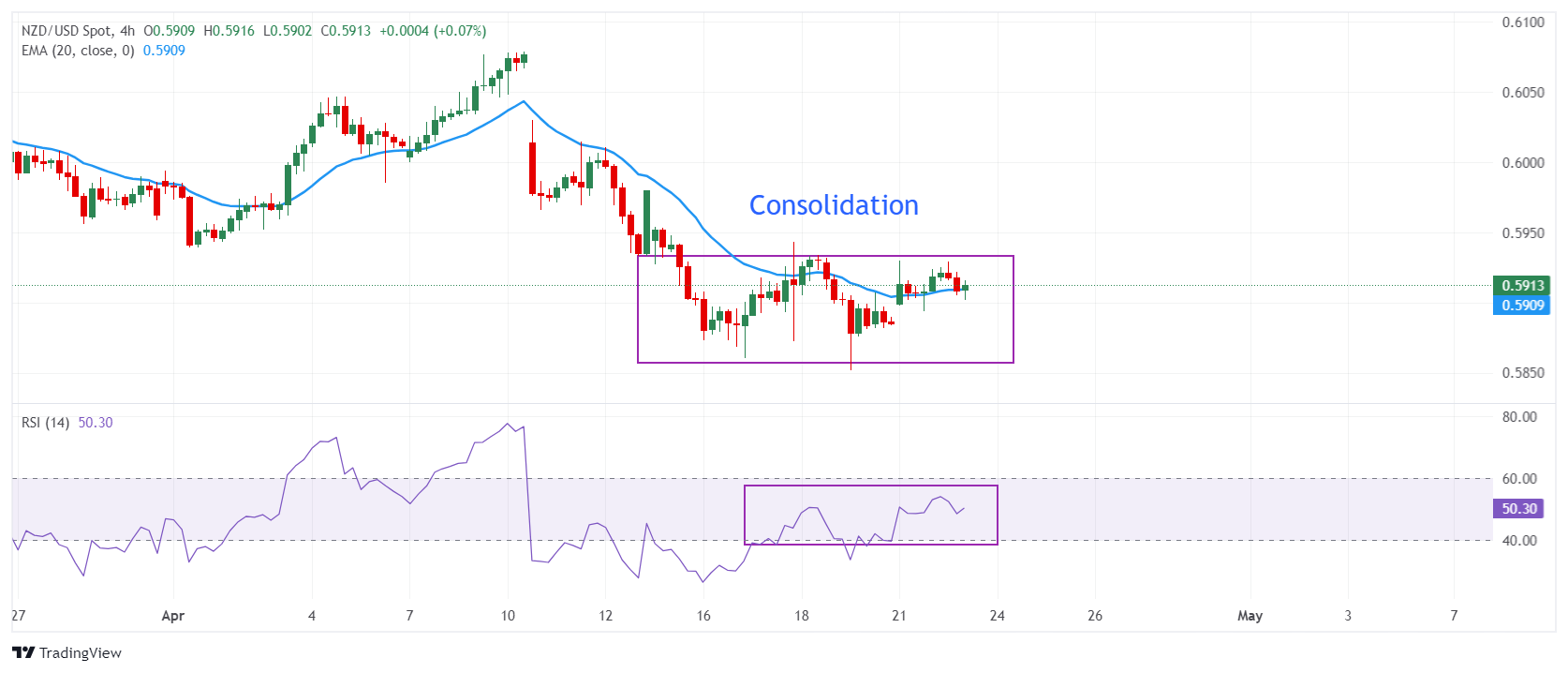
  • NZD/USD consolidates in a 0.5850-0.5933 range for almost a week.

The NZD/USD pair drops to near the crucial support of 0.5900 in Tuesday’s European session while attempting to break above the immediate resistance of 0.5930. A sideways performance is anticipated from the Kiwi asset as investors await the United States core Personal Consumption Expenditure Price Index (PCE) data for March, which will be published on Friday.

The inflation data will be keenly watched as it will provide cues about when the Federal Reserve (Fed) could start reducing interest rates. The inflation data will influence the Fed’s guidance on interest rates, which will be provided in next week’s monetary policy meeting in which key borrowing rates are widely expected to remain unchanged in the range of 5.25%-5.50%.

Market sentiment remains cheerful as investors expect that conflicts between Iran and Israel will not widen further. S&P 500 futures have posted significant gains in the London session, portraying higher investors’ risk-appetite. 10-year US Treasury yields hovers near 4.63% with eyes on US core PCE inflation data, which is expected to have grown steadily by 0.3% on a month-on-month basis.

The New Zealand Dollar drops despite improved appeal for risk-sensitive assets. Meanwhile, expectations for the Reserve Bank of New Zealand (RBNZ) reducing interest rates later in November remain firm. The speculation for the RBNZ pivoting interest rate cuts postponed for later this year after the Q1 Consumer Price Index (CPI) grew expectedly by 0.6%.

The NZD/USD pair has moved back and forth between 0.5850 and 0.5933 over the past week, suggesting a sharp volatility contraction. The 20-period Exponential Moving Average (EMA) at 0.5910 remains stuck to spot prices and exhibits indecisiveness among market participants.

The 14-period Relative Strength Index (RSI) oscillates in the 40.00-60.00 range, suggesting a consolidation ahead.

Fresh downside would appear if the asset breaks below April 16 low at 0.5860. This would drag the asset toward 8 September 2023 low at 0.5847, followed by the round-level support of 0.5900

On the flip side, a recovery move above March 18 high at 0.6100 will drive the pair toward March 12 low at 0.6135. A breach of the latter will drive the asset further to February 9 high around 0.6160.

NZD/USD four-hour chart
NZD/USD

Overview
Today last price0.5909
Today Daily Change-0.0010
Today Daily Change %-0.17
Today daily open0.5919
 
Trends
Daily SMA200.5968
Daily SMA500.6058
Daily SMA1000.6121
Daily SMA2000.6053
 
Levels
Previous Daily High0.593
Previous Daily Low0.5886
Previous Weekly High0.5954
Previous Weekly Low0.5851
Previous Monthly High0.6218
Previous Monthly Low0.5956
Daily Fibonacci 38.2%0.5913
Daily Fibonacci 61.8%0.5903
Daily Pivot Point S10.5894
Daily Pivot Point S20.5868
Daily Pivot Point S30.585
Daily Pivot Point R10.5938
Daily Pivot Point R20.5956
Daily Pivot Point R30.5982

Author

Sagar Dua

Sagar Dua

FXStreet

Sagar Dua is associated with the financial markets from his college days. Along with pursuing post-graduation in Commerce in 2014, he started his markets training with chart analysis.


More from Sagar Dua
Share:

Editor's Picks

AUD/USD consolidates above 0.7200 after hot Chinese CPI data

AUD/USD is extending its consolidative price action above 0.7200 during the Asian session on Wednesday, uninspired by hot Chinese CPI and PPI data. Meanwhile, rising RBA rate-hike bets act as a tailwind for the Aussie amid Yen-inspired US Dollar weakness. Traders await the release of US inflation figures later in the week for fresh impetus.

USD/JPY stays weak near 153.50 amid aggressive BoJ hike bets


USD/JPY attracts fresh sellers in the Asian session on Wednesday as the strong Reuters Tankan business survey adds to the case for continued BoJ policy normalisation and boosts the Japanese Yen. This, along with a broadly weaker US Dollar, keeps the pair close to a nearly seven-month low set on Tuesday.

Gold recovers further from one-week low, retakes $4.400 amid sustained USD selling

Gold builds on its intraday recovery from a one-week low and reclaims the $4,400 mark heading into the European session on Wednesday. The commodity, for now, seems to have snapped a three-day losing streak amid a weaker US Dollar, which remains depressed near its lowest level in over two weeks amid the Bank of Japan-inspired rally in the Japanese Yen.

Bitcoin takes a breather, Ethereum and XRP maintain bullish footing
Bitcoin (BTC), Ethereum (ETH) and Ripple (XRP) are trading with a broadly constructive tone on Wednesday despite BTC's mild pullback over the past two days. The Crypto King holds above $78,000; ETH and XRP remain strong above key Exponential Moving Averages (EMAs), keeping their upside prospects intact.
Gold and stocks: What eight midterm elections did
I went back through every midterm election since 1994 and asked one question of each: when did the stock market make its low for the year, before the vote or after it? In seven of the eight cycles, the low came before the election. In six of the eight, it came between mid-June and mid-October, which is to say in the exact window that the "they won't let it fall" argument says is protected.
Diesel’s record $100 warning: The oil shock hiding in plain sight

The Oil market may look calmer than it did a few months ago, but diesel is sending a very different message. The US diesel crack spread, the premium of ultra-low sulphur diesel futures over WTI, recently surged above $100 per barrel for the first time, reaching an intraday record of just over $102.00.















