|

NZD/USD dips towards 0.6800 amid a mixed market mood

  • The NZD/USD falls as traders head into the weekend, down 0.71% in the week.
  • Lack of progress in talks between Russia and Ukraine would keep investors on their toes, at least for another week.
  • NZD/USD Technical Outlook: The pair is neutral with the 100-DMA in play.

Following Monday’s 100-pip rally, the NZD/USD is set to end the week with losses, despite an upbeat market mood spurred by Russia’s President Putin saying that the discussions with Ukraine had taken a positive turn. Later it crossed the wires that Ukrainian Foreign Minister Dmytro Kubela said on Friday that “there had been zero progress in talks with Russia on Thursday,” reported Bloomberg. At 0.6812, the NZD/USD reflects the sudden shift in the market towards a risk-off

Meanwhile, the greenback remains bid, at 98.960 up 0.45%, eyes to finish the week above the 99 mark. Furthermore, rising US Treasury yields, led by the 10-year sitting at 1.979%, weighed on the commodity-linked NZD.

In the Asian session, the New Zealand macroeconomic docket featured the Business Performance of Manufacturing Index, which rose to 53.6 in February. “Underlying unease will certainly be piqued by the sustained high COVID case numbers as we go into March. The next PMI result may also see fallout from the Russia/Ukraine conflict, whose global impacts will be felt far and wide,” BNZ Senior Economist, Craig Ebert

The US economic docket featured the University of Michigan Consumer Sentiment for March, which declined from 62.8 in February to 59.7, while Inflation expectations rose to 5.4% from 4.9% in the previous reading. This was the lowest UoM Consumer Confidence reading since November of 2011, as inflation expectations rose sharply due to a surge in fuel prices exuberated by the Russian invasion of Ukraine.

NZD/USD Price Forecast: Technical outlook

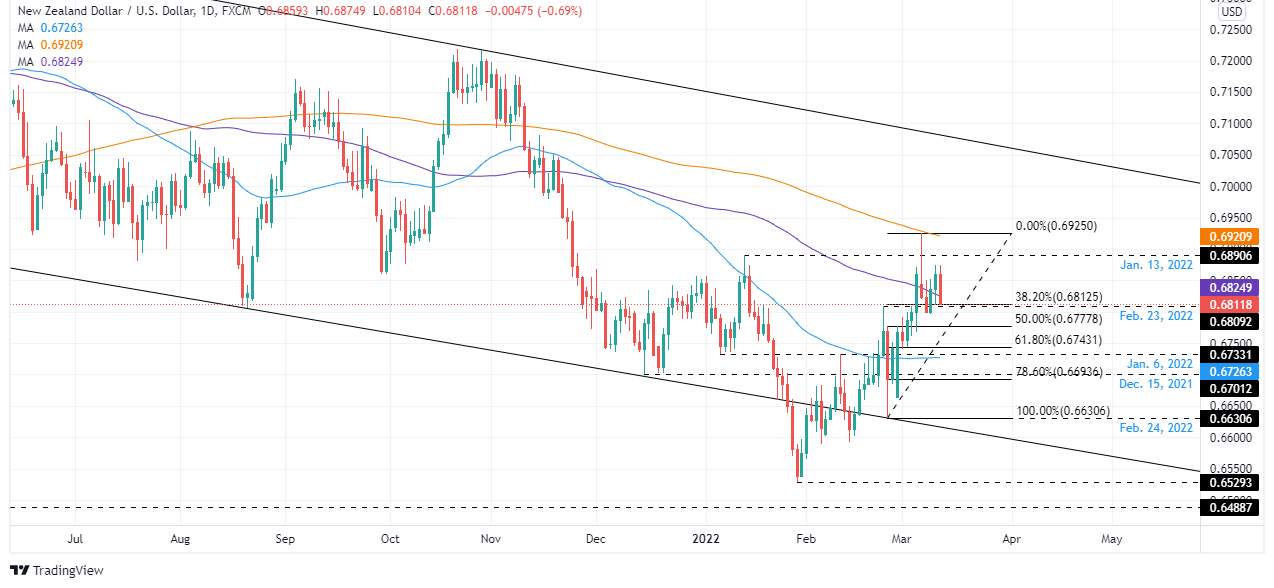
Overnight, the NZD/USD seesawed in a narrow range. However, the NZD/USD broke downwards once European trading began, dipping towards the 200-hour simple moving average (SMA) and extending its losses beyond that level as bears eye the February 23 high previous resistance/support at 0.6809.

That said, the NZD/USD is neutral-downwards biased, as bulls/bears battle to reclaim the 100-day moving average (DMA) around 0.6824.

In the event of a daily close below the 100-DMA, the NZD/USD first support would be 0.6809 the February 23 resistance/support. Breach of the latter would expose the 50% Fibonacci level at 0.6777, followed by the confluence of the 50-DMA and the 50% Fibonacci level around the 0.6733-43 area.

Otherwise, the NZD/USD first resistance would be March 9 daily high at 0.6752. Once cleared, the following resistance areas would be January 13 high at 0.6890 and the YTD high at 0.6925.
NZD/USD

Overview
Today last price0.6812
Today Daily Change-0.0054
Today Daily Change %-0.79
Today daily open0.6866
 
Trends
Daily SMA200.6747
Daily SMA500.673
Daily SMA1000.6831
Daily SMA2000.6926
 
Levels
Previous Daily High0.6875
Previous Daily Low0.6811
Previous Weekly High0.6873
Previous Weekly Low0.6665
Previous Monthly High0.681
Previous Monthly Low0.6565
Daily Fibonacci 38.2%0.6851
Daily Fibonacci 61.8%0.6835
Daily Pivot Point S10.6826
Daily Pivot Point S20.6787
Daily Pivot Point S30.6762
Daily Pivot Point R10.689
Daily Pivot Point R20.6915
Daily Pivot Point R30.6954

Author

Christian Borjon Valencia

Markets analyst, news editor, and trading instructor with over 14 years of experience across FX, commodities, US equity indices, and global macro markets.


More from Christian Borjon Valencia
Share:

Editor's Picks

AUD/USD hangs near three-week low, above 0.7100 ahead of Fed decision

AUD/USD retains its negative bias for the third straight day, trading around 0.7120 and close to a three-week low during the Asian session on Wednesday. The US Dollar stands firm near a two-week high as the anticipated Fed rate hike and oil-driven inflation fears continue to push US bond yields to a multi-year high. Furthermore, escalating Middle East tensions benefit the safe-haven buck and weigh on the risk-sensitive Aussie.

USD/JPY remains below 155.50 as bulls await the key Fed decision

USD/JPY climbs to a fresh one-week high during the Asian session on Wednesday amid a bullish US Dollar. Oil-driven inflation fears, along with the anticipated Fed rate hike, continue to support surging US bond yields. Moreover, rising US-Iran tensions underpin the USD's reserve currency status. Spot prices, however, remain below the mid-155.00s as bulls seem hesitant ahead of the Fed decision later today and the BoJ meeting, starting on Thursday.

Gold struggles below $4,300, near one-month low as Fed decision looms

Gold remains depressed below $4,300 during the Asian session on Wednesday as traders look to the crucial Fed decision for a fresh impetus. Meanwhile, a surge in US bond yields, bolstered by oil-driven inflation fears, continues to weigh on the non-yielding bullion. Furthermore, escalating Middle East tensions underpin the safe-haven US Dollar and contribute to a weaker tone around the XAU/USD.

Ethereum continues to attract capital despite impending rate hike and Clarity Act failure

Ethereum declined to $2,400 on Tuesday after the Clarity Act failed to progress in the Senate. Despite that and the market's near certainty of an interest rate hike at the next Federal Reserve (Fed) meeting, the top altcoin has continued to attract fresh capital. Ethereum buyers have been dominating sellers over the past few days.

How Japan became the World's Banker and why that era may be ending

Japan's ultra-low interest rates helped finance trillions of dollars in global investments for more than a decade, making the Japanese Yen one of the world’s cheapest sources of funding. With the Bank of Japan expected to tighten policy again this week, that advantage may be entering a new phase. While most major economies raised interest rates, Japan remained the world's outlier.

Venezuela’s 65-billion-barrel Oil deal could reshape America’s inflation fight
The United States (US) has secured unprecedented access to part of Venezuela’s vast Oil reserves. The timing is particularly significant as the war with Iran is disrupting Middle Eastern supplies, keeping energy prices elevated and reviving concerns about inflation.