|

NZD/USD bulls move in at the start of the week but bears are lurking

  • NZD/USD bulls move in for a deeper correction into the prior bearish impulse. 
  • As demand for safe haven increases, the bird would be expected to fall. 

NZD/USD is up at the start of the week, higher by 0.14% having popped from a low of 0.6368 to a high of 0.6368 so far despite the market mood turning dark upon further reflection of last week's Federal Reserve meeting. The US Dollar climbed on Friday as risk appetite soured and investors weighed the prospect that the Fed and other central banks still had some way to go. 

As analysts at ANZ Bank explained, ''the Fed may not be hiking as fast, but it still has the highest policy rate in the G10 and will be one of the few central banks to take policy past 5%.''

The other notable one is of course the Reserve Bank of New Zealand, the analysts said but explained that ''this remains a USD show, as we saw by the Kiwi’s failure to capitalise on bumper GDP data yesterday. We expect the next few weeks to be volatile, so buckle up (and enjoy the holidays!).''

Meanwhile, analysts at Rabobank said, ''we see scope for NZD/USD to drop back in the coming months as global growth slows and demand for safe haven increases but look for NZD/USD to move higher again on a 6 to 9-month view.''

NZD/USD technical analysis

As per the prior analysis, NZD/USD Price Analysis: Bulls move in from critical support, bears eye an opportunity, the bulls have moved in and this is giving the bears an opportunity of a discount:

NZD/USD prior analysis
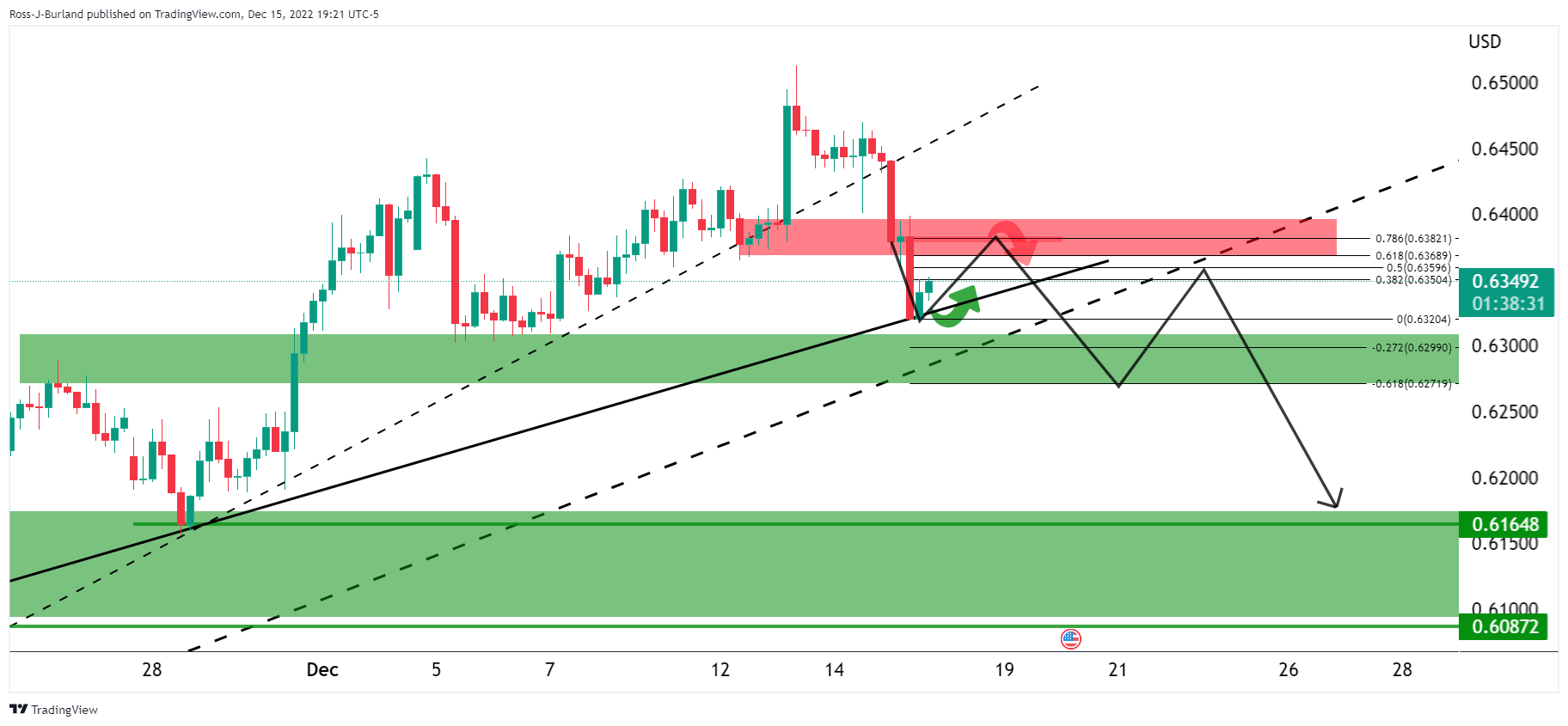
The 4-hour time frame showed the price correcting towards the upside, in accordance to the daily chart analysis.

NZD/USD update

We have seen the correction into resistance and bears will be in anticipation of a bearish structure forming to leave against the prospect of a downside continuation. 

Author

Ross J Burland

Ross J Burland, born in England, UK, is a sportsman at heart. He played Rugby and Judo for his county, Kent and the South East of England Rugby team.


More from Ross J Burland
Share:

Editor's Picks

AUD/USD sits at two-month lows near 0.6950 after Australian CPI data

AUD/USD is sitting at two-month lows near 0.6950 in the Asian session on Wednesday, as below-expectations August Australian underlying CPI data pours cold water on expectations for further RBA interest rate hikes. Chinese PMI data also fail to inspire the Australian Dollar, despite a pause in the US Dollar advance.

USD/JPY stays weak below 157.00 amid Japanese intervention risks

USD/JPY keeps losses below 157.00 in the Asian session on Wednesday, as hawkish BoJ expectations, along with intervention risks, underpin the Japanese Yen, countering dismal domestic factory output and retail sales data. Meanwhile, a broad US Dollar retreat also collaborates to the pair's downside.

Gold meets resistance just above $4,200

Gold now makes a U-turn and recedes toward the $4,150 region per troy ounce on Wednesday. Indeed, the precious metal fades the earlier move past the key $4,200 yardstick and retreats marginally as the US Dollar trims part of its daily losses amid mixed US Treasury yields.

Crypto Today: Bitcoin holds $83K as Ethereum remains below $2,700 and XRP consolidates

Bitcoin trades lethargically on Wednesday, with bulls battling to defend the immediate $83,000 level as immediate support. Ethereum trades in tandem with Bitcoin, holding below key levels of $2,700 on the upside and $2,600 on the downside. Ripple, meanwhile, hovers near $1.50,

The Euro is near a one-year low: Inflation could trigger its rebound, not its fall

EUR/USD has fallen to its lowest level since May 2025, but a fresh inflation shock in the Eurozone could give the Euro an unexpected lifeline. The pair hit 1.1312 on Wednesday and trades well below the January peak of 1.2082. The decline reflects a powerful combination of US Dollar strength, geopolitical uncertainty and renewed concerns about Europe's exposure to higher energy prices.

The Euro is near a one-year low: Inflation could trigger its rebound, not its fall

EUR/USD has fallen to its lowest level since May 2025, but a fresh inflation shock in the Eurozone could give the Euro (EUR) an unexpected lifeline. The pair hit 1.1312 on Wednesday and trades well below the January peak of 1.2082.














