Nvidia Stock Forecast: NVDA closes up 2% as market sells off on sticky March inflation
- NVDA stock held onto gains on Wednesday despite broad market sell-off.
- Indices trended more than 1% lower after March CPI inflation arrived higher than expectations.
- Futures markets tell us that traders now expect two interest rate cuts in 2024 rather than three.
- D.A. Davidson analyst forecasts cyclical downturn in 2026 for semiconductors.

Nvidia (NVDA) stock was the safe haven of choice on Wednesday as the US stock market skidded following a hotter than expected inflation report.
Nvidia stock gained 2% to close at $870.39 as traders sold other positions to stampede into the leading semiconductor’s shares. This happened despite the fact that a prominent analyst sees storm clouds on the horizon for Nvidia.
Early Wednesday, March’s US Consumer Price Index (CPI) data showed that headline inflation increased and core inflation remained sticky. This data led the market to reduce its expectations on interest rate cuts from three to two in 2024 and write off any cut at the June meeting, which can be seen in CME Group's FedWatch Tool.
The NASDAQ, S&P 500 and Dow Jones indices closed down 0.84%, 0.95% and 1.09%, respectively. The 2-year, 5-year and 10-year US Treasuries all saw their yields skyrocket more than 4% as the US Dollar gained strength.
Nvidia stock news: the newest defensive play
Nvidia’s positive performance is unusual since growth stocks trading at high valuations typically fall hard when inflation rears its head. But on Wednesday, Nvidia looks like a defensive stock as it gains in tandem with Walmart (WMT), Waste Management (WMT) and Kroger (KR).
Part of the reason may be that Nvidia is trading more than 11% off its March 8 all-time high of $974. This gives investors a bit of a cushion compared to a month ago.
Nvidia’s comparative strength comes in a week when it received unusual longer-term skepticism from a star analyst. D.A Davidson’s Gil Luria has been making the rounds saying that Nvidia’s impressive lead in artificial intelligence-focused chips may begin ebbing in 2026. That is when Luria thinks Nvidia will face a cyclical pullback along with the rest of the semiconductor industry.
Still, bulls will be delighted to know that Luria continues to believe that 2024 will be quite good to Nvidia as supply will have trouble keeping up with expansive demand. However, his main thesis is that Nvidia GPUs are so expensive that cloud divisions at hyperscalers like Microsoft (MSFT), Amazon (AMZN) and Alphabet (GOOGL) will be forced to invest more heavily in their own customized chips.
Alphabet just did that earlier this week when it unveiled its new Axion TPU, a type of specialized CPU based on Arm Holdings’ (ARM) architecture.
In recent sessions, noted tech investor Cathie Wood of ARK Invest has been selling large quantities of Nvidia stock and reallocating capital into Tesla (TSLA) shares.
Semiconductor stocks FAQs
A semiconductor is a term for various types of computer chips. Officially called semiconductor devices, these computer chips rely on semiconductor materials like silicon and gallium arsenide to process the electrical current that produces the modern world of computing. They come in many shapes, sizes, enhancements and configurations such as diodes, transistors and integrated circuits to more complicated applications like DRAM memory, simple processors and even GPUs.
First, there are the pure chip designers, such as Nvidia, AMD, Broadcom and Qualcomm. These companies use sophisticated software to design and test chips. Second, there are the equipment manufacturers that provide the machines necessary to build computer chips. These include ASML and Lam Research. Then, there are foundries that manufacture the chips. These include Taiwan Semiconductor and GlobalFoundries. Last of all are the integrated device manufacturers who design their own chips and additionally manufacture themselves. These include Samsung and Intel.
It is the observation that the number of transistors in an integrated circuit doubles every two years. The “law” is named after Gordon Moore, who founded Fairchild Semiconductor and later Intel. The doubling is possible due to the shrinking size of process nodes or parts in the computer chip. In 1971 the advanced commercial manufacturing had reached 10 microns in width. In 1987 semiconductor technology had advanced to 800 nanometers in width. By 1999, this process had moved to 180 nanometers. By 2007, the size had dropped to 32 nanometers, and this fell all the way to 3 nanometers in 2022, which is close to the size of human DNA.
In 2022, the global semiconductor industry had revenues just under $600 billion. In total, the industry shipped 1.15 trillion semiconductor units in 2021. The leading nations involved in the semiconductor supply chain are Taiwan, the United States, China, the Netherlands, South Korea, Japan and Israel.
Nvidia stock forecast: Support at $840, $800 and $745
On Wednesday morning, Nvidia dipped momentarily below the $840 support, which stems from early March, but quickly picked itself back up. It spent the remainder of the session in the $860s. This would appear to tell us that the $840 support is still in play, although $800 sits nearby and flipped from resistance into support earlier this year as well.
Nvidia stock appears to have faced off against a mangled double top on March 8 and again on March 25 and 26. All three sessions reached resistance above $960. The current pullback owes to that chart pattern, and bulls must bide their time until consolidation emerges.
If the downtrend continues below $840 in subsequent weeks, expect $800 to hold. Barring that, the former top trendline that began in 2020 may turn into support near $745 to $750. The Relative Strength Index (RSI) has reached 50, which shows that momentum is neutral. Additionally, the 20-day Simple Moving Average (SMA) has broken above the 9-day SMA, which tells us that the short-term downtrend may have legs.
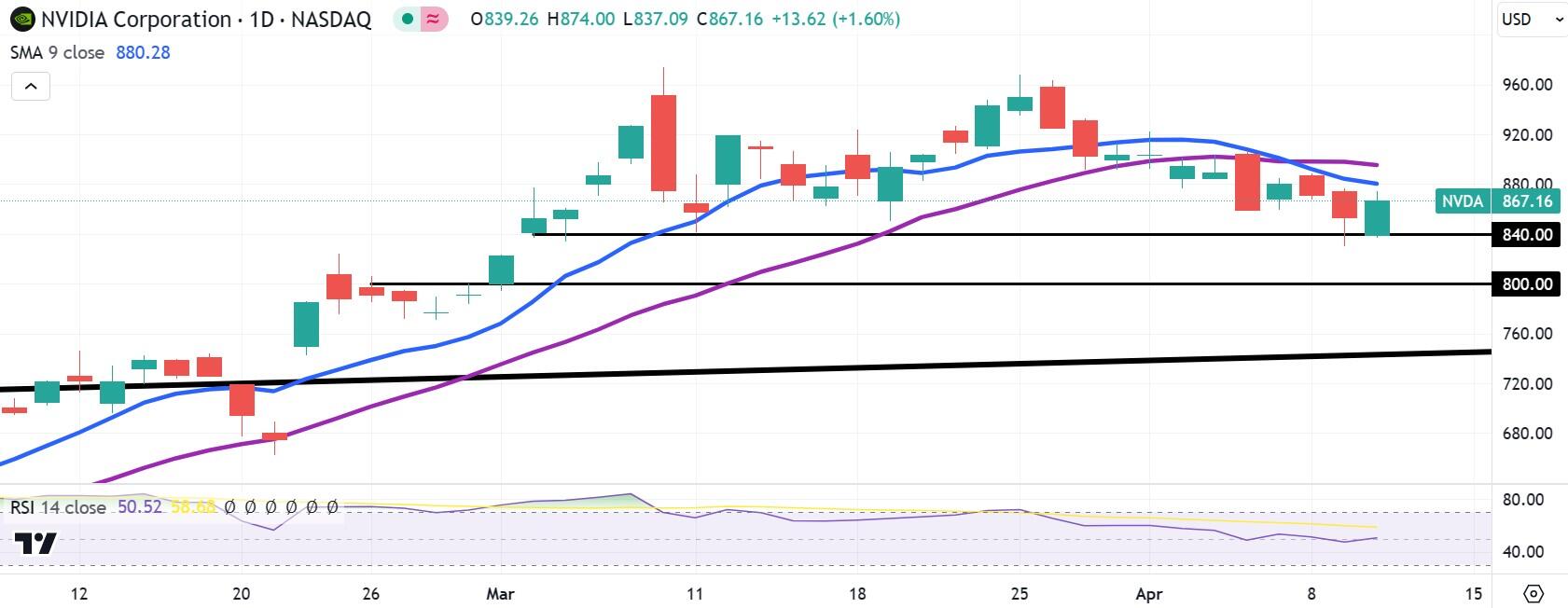
NVDA daily stock chart
Author

Clay Webster
FXStreet
Clay Webster grew up in the US outside Buffalo, New York and Lancaster, Pennsylvania. He began investing after college following the 2008 financial crisis.














