Mexican Peso edges lower on domestic concerns, technicals favor short-positioning
- The Mexican Peso continues falling on Friday.
- Continued domestic woes and technical trading may be weighing on MXN.
- Technically, USD/MXN finds a firm bedrock of support at the base of a channel and recovers.

The Mexican Peso (MXN) is trading marginally down in its key pairs on Friday as the currency suffers from elevated political risk premia, a negative outlook for the domestic economy and as chart technicals favor short-positioning.
Mexican Peso depreciates amid political concerns
The Mexican Peso depreciated for the second day in a row in its most heavily traded pairs on Thursday as domestic headwinds continued to weigh on investor confidence. Reforms to the judiciary, the abolition of autonomous regulatory bodies and the perilous state of the public finances, including those of public-owned companies such as the Mexican state-owned Oil company Pemex, are all taking a toll.
The Bank of Mexico is widely expected to cut interest rates by 25 basis points (bps), from 10.75% to 10.50%, at its meeting on Thursday. Although this is less than the Fed’s 50 bps cut, the expectation of lower interest rates is still generally negative for a currency since it lessens foreign capital inflows.
The Peso lost the most ground against the Pound Sterling (GBP) and the Euro (EUR) on Thursday as both these currencies’ central banks are likely to take a more measured approach to cutting interest rates compared to the Fed.
In fact, the Bank of England (BoE), which had its meeting on Thursday, decided to keep interest rates unchanged amid still-high core inflation. For the Euro, wage inflation is expected to remain inflationary until the end of the year, preventing the European Central Bank (ECB) from slashing interest rates aggressively in the Eurozone.
Technical Analysis: USD/MXN extends recovery from base of channel
USD/MXN is finding technical support at the base of a long-term rising channel and recovering slowly.
Although the pair declined sharply last week it found key support from the base of a long-term rising channel and the 50-day Simple Moving Average at just above 19.00, which has so far prevented a deeper slide.
USD/MXN Daily Chart
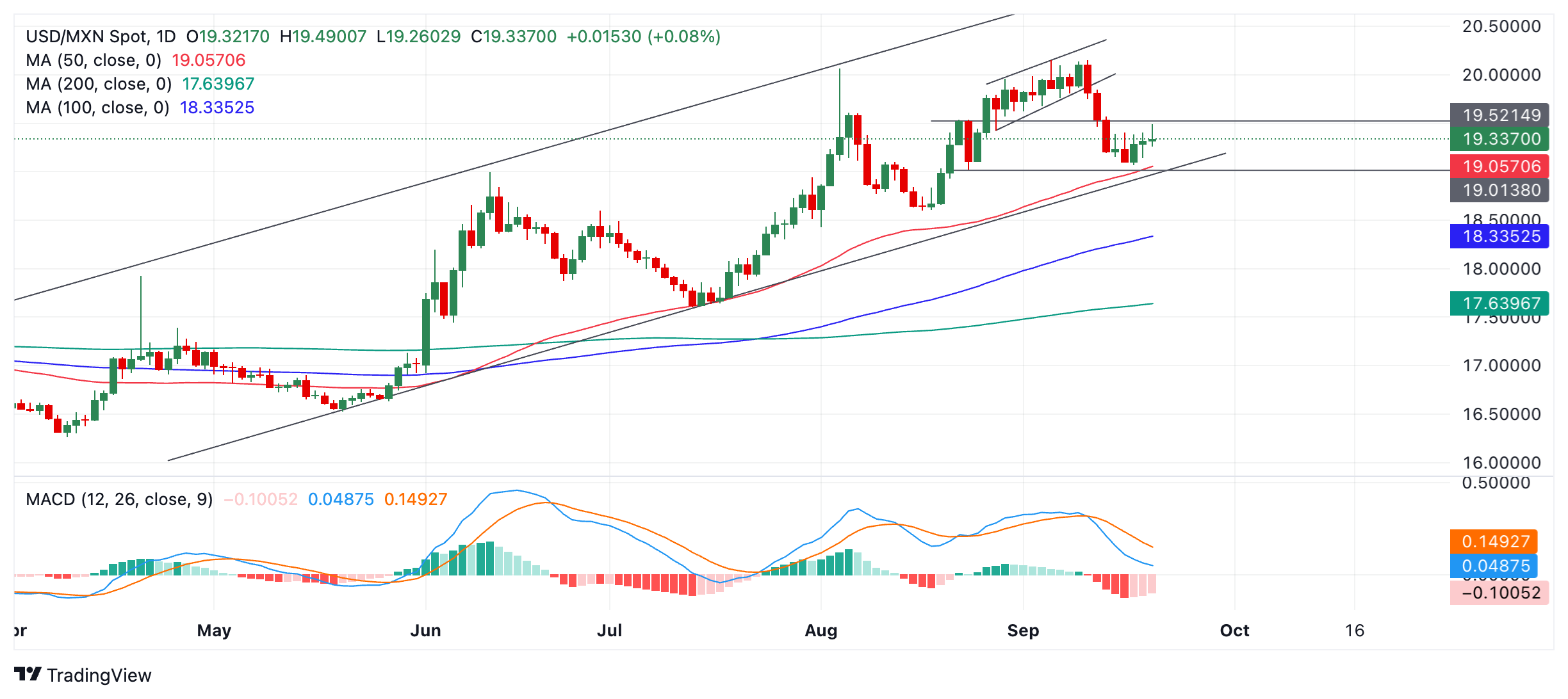
There is a possibility now that USD/MXN has found stability at these support levels and is launching a recovery leg back up within the channel, thereby extending the medium and long-term uptrends.
USD/MXN formed a Bullish Engulfing candlestick pattern (albeit small) on Wednesday and followed through higher on Thursday, thus providing confirmation. This is another possible sign the short-term trend could be reversing. A close above 19.53 (August 23 swing high), however, would be required to shift the diagnosis to bullish in the short-term.
Alternatively, a decisive break below the lower channel line and 50-day SMA could still be possible, although less likely now. Such a move would alter the outlook and indicate a continuation of the near-term downtrend.
A decisive break would be one accompanied by a long red candle that pierced well below the channel line and closed near its low, or three down days in a row that broke clearly below the line.
Mexican Peso FAQs
The Mexican Peso (MXN) is the most traded currency among its Latin American peers. Its value is broadly determined by the performance of the Mexican economy, the country’s central bank’s policy, the amount of foreign investment in the country and even the levels of remittances sent by Mexicans who live abroad, particularly in the United States. Geopolitical trends can also move MXN: for example, the process of nearshoring – or the decision by some firms to relocate manufacturing capacity and supply chains closer to their home countries – is also seen as a catalyst for the Mexican currency as the country is considered a key manufacturing hub in the American continent. Another catalyst for MXN is Oil prices as Mexico is a key exporter of the commodity.
The main objective of Mexico’s central bank, also known as Banxico, is to maintain inflation at low and stable levels (at or close to its target of 3%, the midpoint in a tolerance band of between 2% and 4%). To this end, the bank sets an appropriate level of interest rates. When inflation is too high, Banxico will attempt to tame it by raising interest rates, making it more expensive for households and businesses to borrow money, thus cooling demand and the overall economy. Higher interest rates are generally positive for the Mexican Peso (MXN) as they lead to higher yields, making the country a more attractive place for investors. On the contrary, lower interest rates tend to weaken MXN.
Macroeconomic data releases are key to assess the state of the economy and can have an impact on the Mexican Peso (MXN) valuation. A strong Mexican economy, based on high economic growth, low unemployment and high confidence is good for MXN. Not only does it attract more foreign investment but it may encourage the Bank of Mexico (Banxico) to increase interest rates, particularly if this strength comes together with elevated inflation. However, if economic data is weak, MXN is likely to depreciate.
As an emerging-market currency, the Mexican Peso (MXN) tends to strive during risk-on periods, or when investors perceive that broader market risks are low and thus are eager to engage with investments that carry a higher risk. Conversely, MXN tends to weaken at times of market turbulence or economic uncertainty as investors tend to sell higher-risk assets and flee to the more-stable safe havens.
Author

Joaquin Monfort
FXStreet
Joaquin Monfort is a financial writer and analyst with over 10 years experience writing about financial markets and alt data. He holds a degree in Anthropology from London University and a Diploma in Technical analysis.

















