Mexican Peso edges higher in wake of Banxico decision
- The Mexican Peso makes tepid gains following the Bank of Mexico (Banxico) meeting.
- The bank decided to cut interest rates by 25 bps and revised down its forecasts for inflation.
- USD/MXN steadily climbs within its rising channel.

The Mexican Peso (MXN) edges higher in its major pairs on Friday, a day after the Bank of Mexico (Banxico) policy meeting at which the bank decided to cut interest rates by 25 basis points (0.25%), bringing the official cash rate down to 10.50% from 10.75% previously.
Changes to interest rates can have a high impact on exchange rates. However, the cut was in line with consensus expectations, so the Peso remained relatively stable following the announcement.
Revisions to Banxico’s forecasts for the economy, however, suggest more interest rate cuts are probably on the way, with potentially negative implications for MXN.
Mexican Peso weighed by downwardly revised inflation forecasts
The Mexican Peso ended the day little-changed following the Banxico interest-rate decision, closing Thursday close to where it started in its major pairs.
The bank decided to cut interest rates by 25 bps to 10.50% as expected, with four of the members of the board voting in support of the decision and one dissenter – Jonathan Heath – voting to keep rates unchanged.
Banxico did, however, revise down its inflation forecasts in light of recent data that showed a cooling in price pressures. It forecast headline inflation (INPC) at 5.1% in Q3 of 2024, down from 5.2% in the August policy statement, and at 4.3% instead of 4.4% in Q4. As for core inflation, the bank saw it falling to 3.8% in Q4 of 2024, below the 3.9% in the previous forecast, and to 3.5% in Q1 of 2025, down from 3.6% previously.
The Banxico statement noted that “Mexico’s economy is undergoing a period of weakness” and that the balance of risks to growth remains to the downside.
With lower inflation expected and doubts over economic growth, the forecast revisions suggest a greater likelihood of the Banxico making more cuts to interest rates in the future.
“We are forecasting two more 25bp cuts this year at the November 14th and December 19th meetings, respectively, bringing the year-end rate to 10.00%. This in addition to a total of 200 bps cuts throughout next year,” said Rabobank in a note.
Advisory service Capital Economics were of a similar view stating: “Overall, we expect two more 25bp interest rate cuts over the rest of the year, to 10.00%. The easing cycle is likely to be a bit more stop-start next year as it takes time for inflation to fall to the central bank's 2-4% target. Our end-2025 forecast of 8.50% is above consensus expectations,” said Liam Peach, Senior Emerging Markets Economist.
Technical Analysis: USD/MXN continues steady rise within channel
USD/MXN continues to trade within its rising channel as it extends the uptrending bias of recent months. Overall, it is in a short, medium and long-term uptrend. Given the theory that “the trend is your friend”, it’s more likely than not to continue higher.
USD/MXN Daily Chart
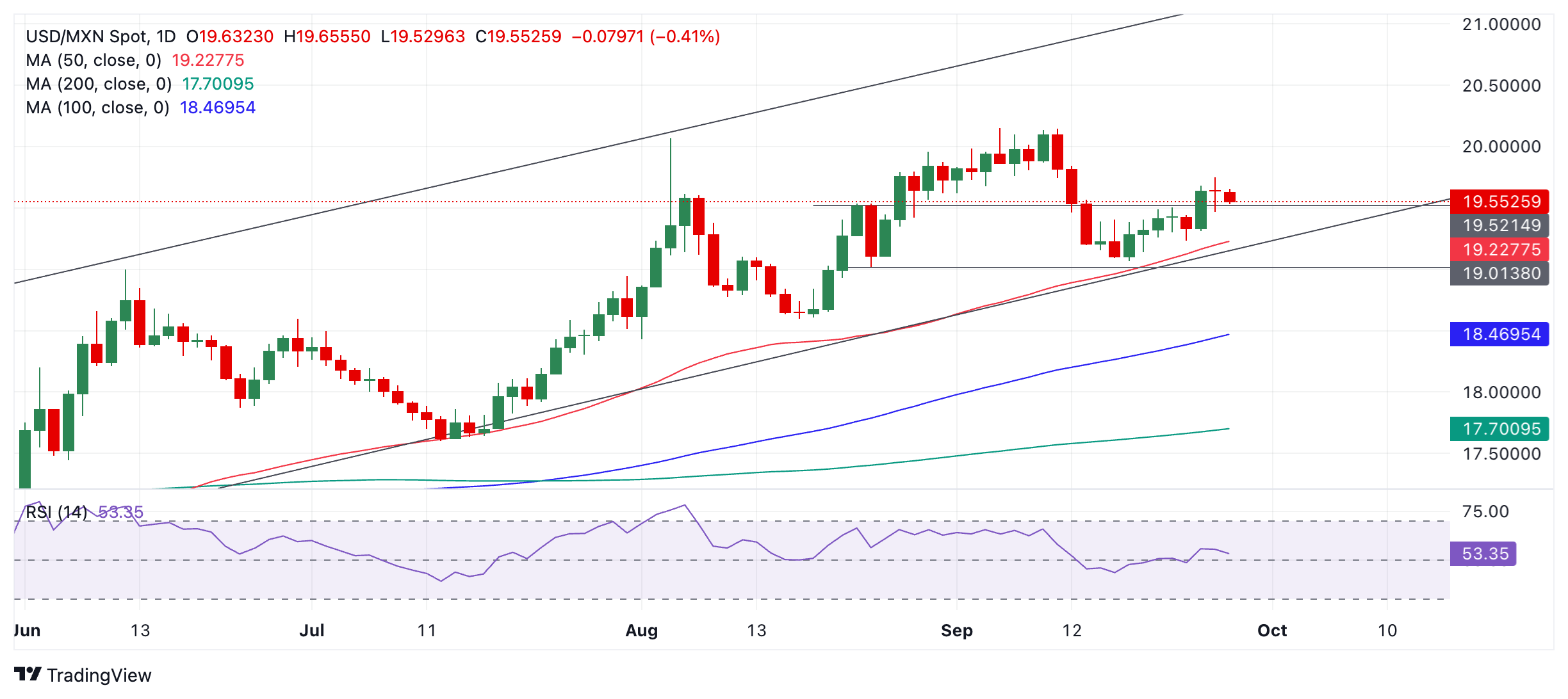
Thursday’s close above 19.63 (September 25 high) provided more bullish certainty of the pair’s near-term upside bias after it recently bottomed out at the base of the rising channel, towards a target at 20.15, the high of the year.
A further break above 19.75 (the September 26 high) would create a higher high and provide yet more proof of an extension of the uptrend.
Banxico FAQs
The Bank of Mexico, also known as Banxico, is the country’s central bank. Its mission is to preserve the value of Mexico’s currency, the Mexican Peso (MXN), and to set the monetary policy. To this end, its main objective is to maintain low and stable inflation within target levels – at or close to its target of 3%, the midpoint in a tolerance band of between 2% and 4%.
The main tool of the Banxico to guide monetary policy is by setting interest rates. When inflation is above target, the bank will attempt to tame it by raising rates, making it more expensive for households and businesses to borrow money and thus cooling the economy. Higher interest rates are generally positive for the Mexican Peso (MXN) as they lead to higher yields, making the country a more attractive place for investors. On the contrary, lower interest rates tend to weaken MXN. The rate differential with the USD, or how the Banxico is expected to set interest rates compared with the US Federal Reserve (Fed), is a key factor.
Banxico meets eight times a year, and its monetary policy is greatly influenced by decisions of the US Federal Reserve (Fed). Therefore, the central bank’s decision-making committee usually gathers a week after the Fed. In doing so, Banxico reacts and sometimes anticipates monetary policy measures set by the Federal Reserve. For example, after the Covid-19 pandemic, before the Fed raised rates, Banxico did it first in an attempt to diminish the chances of a substantial depreciation of the Mexican Peso (MXN) and to prevent capital outflows that could destabilize the country.
Author

Joaquin Monfort
FXStreet
Joaquin Monfort is a financial writer and analyst with over 10 years experience writing about financial markets and alt data. He holds a degree in Anthropology from London University and a Diploma in Technical analysis.