Mexican Peso extends sell-off after inflation data release
- The Mexican Peso extends its losses after the release of July Mexican inflation data.
- The Peso was declining after Mexican GDP and Retail Sales data missed economists’ expectations.
- The Banxico is now widely expected to cut interest rates in August, further weighing on the Peso.
- USD/MXN is now in a short-term uptrend, with sights set on the June 28 high.

The Mexican Peso (MXN) accelerates its decline in key pairs on Wednesday after the release of Mexican inflation data for July reaffirmed market expectations that the Banxico will go ahead and cut interest rates at its August meeting, as widely expected. Lower interest rates are neagtive for a currency as they reduce foreign capital inflows.
Mexican Peso continues depreciating after inflation data
The Mexican Peso continues its downtrend on Wednesday after the release of Mexican inflation data showed core inflation little-changed despite a rise in the headline rate of inflation. The data reconfirmed monetary policymaker's views that whilst core inflation, which does not include volatile food and energy prices, is steadily falling, headline inflation remains hot because of temporary factors. Core inflation is more important for the Banxico as it is viewed as more accurate. The data suggests the central bank will go ahead and cut interest rates in the near term as many forecasters are predicting.
Mexican 1st Half-Month Core Inflation rose 0.18% in July, beating the previous month's 0.17% and estimates of 0.17%. At 4.02%, however mid-month Core Inflation was in line with analysts estimates and below the previous month's 4.17%.
Mid-month headline inflation, meanwhile, rose 0.71% in July on a month-over-month basis, beating consensus estimates of 0.38% and 0.21% previously. On a year-over-year basis inflation rose 5.61% which was well above the previous month's 4.78% and economists' expectations of 5.27%.
Earlier on Wednesday the Peso was trading broadly lower prior to the release after a string of macroeconomic data releases showed below-expectations growth and activity in Mexico.
At the time of writing, one US Dollar (USD) buys 18.34 Mexican Pesos, EUR/MXN trades at 19.91, and GBP/MXN at 23.71.
Mexican Peso falls after weak macroeconomic data weighs
The Mexican Peso is weakening overall after disappointing retail sales figures have contributed to a bleak outlook for Mexico's economic activity. This, combined with expectations of a 0.25% interest rate cut by Banxico in August, has led to a downward revision for the Peso’s year-end forecasts. The USD/MXN, which gives the number of Pesos a single US Dollar can purchase, is now forecast to rise from 18.70 to 18.80, according to the Citi Research Expectations survey.
The latest Economic Activity Indicator from the Instituto Nacional de Estadistica, Geografia e Informatica (INEGI) underscores ongoing economic challenges. According to INEGI, Mexico’s economy expanded by 1.6% year-over-year (YoY) in May, a notable deceleration from the near-two-year-high increase of 5.4% recorded in the previous month. Despite this slowdown, the growth exceeded market expectations of a 1.4% increase, buoyed by robust performance in services.
Retail sales for May grew by 0.3% from the same period in the previous year, significantly easing from a 3.2% increase in April. On a seasonally adjusted monthly basis, retail sales inched up by 0.1% following a 0.5% increase in April.
Adding to the economic uncertainty, Fitch Ratings reaffirmed Mexico’s BBB- rating but warned of potential impacts from proposed judicial reforms. Meanwhile, the International Monetary Fund (IMF) revised Mexico’s 2024 Gross Domestic Product (GDP) growth forecast down from 2.4% to 2.2%, citing a slowdown in manufacturing linked to reduced US economic activity. This has pressured Banxico to consider a more accommodative monetary stance.
Furthermore, the Mexican Congress is set to discuss President Andrés Mañuel Lopez Obrador's judicial reform on August 1, in preparation for approval once the new Congress begins its term on September 1. This political development adds another layer of complexity to the economic landscape.
Technical Analysis: USD/MXN now targeting June 28 high at 18.60
USD/MXN found support at the 50-day Simple Moving Average (SMA) after completing an ABC correction lower, and has rebounded higher, hurdling the 18.00 barrier in the process.
USD/MXN Daily Chart
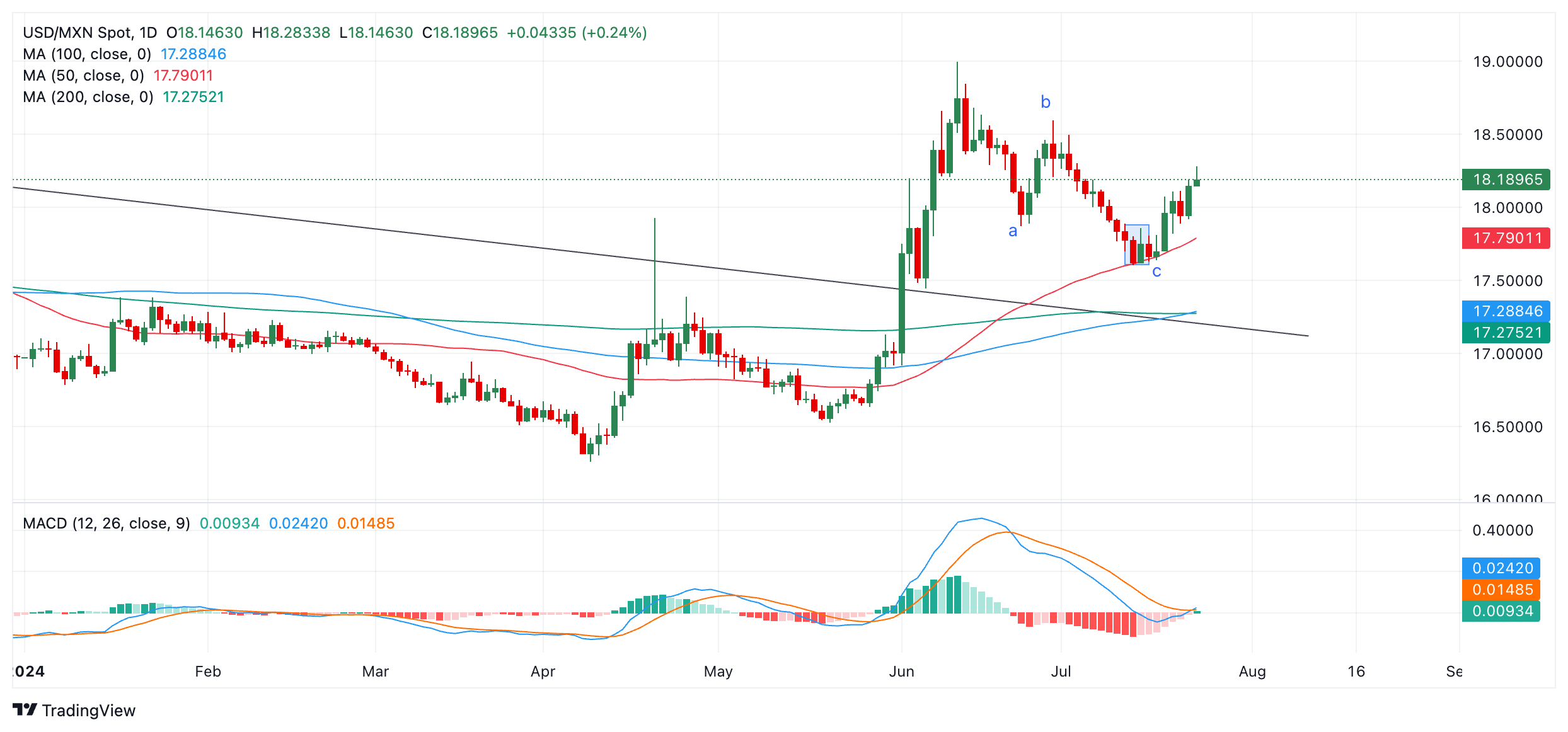
The short-term trend is now bullish for USD/MXN, and given that the “trend is your friend,” this still technically favors bullish bets over that timeframe.
The next target higher for the pair is the key June 28 swing high at 18.60.
Meanwhile, the direction of the medium and long-term trends remain in doubt.
Economic Indicator
1st half-month Core Inflation
The 1st half-month core inflation index released by the Bank of Mexico is a measure of price movements by the comparison between the retail prices of a representative shopping basket of goods and services, excluding taxes and energy. The purchase power of Mexican Peso is dragged down by inflation. The inflation index is a key indicator since it is used by the central bank to set interest rates. Generally speaking, a high reading is seen as positive (or bullish) for the Mexican Peso, while a low reading is seen as negative (or Bearish).
Read more.Last release: Wed Jul 24, 2024 12:00
Frequency: Monthly
Actual: 0.18%
Consensus: 0.17%
Previous: 0.17%
Source: National Institute of Statistics and Geography of Mexico
Author

Joaquin Monfort
FXStreet
Joaquin Monfort is a financial writer and analyst with over 10 years experience writing about financial markets and alt data. He holds a degree in Anthropology from London University and a Diploma in Technical analysis.