Mexican Peso rallies as trade war jitters calm
- Mexican Peso strengthened after Trump – Sheinbaum’s call, reversing some of the losses spurred by Trump's earlier threats.
- Banxico minutes reflect a possibility of further interest rate adjustments based on the inflation outlook.
- Fed’s favorite inflation gauge suggests prices remain high, justifying its gradual approach.

The Mexican Peso rallied against the US Dollar on Thursday after being pressured by Trump’s tariff threats. Upbeat news related to a call between the United States (US) President-elect and Mexico’s President Claudia Sheinbaum weighed on the exotic pair as the Peso recovered and trimmed weekly losses. The USD/MXN trades at 20.41,down 0.72%.
The call betweenSheinbaum and Trump revealed that both countries found common ground to fix issues involving them. In his Truth Social network, Trump indicated that he “had a wonderful conversation with the new President of Mexico, Claudia Sheinbaum Pardo. She has agreed to stop migration through Mexico.” He added they discussed how they could work “to stop the massive drug inflow to the US.”
Following the post, the USD/MXN began to slide after hitting a new year-to-date (YTD) high of 20.82 on Monday.
On the monetary policy front, the Bank of Mexico (Banxico) revealed in its minutes that the inflationary scenario will allow for further adjustments to interest rates.
Across the north of the border, the Federal Reserve’s (Fed) preferred gauge for inflation, the Core Personal Consumption Expenditures (PCE) Price Index, increased 2.8% YoY in October, up from 2.7% in September and in line with analysts’ estimates.. This justifies the Fed’s policymakers' gradual approach to monetary policy, adopted since the latest meeting in early November.
Ahead this week, Mexico’s docket remains light, yet it will feature Fiscal Balance figures. However, USD/MXN traders should be aware of political developments, including US President-elect Donald Trump’s posts on social media.
Daily digest market movers: Mexican Peso to remain volatile – Banxico
- Banxico’s board members noted that the Mexican Peso traded broadly, depreciating markedly and exhibiting volatility mainly due to uncertainty about the US election.
- They added that inflation risks are tilted to the upside, mentioning a greater exchange rate depreciation. They acknowledged the outlook for inflation still calls for a restrictive policy stance.
- In the bank's quarterly report, Banxico’s Governor Victoria Rodriguez commented that they monitored the recent peso volatility and added that there has not been a need to intervene in the forex market.
- The quarterly report revealed that Banxico updated the Mexican economy to grow 1.8% in 2024, up from 1.5%. Nevertheless, the central bank kept its 2025 Gross Domestic Product (GDP) projection at 1.2%.
- The CME FedWatch Tool suggests that investors see a 66% chance of a 25-basis-points (bps) rate cut at the US central bank’s December meeting, up from 59% a day ago.
- Data from the Chicago Board of Trade, via the December Fed funds rate futures contract, shows investors estimate 24 bps of Fed easing by the end of 2024.
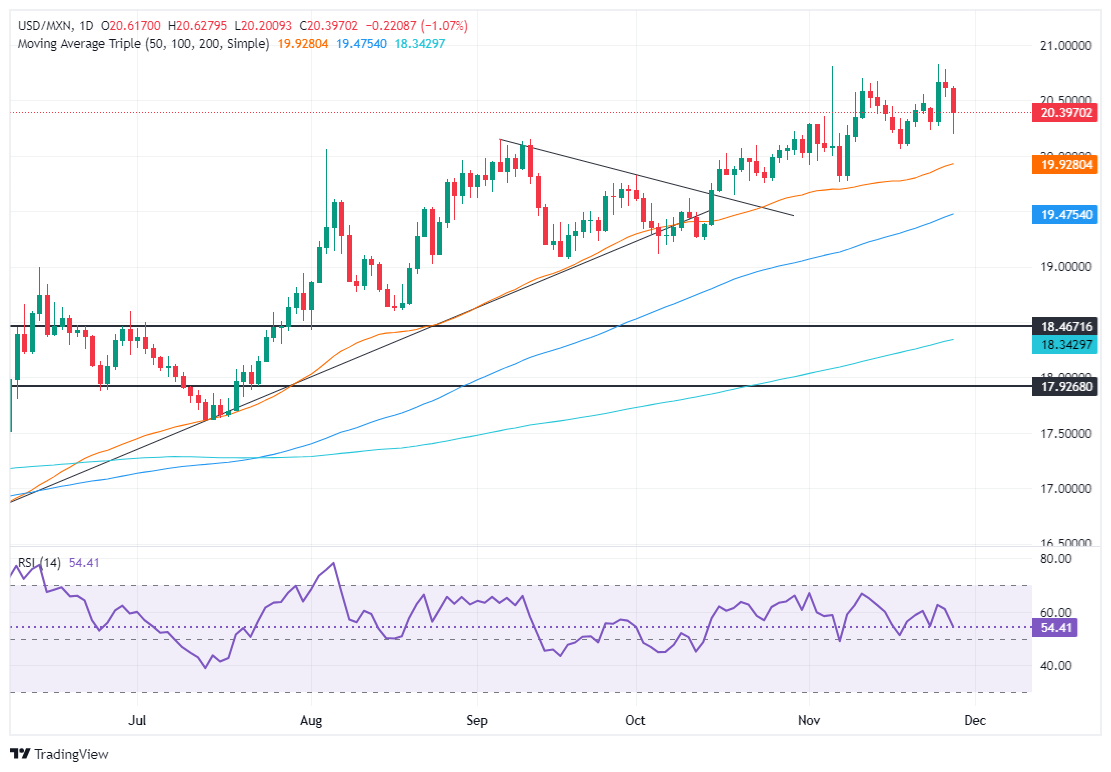
USD/MXN technical outlook: Mexican Peso recovers as USD/MXN falls below 20.50
The USD/MXN is still upward biased despite hitting a daily low of 20.20. Despite recovering some ground, it remains below the psychological 20.50 figure, meaning that bulls are not out of the woods. If they want to extend the uptrend, they need to reclaim 20.50, followed by the YTD high of 20.83, ahead of the 21.00 mark. Once those levels are cleared, bulls will target the March 8, 2022, peak at 21.46, followed by the November 26, 2021, high at 22.15.
Conversely, if bears drag the exchange rate below 20.00, the next support would be the 50-day Simple Moving Average (SMA) at 19.90. Key support levels lie beneath the latter, with the 100-day SMA at 19.45, before the psychological 19.00 figure.
Mexican Peso FAQs
The Mexican Peso (MXN) is the most traded currency among its Latin American peers. Its value is broadly determined by the performance of the Mexican economy, the country’s central bank’s policy, the amount of foreign investment in the country and even the levels of remittances sent by Mexicans who live abroad, particularly in the United States. Geopolitical trends can also move MXN: for example, the process of nearshoring – or the decision by some firms to relocate manufacturing capacity and supply chains closer to their home countries – is also seen as a catalyst for the Mexican currency as the country is considered a key manufacturing hub in the American continent. Another catalyst for MXN is Oil prices as Mexico is a key exporter of the commodity.
The main objective of Mexico’s central bank, also known as Banxico, is to maintain inflation at low and stable levels (at or close to its target of 3%, the midpoint in a tolerance band of between 2% and 4%). To this end, the bank sets an appropriate level of interest rates. When inflation is too high, Banxico will attempt to tame it by raising interest rates, making it more expensive for households and businesses to borrow money, thus cooling demand and the overall economy. Higher interest rates are generally positive for the Mexican Peso (MXN) as they lead to higher yields, making the country a more attractive place for investors. On the contrary, lower interest rates tend to weaken MXN.
Macroeconomic data releases are key to assess the state of the economy and can have an impact on the Mexican Peso (MXN) valuation. A strong Mexican economy, based on high economic growth, low unemployment and high confidence is good for MXN. Not only does it attract more foreign investment but it may encourage the Bank of Mexico (Banxico) to increase interest rates, particularly if this strength comes together with elevated inflation. However, if economic data is weak, MXN is likely to depreciate.
As an emerging-market currency, the Mexican Peso (MXN) tends to strive during risk-on periods, or when investors perceive that broader market risks are low and thus are eager to engage with investments that carry a higher risk. Conversely, MXN tends to weaken at times of market turbulence or economic uncertainty as investors tend to sell higher-risk assets and flee to the more-stable safe havens.
Author

Christian Borjon Valencia
FXStreet
Markets analyst, news editor, and trading instructor with over 14 years of experience across FX, commodities, US equity indices, and global macro markets.

















