Mexican Peso soars to 9-day high as USD/MXN dips below 18.00
- Mexican Peso rallies as USD/MXN drops below 18.00 and hits lowest level since June 25.
- June’s CPI report, Consumer Confidence, and Industrial Production to shape Mexico's economic outlook.
- Banxico minutes likely to signal patience on rate cuts amid steady inflation expectations.

The Mexican Peso rallied sharply against the US Dollar as the USD/MXN fell below the 18.00 psychological figure on Monday, a level last seen on June 25. This signaled that Peso’s buyers remain committed to the so-called “carry trade,” which underpins the Mexican currency. Therefore, the exotic pair exchanged hands at 17.99, down 0.45%.
Mexico’s economic docket will interest traders. The focus is June’s Consumer Price Index (CPI) report, which will be released on July 9. Further data, like Consumer Confidence and Industrial Production, will be released, which will dictate the economic trend and set it to slow down, according to analysts.
On Thursday, the Bank of Mexico (Banxico) will reveal the latest meeting monetary policy minutes, which are expected to show that the central bank will remain patient regarding cutting borrowing costs.
Across the border, the New York Federal Reserve revealed that consumer inflation expectations were lowered from 3.2% to 3% for one year. Besides that, market players will be focused on Federal Reserve (Fed) Chair Jerome Powell's speech at the US Congress on Tuesday and Wednesday and the release of June’s inflation figures.
Last week’s US jobs data sparked speculation that the Fed might ease policy in September, according to the CME FedWatch Tool data. Odds for a September cut stand at 73%, up from 71% last Friday.
Daily digest market movers: Mexican Peso rises further despite firm US Dollar
- Banxico’s survey showed that economists estimate the Gross Domestic Product (GDP) will end the year at 2%, down from 2.1%. They expect Banxico to cut rates from 11.00% to 10.25%, up from 10.00% projected in May.
- Some analysts in Mexico estimate the economy might slow down but dodge a recession, according to the National Statistics Agency (INEGI) Coincident Indicator. Despite that, they said reforms pushed by President Andres Manuel Lopez Obrador (AMLO), particularly the judiciary reform, could affect the country’s creditworthiness.
- Mexico’s CPI is expected to rise from 4.69% YoY to 4.84% in June, while core CPI is estimated to dip from 4.21% to 4.15% annually.
- US CPI is foreseen to drop from 3.3% to 3.1% in the 12 months to June, while underlying inflation is projected to stay firm at 3.4% YoY.
- US Dollar Index (DXY), which tracks the value of a basket of six currencies against the American Dollar, stays firm at 104.94, up 0.06%.
Technical analysis: Mexican Peso stays near weekly highs as USD/MXN hovers around 18.00
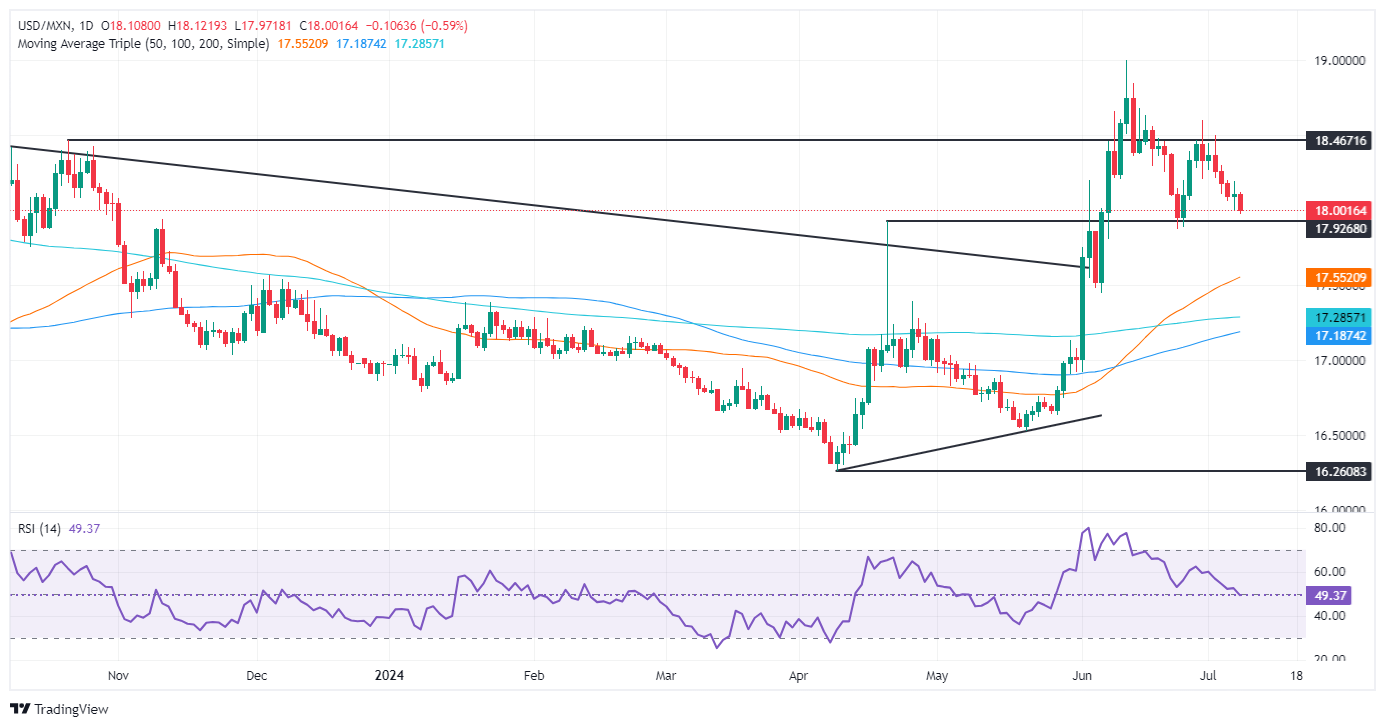
The USD/MXN reached a nine-day low of 17.97, though some bids below the 18.00 figure lifted the pair above the latter. The Greenback remains soft against the Peso. The momentum has shifted in the sellers' favor, with the Relative Strength Index (RSI) about to drop below the 50-neutral line.
If USD/MXN achieves a daily close below 18.00, the next support would be the June 24 swing low of 17.87. Further losses lie underneath at the 50-day Simple Moving Average (SMA) at 17.56, followed by the 200-day SMA at 17.26. The next floor level would be the 100-day SMA at 17.17.
For a bullish resumption, the USD/MXN must surpass 18.10, followed by a rally above the June 28 high of 18.59, so buyers can challenge the YTD high at 18.99. Conversely, sellers will need a drop below 18.00, which could extend the pair’s decline toward the December 5 high, which turned support at 17.56, followed by the 50-day Simple Moving Average (SMA) at 17.37.
Mexican Peso FAQs
The Mexican Peso (MXN) is the most traded currency among its Latin American peers. Its value is broadly determined by the performance of the Mexican economy, the country’s central bank’s policy, the amount of foreign investment in the country and even the levels of remittances sent by Mexicans who live abroad, particularly in the United States. Geopolitical trends can also move MXN: for example, the process of nearshoring – or the decision by some firms to relocate manufacturing capacity and supply chains closer to their home countries – is also seen as a catalyst for the Mexican currency as the country is considered a key manufacturing hub in the American continent. Another catalyst for MXN is Oil prices as Mexico is a key exporter of the commodity.
The main objective of Mexico’s central bank, also known as Banxico, is to maintain inflation at low and stable levels (at or close to its target of 3%, the midpoint in a tolerance band of between 2% and 4%). To this end, the bank sets an appropriate level of interest rates. When inflation is too high, Banxico will attempt to tame it by raising interest rates, making it more expensive for households and businesses to borrow money, thus cooling demand and the overall economy. Higher interest rates are generally positive for the Mexican Peso (MXN) as they lead to higher yields, making the country a more attractive place for investors. On the contrary, lower interest rates tend to weaken MXN.
Macroeconomic data releases are key to assess the state of the economy and can have an impact on the Mexican Peso (MXN) valuation. A strong Mexican economy, based on high economic growth, low unemployment and high confidence is good for MXN. Not only does it attract more foreign investment but it may encourage the Bank of Mexico (Banxico) to increase interest rates, particularly if this strength comes together with elevated inflation. However, if economic data is weak, MXN is likely to depreciate.
As an emerging-market currency, the Mexican Peso (MXN) tends to strive during risk-on periods, or when investors perceive that broader market risks are low and thus are eager to engage with investments that carry a higher risk. Conversely, MXN tends to weaken at times of market turbulence or economic uncertainty as investors tend to sell higher-risk assets and flee to the more-stable safe havens.
Author

Christian Borjon Valencia
FXStreet
Markets analyst, news editor, and trading instructor with over 14 years of experience across FX, commodities, US equity indices, and global macro markets.