Mexican Peso resilient as Banxico cuts rates
- Mexican Peso is virtually unchanged after hitting a daily high of 19.46.
- Banxico cuts rates by 25 bps in a 4-1 vote, with inflation expected to ease by 2025.
- USD/MXN briefly dipped to 19.55 but stabilized above 19.60 after Banxico’s rate cut decision.

The Mexican Peso steadied against the Greenback on Thursday after the Bank of Mexico (Banxico) decided to lower rates by 25 basis points (bps) in accordance with estimates by market participants. Initially, the USD/MXN whipsawed but stabilized above the 19.60 area, virtually unchanged.
Banxico decided by majority to lower rates to 10.50% in a 4-1 vote split, while Deputy Governor Jonathan Heath voted to hold rates unchanged.
In the monetary policy statement, Banxico recognized that economic activity is weakening, weighing on the labor market, which has cooled down. The central bank revised its inflation expectations for headline and core figures upward in 2024 but still estimates inflation would hit the target by the end of 2025.
Despite revising inflation, the bank added, "the nature of the shocks that have affected the non-core component and the projection that their effects on headline inflation will continue dissipating over the next quarters,” adding that “although the outlook for inflation still calls for a restrictive monetary policy stance, its evolution implies that it is adequate to reduce the level of monetary restriction.”
After the decision, the USD/MXN dipped toward 19.55 before aiming above the 19.60 area and stabilized at around the current exchange rate.
Across the south of the border, the US schedule revealed final Gross Domestic Product (GDP) figures for Q2 2024, which were better than expected, while jobs data showed that the number of Americans filing for unemployment benefits was lower than anticipated and also below the previous number.
Meanwhile, Fed speakers had crossed the newswires but failed to comment on monetary policy.
Daily digest market movers: Mexican Peso stays firm amid lack of catalysts
- Mexican political turmoil eases as market participants prepare for the change of president on October 1, a bank holiday in Mexico. President-Elect Claudia Sheinbaum’s speech will be watched for hints about her economic plan.
- USD/MXN whipsawed and erased earlier losses, boosted by the buck’s recovery.
- Banxico is expected to lower borrowing costs by 175 bps toward the end of 2025, according to the swaps markets.
- US Dollar Index (DXY), which tracks the buck’s performance against a basket of six peers, is virtually unchanged at 100.90.
- Market participants have fully priced in at least a 25 bps rate cut by the Fed. However, the odds for 50 bps of easing are 51.3%, lower than the 60% chance a day ago, according to the CME FedWatch Tool.
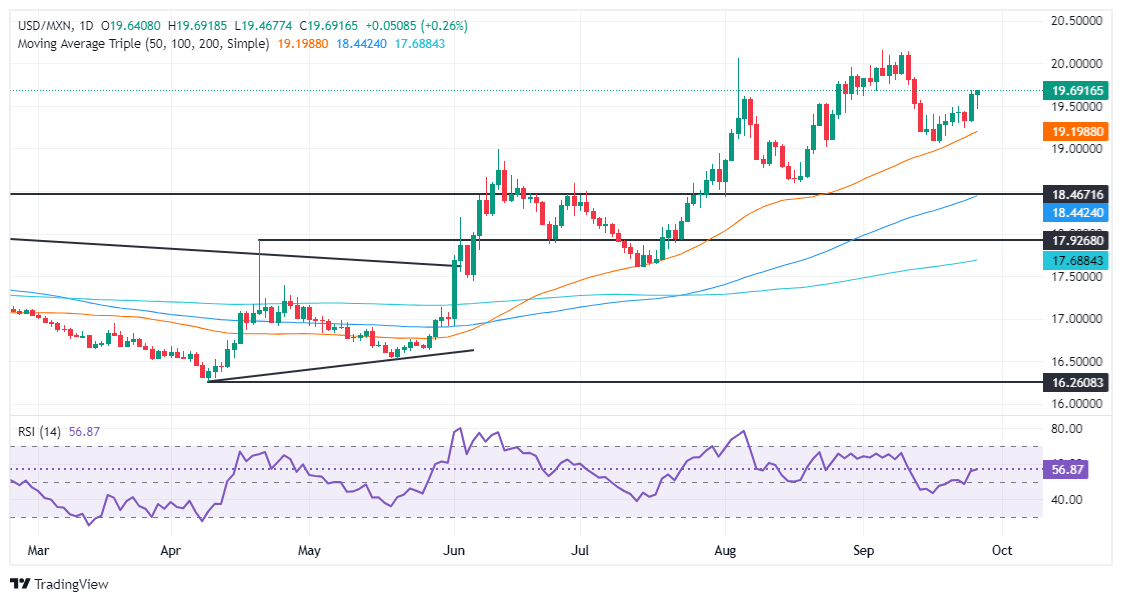
USD/MXN technical analysis: Mexican Peso hovers at around 19.60
The uptrend remains in place, with USD/MXN eyeing further upside, which could happen if they push the spot price above the current weekly high of 19.68, opening the door to challenge the September 12 peak at 19.84 ahead of the psychological 20.00 figure. Momentum favors further upside as the Relative Strength Index (RSI) is bullish.
Failure to conquer 19.68 could pave the way for lower prices. The first support would be the 19.50 mark, followed by the September 24 swing low of 19.23, before the pair moves toward the September 18 low of 19.06. Once those levels are surpassed, the 19.00 figure emerges as the next line of defense.
Mexican Peso FAQs
The Mexican Peso (MXN) is the most traded currency among its Latin American peers. Its value is broadly determined by the performance of the Mexican economy, the country’s central bank’s policy, the amount of foreign investment in the country and even the levels of remittances sent by Mexicans who live abroad, particularly in the United States. Geopolitical trends can also move MXN: for example, the process of nearshoring – or the decision by some firms to relocate manufacturing capacity and supply chains closer to their home countries – is also seen as a catalyst for the Mexican currency as the country is considered a key manufacturing hub in the American continent. Another catalyst for MXN is Oil prices as Mexico is a key exporter of the commodity.
The main objective of Mexico’s central bank, also known as Banxico, is to maintain inflation at low and stable levels (at or close to its target of 3%, the midpoint in a tolerance band of between 2% and 4%). To this end, the bank sets an appropriate level of interest rates. When inflation is too high, Banxico will attempt to tame it by raising interest rates, making it more expensive for households and businesses to borrow money, thus cooling demand and the overall economy. Higher interest rates are generally positive for the Mexican Peso (MXN) as they lead to higher yields, making the country a more attractive place for investors. On the contrary, lower interest rates tend to weaken MXN.
Macroeconomic data releases are key to assess the state of the economy and can have an impact on the Mexican Peso (MXN) valuation. A strong Mexican economy, based on high economic growth, low unemployment and high confidence is good for MXN. Not only does it attract more foreign investment but it may encourage the Bank of Mexico (Banxico) to increase interest rates, particularly if this strength comes together with elevated inflation. However, if economic data is weak, MXN is likely to depreciate.
As an emerging-market currency, the Mexican Peso (MXN) tends to strive during risk-on periods, or when investors perceive that broader market risks are low and thus are eager to engage with investments that carry a higher risk. Conversely, MXN tends to weaken at times of market turbulence or economic uncertainty as investors tend to sell higher-risk assets and flee to the more-stable safe havens.
Author

Christian Borjon Valencia
FXStreet
Markets analyst, news editor, and trading instructor with over 14 years of experience across FX, commodities, US equity indices, and global macro markets.
















