Mexican Peso declines on sour sentiment following a weaker ISM report
- Mexican Peso depreciates over 1% after printing solid gains.
- Mexico's economic data shows unchanged business confidence and contraction in manufacturing activity.
- Fed hints at possible rate cut in September, driving traders to the safety of the USD.

The Mexican Peso erases earlier gains and tanks against the US Dollar, extending its weekly losses after the US Federal Reserve (Fed) kept interest rates unchanged and opened the door for a possible cut at the upcoming September meeting. This underpinned the Peso, which strengthened to a high of 18.42 before erasing those gains, as the USD/MXN trades at 18.85, over 1%.
Risk aversion keeps Wall Street trading with losses, undermining high-beta currencies like the Mexican Peso. Traders flock to the safety of the Greenback, although US Treasury bond yields plunge following Wednesday’s Fed decision.
Mexico’s economic docket revealed that Business Confidence in July was unchanged compared to June’s data, while a measure of business activity revealed by S&P Global, showed that manufacturing activity contracted for the first time since September 2023.
In the meantime, US data provides the Fed with the tools needed to lower borrowing costs after Wednesday's decision. The Federal Open Market Committee (FOMC) stated that it wouldn’t be “appropriate to reduce the target range until it has gained greater confidence” in the disinflation process, attaining the 2% goal.
Even though that was “hawkish,” Fed Chairman Jerome Powell said that if the labor market weakens substantially, “we should respond.” This was in response to a question about a September rate cut, which he said if data evolves as of late, easing in September would be “on the table.”
Following these remarks, the US Initial Jobless Claims report, which was revealed earlier, points out further weakness in the jobs market, as the number of Americans applying for unemployment benefits rose.
Other data showed that manufacturing activity weakened, spurring fears that the economy might slow down sharply than expected and inreasing recession fears.
Due to these remarks, Friday’s Nonfarm Payrolls report for July would be a crucial piece of the puzzle as the Fed pivoted towards becoming slightly concerned about employment.
Following Powell’s remarks, market participants had priced in three 75 bps of interest rate cuts toward the end of the year.
Daily digest market movers: Mexican Peso depreciates as manufacturing activity contracts
- Mexico’s S&P Global Manufacturing PMI for July contracted to 49.60, below June’s 51.10 expansion, underscoring the economy’s undergoing a slowdown.
- July’s Business Confidence was unchanged at 52.9.
- Mexico's Gross Domestic Product (GDP) for Q2 rose 0.2% QoQ, below estimates of 0.4% and a 0.3% increase in Q1. On an annual basis, GDP for Q2 2024 grew 2.2% YoY on its preliminary reading, above estimates of 2% and the previous quarter's 1.6% expansion.
- The Federal Reserve decided to hold rates unchanged yet commented that goodish data regarding inflation and further weakening in the labor market could be the triggers for action.
- US Initial Jobless Claims for the week ending July 27 rose 248K, exceeding estimates of 236K and the prior week’s 235K.
- The Institute for Supply Management (ISM) Manufacturing PMI for July plunged from 48.5 to 46.8, below estimates for an expansion of 48.8 and is the lowest reading since December 2023.
- Today’s jobless claims data and Wednesday’s ADP Employment Change in July missing the market could be a prelude to Friday’s Nonfarm Payrolls. Estimates suggest the US economy added 175K employees to the workforce, below June’s 206K.
- Data from the Chicago Board of Trade (CBOT) shows that the December 2024 fed funds rates futures contract suggests that policymakers will ease policy at least 80 basis points.
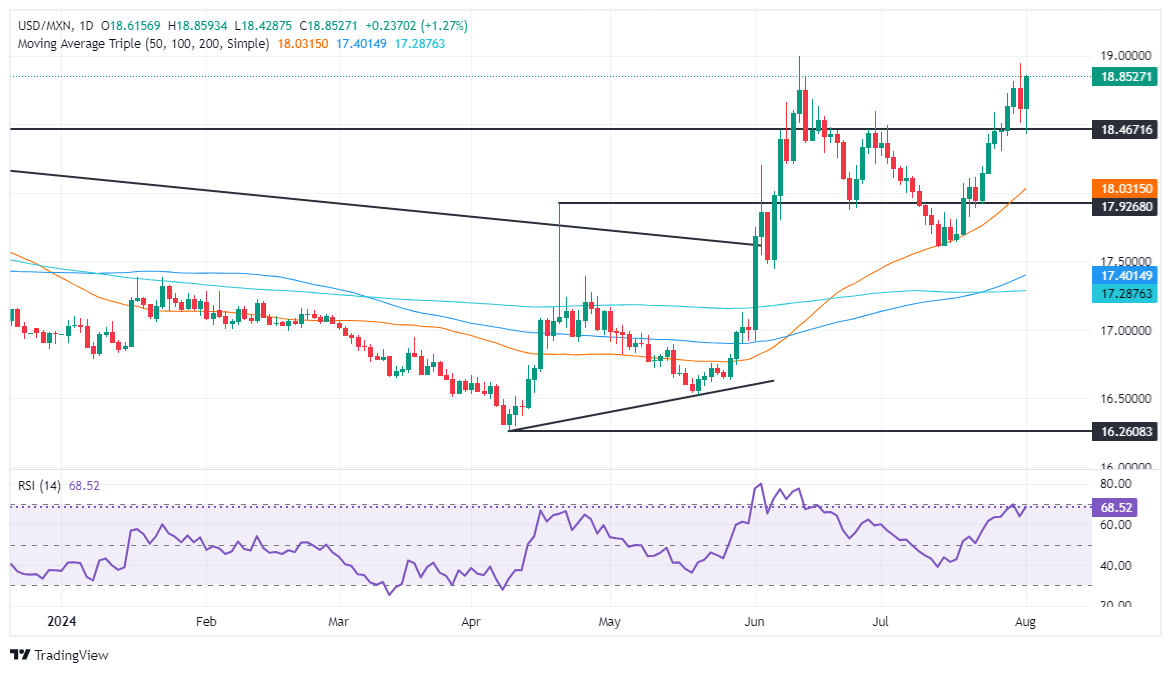
Technical analysis: Mexican Peso retreats as USD/MXN rises above 18.60
The USD/MXN climbed after falling to the 18.40 area, yet it’s recovering, with traders eyeing the 18.75 area following Wednesday’s losses. Momentum favors buyers, which, according to the Relative Strength Index (RSI), took a breather as the RSI pierced oversold levels.
For a bullish continuation, the USD/MXN must challenge the year-to-date (YTD) high at 18.99, followed by the psychological 19.00 mark. Further upside is seen at the March 20, 2023, high of 19.23, ahead of 19.50.
On the bearish side, a drop below 18.50, could sponsor a test of the psychological 18.00 mark, followed by the 50-day Simple Moving Average (SMA) at 17.97.
Mexican Peso FAQs
The Mexican Peso (MXN) is the most traded currency among its Latin American peers. Its value is broadly determined by the performance of the Mexican economy, the country’s central bank’s policy, the amount of foreign investment in the country and even the levels of remittances sent by Mexicans who live abroad, particularly in the United States. Geopolitical trends can also move MXN: for example, the process of nearshoring – or the decision by some firms to relocate manufacturing capacity and supply chains closer to their home countries – is also seen as a catalyst for the Mexican currency as the country is considered a key manufacturing hub in the American continent. Another catalyst for MXN is Oil prices as Mexico is a key exporter of the commodity.
The main objective of Mexico’s central bank, also known as Banxico, is to maintain inflation at low and stable levels (at or close to its target of 3%, the midpoint in a tolerance band of between 2% and 4%). To this end, the bank sets an appropriate level of interest rates. When inflation is too high, Banxico will attempt to tame it by raising interest rates, making it more expensive for households and businesses to borrow money, thus cooling demand and the overall economy. Higher interest rates are generally positive for the Mexican Peso (MXN) as they lead to higher yields, making the country a more attractive place for investors. On the contrary, lower interest rates tend to weaken MXN.
Macroeconomic data releases are key to assess the state of the economy and can have an impact on the Mexican Peso (MXN) valuation. A strong Mexican economy, based on high economic growth, low unemployment and high confidence is good for MXN. Not only does it attract more foreign investment but it may encourage the Bank of Mexico (Banxico) to increase interest rates, particularly if this strength comes together with elevated inflation. However, if economic data is weak, MXN is likely to depreciate.
As an emerging-market currency, the Mexican Peso (MXN) tends to strive during risk-on periods, or when investors perceive that broader market risks are low and thus are eager to engage with investments that carry a higher risk. Conversely, MXN tends to weaken at times of market turbulence or economic uncertainty as investors tend to sell higher-risk assets and flee to the more-stable safe havens.
Author

Christian Borjon Valencia
FXStreet
Markets analyst, news editor, and trading instructor with over 14 years of experience across FX, commodities, US equity indices, and global macro markets.