Mexican Peso climbs as weak USD spurs risk appetite
- Mexican Peso gains traction against the US Dollar, spurred by an uplift in global risk appetite and a softer Greenback.
- Wall Street responds favorably to President-elect Donald Trump's market-friendly Treasury Secretary appointment, influencing broader market trends.
- INEGI reports progress in Mexico’s disinflation process and a deceleration in Q3 GDP growth, fueling speculation of potential Banxico rate cuts.

The Mexican Peso begins the week on the front foot against the US Dollar due to an improvement in risk appetite and overall US Dollar weakness. US President-elect Donald Trump's pick of Scott Bessent as Secretary of the Treasury was cheered by investors with global equities trading in the green. The USD/MXN trades at 20.30, down by 0.45%.
Wall Street rallied after Trump chose the hedge fund manager since he is deemed a market-friendly pick. Consequently, the Greenback is heavy, losing over 0.40% as depicted by the US Dollar Index (DXY). The DXY dropped beneath the 107.50 mark, undermined by falling US Treasury yields.
Last Friday, the Instituto Nacional de Estadistica, Geografia e Informatica (INEGI) revealed that the disinflation process in Mexico is evolving, approaching the Bank of Mexico's (Banxico) 3% inflation goal. At the same time, despite growing, the Gross Domestic Product (GDP) dipped from 2.1% to 1.6% QoQ in the third quarter, indicating the economy's deceleration.
Kimberley Sperrfechter, EM Economist at Capital Economics, revealed, “The good inflation data raises the possibility of a 50 basis point cut by Banxico in December.” She added that their base case is for a 25 basis points cut, “given the strong Q3 economic activity and upward pressure on US interest rates.”
Banxico revealed earlier on Monday that Mexico's economy posted a current account surplus of $733 million in Q3.
Across the border, the US economic docket remains scarce ahead of Thanksgiving, yet the Chicago Fed revealed the National Activity Index.
Ahead this week, traders await the release of the Conference Board (CB) Consumer Confidence and the latest Federal Open Market Committee (FOMC) Meeting Minutes on Tuesday, followed by Wednesday’s Durable Goods Orders, Initial Jobless Claims and the Fed’s preferred inflation gauge, the Personal Consumption Expenditures (PCE) Price Index.
Money market players have grown more cautious about the Fed cutting rates. The CME FedWatch Tool suggests that investors see a 56% chance of a 25-basis-point rate cut at the December meeting, unchanged from last Friday.
Daily digest market movers: Mexican Peso advances on improved risk appetite
- Last week, Bank of Mexico Governor Victoria Rodriguez Ceja said they’re ready to slash interest rates if inflation continues downward. This would exert downward pressure on the Peso, which has depreciated after former US President Donald Trump’s victory boosted the Greenback, as some of its policies are inflation prone.
- Mexico’s Chamber of Deputies approved the dissolution of autonomous bodies, which, according to experts, puts Mexico at risk of being taken out of the USMCA free trade agreement.
- Mexico’s mid-month inflation rate dived from 4.68% to 4.56%. Core inflation, seen as a better gauge of price trends because it strips out volatile energy and food prices, came below the forecast of 3.72% at 3.58% YoY.
- Data from the Chicago Board of Trade, via the December fed funds rate futures contract, shows investors estimate 22 bps of Fed easing by the end of 2024.
USD/MXN technical outlook: Mexican Peso appreciates as USD/MXN drops below 20.30
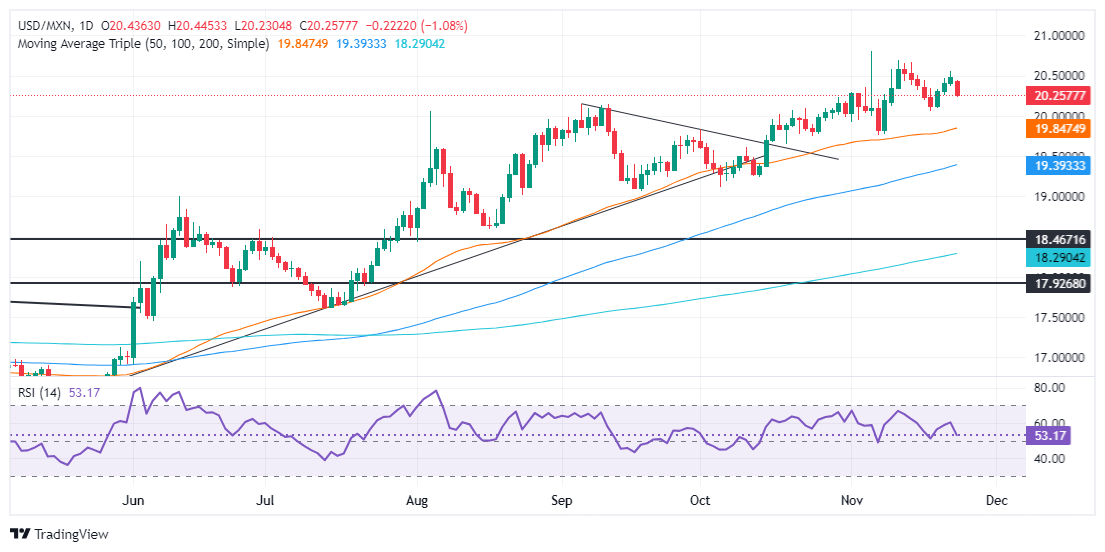
The USD/MXN uptrend remains intact, with sellers eyeing a clear break below the previous year-to-date peak of 20.22, which could pave the way to test the 20.00 mark. Once those two support levels are surpassed, the next support would be the November 7 low and the 50-day Simple Moving Average (SMA) around 19.75/82, followed by the 19.50 mark.
Conversely, if USD/MXN resumes to the upside, the first resistance would be 20.50. A breach of the latter will expose the November 22 high at 20.55, followed by the November 12 peak at 20.69. Once cleared, the next resistance would be the year-to-date high of 20.80.
Mexican Peso FAQs
The Mexican Peso (MXN) is the most traded currency among its Latin American peers. Its value is broadly determined by the performance of the Mexican economy, the country’s central bank’s policy, the amount of foreign investment in the country and even the levels of remittances sent by Mexicans who live abroad, particularly in the United States. Geopolitical trends can also move MXN: for example, the process of nearshoring – or the decision by some firms to relocate manufacturing capacity and supply chains closer to their home countries – is also seen as a catalyst for the Mexican currency as the country is considered a key manufacturing hub in the American continent. Another catalyst for MXN is Oil prices as Mexico is a key exporter of the commodity.
The main objective of Mexico’s central bank, also known as Banxico, is to maintain inflation at low and stable levels (at or close to its target of 3%, the midpoint in a tolerance band of between 2% and 4%). To this end, the bank sets an appropriate level of interest rates. When inflation is too high, Banxico will attempt to tame it by raising interest rates, making it more expensive for households and businesses to borrow money, thus cooling demand and the overall economy. Higher interest rates are generally positive for the Mexican Peso (MXN) as they lead to higher yields, making the country a more attractive place for investors. On the contrary, lower interest rates tend to weaken MXN.
Macroeconomic data releases are key to assess the state of the economy and can have an impact on the Mexican Peso (MXN) valuation. A strong Mexican economy, based on high economic growth, low unemployment and high confidence is good for MXN. Not only does it attract more foreign investment but it may encourage the Bank of Mexico (Banxico) to increase interest rates, particularly if this strength comes together with elevated inflation. However, if economic data is weak, MXN is likely to depreciate.
As an emerging-market currency, the Mexican Peso (MXN) tends to strive during risk-on periods, or when investors perceive that broader market risks are low and thus are eager to engage with investments that carry a higher risk. Conversely, MXN tends to weaken at times of market turbulence or economic uncertainty as investors tend to sell higher-risk assets and flee to the more-stable safe havens.
Author
Christian Borjon Valencia
FXStreet
Markets analyst, news editor, and trading instructor with over 14 years of experience across FX, commodities, US equity indices, and global macro markets.

















