Mexican Peso rockets upward as judicial reform woes wane
- Mexican Senate passes controversial judicial reform, but Peso recovers as investors focus on potential Fed easing cycle.
- USD/MXN drops 1.63% with investors pricing in an 85% chance of a 25 bps rate cut at the Fed's September meeting.
- US inflation data raises doubts over a 50 bps rate cut, while the US economic docket featuring PPI and consumer sentiment may influence USD/MXN.

The Mexican Peso staged a recovery against the US Dollar on Wednesday as investors shrugged off Mexico’s Senate passing of a controversial reform that threatens the state of law. Expectations that the Federal Reserve (Fed) will begin its easing cycle next week keep the Peso on the front foot. The USD/MXN trades at 19.79, down by 1.41%.
Mexico’s economic docket revealed that Industrial Production in July was lower than expected based on monthly figures, while it expanded on an annual basis. Political tensions heightened after the Mexican Senate voted to approve the judiciary reform with 86 votes in favor and 41 against.
Now that the bill has been approved, it will be sent to 32 state congresses. For the reform to become law in the Mexican Constitution, it would need the approval of 17 congresses.
Across the border, data from the US Bureau of Labor Statistics dampened traders' hopes for the Fed's 50-basis-point (bps) rate cut. Inflation in the US remains within reach of the US central bank target, yet core figures on MoM figures rose.
This bolstered the Greenback, though the uptick was short-lived. The US Dollar Index (DXY), which tracks the performance of the buck’s value against a basket of peers, is virtually unchanged at 101.70, up 0.05% following the CPI release.
Meanwhile, sources cited by Bloomberg said that if the Fed doesn’t cut 50 bps in September, it will do so in November, according to Krishna Guha of Evercore.
Money market futures traders slashed the odds for a 50 bps cut to 15%, while chances for 25 bps jumped to 85%, via the CME FedWatch Tool data.
The Mexican docket will be empty for the rest of the week. In the US, the schedule will feature jobs data, the Producer Price Index (PPI), and consumer sentiment data in the US, which could move the needle in the USD/MXN pair.
Daily digest market movers: Mexican Peso strengthens after judicial reform approval in Senate
- Mexico’s Industrial Production in July dipped from 0.4% to 0.2% MoM. On an annual basis, production increased by 2.1%, crushing projections for a 1.1% jump and improving from a -0.7% contraction.
- Mexico’s inflation in August dipped below 5% on headline figures on an annual basis, while core inflation stood firm near 4% YoY.
- September’s Citibanamex Survey showed that Banxico is expected to lower rates to 10.25% in 2024 and to 8.25% in 2025. The USD/MXN exchange rate is forecast to end 2024 at 19.50 and 2025 at 19.85.
- The US Bureau of Labor Statistics’ CPI data revealed that August’s headline inflation dipped from 2.9% to 2.6% YoY as expected.
- Still, US core CPI, which excludes volatile items and is sought as a realistic inflation gauge, stalled at 3.2% YoY. In monthly figures, core CPI increased from 0.2% to 0.3%, while headline CPI stood at 0.2% MoM.
- Data from the Chicago Board of Trade suggests the Fed will cut at least 98 basis points this year, up from 108 a day ago, according to the fed funds rate futures contract for December 2024.
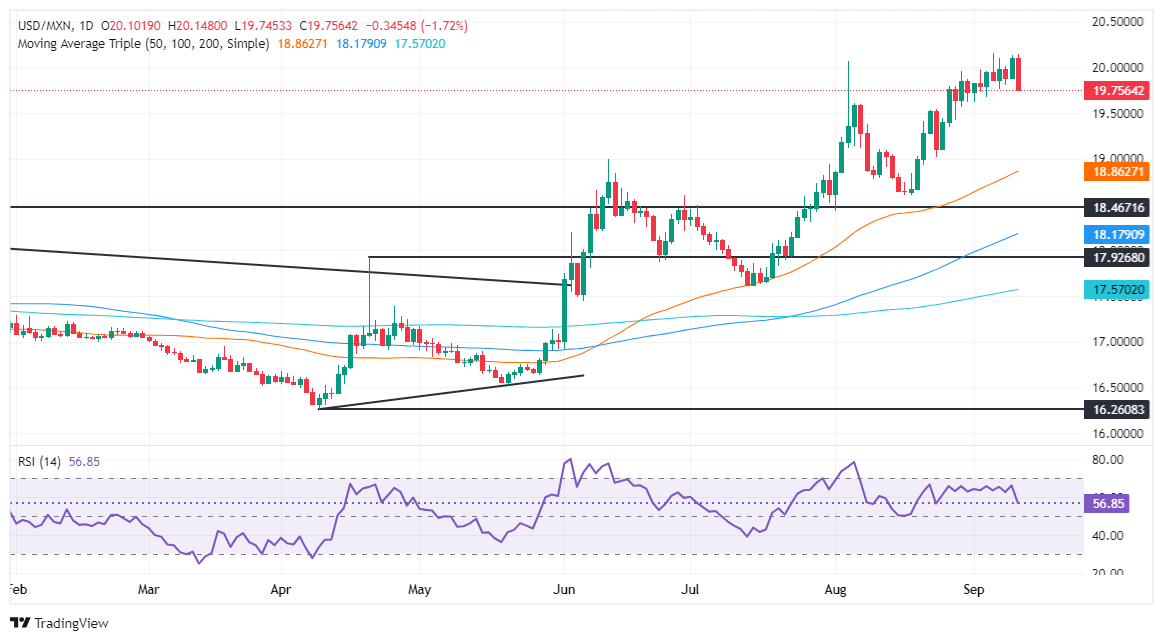
USD/MXN technical outlook: Mexican Peso soars as USD/MXN tumbles below 19.80
The USD/MXN uptrend is intact, although the pair edges lower following the approval of the judicial reform. The pair hit a new weekly low of 19.74, though some buyers entered the market after the dip to the latter.
The Relative Strength Index (RSI) is mixed as the indicator is bullish, but the slope suggests that sellers are gathering steam as the RSI aims for the 50-neutral line. Hence, in the short term, the exotic pair is tilted to the downside.
If USD/MXN stays below 20.00, the first support will be 19.50. A breach of the latter will expose the August 23 swing low of 19.02 before giving way to sellers eyeing a test of the 50-day Simple Moving Average (SMA) at 18.85.
Conversely, the USD/MXN must clear the psychological 20.00 figure for a bullish continuation. If surpassed, the next ceiling level would be the YTD high at 20.22. On further strength, the pair could challenge the daily high of September 28, 2022, at 20.57. If those two levels are surrendered, the next stop would be the swing high at 20.82 on August 2, 2022, ahead of 21.00.
Mexican Peso FAQs
The Mexican Peso (MXN) is the most traded currency among its Latin American peers. Its value is broadly determined by the performance of the Mexican economy, the country’s central bank’s policy, the amount of foreign investment in the country and even the levels of remittances sent by Mexicans who live abroad, particularly in the United States. Geopolitical trends can also move MXN: for example, the process of nearshoring – or the decision by some firms to relocate manufacturing capacity and supply chains closer to their home countries – is also seen as a catalyst for the Mexican currency as the country is considered a key manufacturing hub in the American continent. Another catalyst for MXN is Oil prices as Mexico is a key exporter of the commodity.
The main objective of Mexico’s central bank, also known as Banxico, is to maintain inflation at low and stable levels (at or close to its target of 3%, the midpoint in a tolerance band of between 2% and 4%). To this end, the bank sets an appropriate level of interest rates. When inflation is too high, Banxico will attempt to tame it by raising interest rates, making it more expensive for households and businesses to borrow money, thus cooling demand and the overall economy. Higher interest rates are generally positive for the Mexican Peso (MXN) as they lead to higher yields, making the country a more attractive place for investors. On the contrary, lower interest rates tend to weaken MXN.
Macroeconomic data releases are key to assess the state of the economy and can have an impact on the Mexican Peso (MXN) valuation. A strong Mexican economy, based on high economic growth, low unemployment and high confidence is good for MXN. Not only does it attract more foreign investment but it may encourage the Bank of Mexico (Banxico) to increase interest rates, particularly if this strength comes together with elevated inflation. However, if economic data is weak, MXN is likely to depreciate.
As an emerging-market currency, the Mexican Peso (MXN) tends to strive during risk-on periods, or when investors perceive that broader market risks are low and thus are eager to engage with investments that carry a higher risk. Conversely, MXN tends to weaken at times of market turbulence or economic uncertainty as investors tend to sell higher-risk assets and flee to the more-stable safe havens.
Author

Christian Borjon Valencia
FXStreet
Markets analyst, news editor, and trading instructor with over 14 years of experience across FX, commodities, US equity indices, and global macro markets.

















