Mexican Peso pulls back from overbought extremes ahead of Banxico meeting
- The Mexican Peso corrects back after becoming overbought ahead of Banxico meeting.
- The Banxico is likely to keep interest rates unchanged at 11%, supporting the MXN.
- The short-term trend has reversed for USD/MXN and is probably bearish now.

The Mexican Peso (MXN) comes off its highs on Tuesday, as traders take profit after a concerted period of strengthening, which has seen it reverse almost half of the post-election slide in its most traded pairs.
At the time of writing, one US Dollar (USD) buys 18.11 Mexican Pesos, EUR/MXN is trading at 19.40 and GBP/MXN at 22.96.
Mexican Peso rallies as inflation remains elevated
The Mexican Peso pulls back from overbought highs on Tuesday as traders book profits from their long positions following last week’s strong rebound.
Mexican headline inflation data on Monday came out higher-than-expected, aligning with the Bank of Mexico’s (Banxico) pledge to keep interest rates high in order to combat high inflation.
Mexico’s June mid-month Consumer Price Index (CPI) rose by 0.21% MoM, beating estimates of 0.13% and the previous month’s negative reading. On a year-over-year basis prices rose by 4.78%, unchanged from the previous reading and higher than the 4.70% estimate.
It was a different story for core prices, however, which rose by a below-estimated 0.17% MoM when analysts had expected a 0.18% increase. Although it was higher than the previous month’s 0.15%. Annual core prices rose 4.17%, which was below the consensus estimate of 4.31% and the previous month’s 4.19%.
The Peso spiked higher against the US Dollar (USD) after the release of the CPI data. The reading added to previous stronger-than-expected Retail Sales and Private Spending data, reflecting relatively resilient Mexican consumer spending despite high borrowing costs.
June’s CPI data continue to show both core and headline inflation running above Banxico's 2%-4% target and indicates the bank will probably keep interest rates at their current 11.00% at their June policy meeting on Thursday.
"Banco de Mexico meets Thursday and is expected to keep rates steady at 11.0%,” says Dr. Win Thin, Global Head of Markets Strategy at Brown Brothers Harriman (BBH) in a note on Tuesday. “At the last meeting on May 9, the bank kept rates steady after starting the easing cycle at the March 21 meeting with a 25 bp cut. Recent weakness in MXN is an upside risk to inflation and will keep the bank cautious. The swaps curve has adjusted higher since the May meeting and is pricing in only 75 bp of easing over the next 12 months vs. 125 bp at the start of May,” adds Thin.
The MXN’s post-election slide, which saw it lose over 11% in its main pairs, is likely to bring imported inflation by making imported goods more expensive, according to economists at Standard Chartered. This, in turn, will prevent the Banxico from pressing the trigger on rate cuts, supporting the Peso in the process.
“We now expect Banco de México (Banxico) to stay on hold instead of cutting by 25bps at its 27 June meeting, amid sharp currency depreciation driven by elevated political noise and fiscal uncertainty,” says the bank.
Mexican Peso fights back
Last week the Mexican Peso fought back, recovering over 5.0%, almost half of its decline after the June 2 elections. The recovery took on added momentum on Thursday June 20, after Claudia Sheinbaum’s announcement of top cabinet pics.
The market seemed to look favorably on her choice of Economy Minister in Marcelo Luis Ebrard Casaubón, the former head of Foreign Affairs under President Andres Manuel López Obrador (AMLO).
Further, the Mexican Peso remains supported by the relatively high interest rates in Mexico (11.00%) which make it one of the most attractive currencies to buy in the carry trade, according to Christian Lawrence, Senior Strategist at Rabobank.
The “carry trade” is a type of investment in which investors borrow in a currency with low interest rates, like the Japanese Yen (JPY), and buy a currency with a high interest rate like the Mexican Peso. Their profit is the difference between the interest repayments on the low-interest loan and the profit from the interest on the investment (minus currency risk).
“The main driver of MXN outperformance has been its position as the world’s most attractive carry currency and that remains true and will remain true in the coming months,” Lawrence told FXStreet.
This also makes it expensive for most traders to hold short positions in the Mexican Peso for long periods of time, explains Lawrence, reducing the chances of a long-term bearish trend evolving.
Technical Analysis: USD/MXN short-term trend reverses, RSI oversold
USD/MXN briefly slides below the 18.00 mark before becoming oversold and rebounding.
The short-term trend has now probably reversed and is going down. Given “the trend is your friend”, more weakness is expected as it extends lower.
USD/MXN 4-Hour Chart
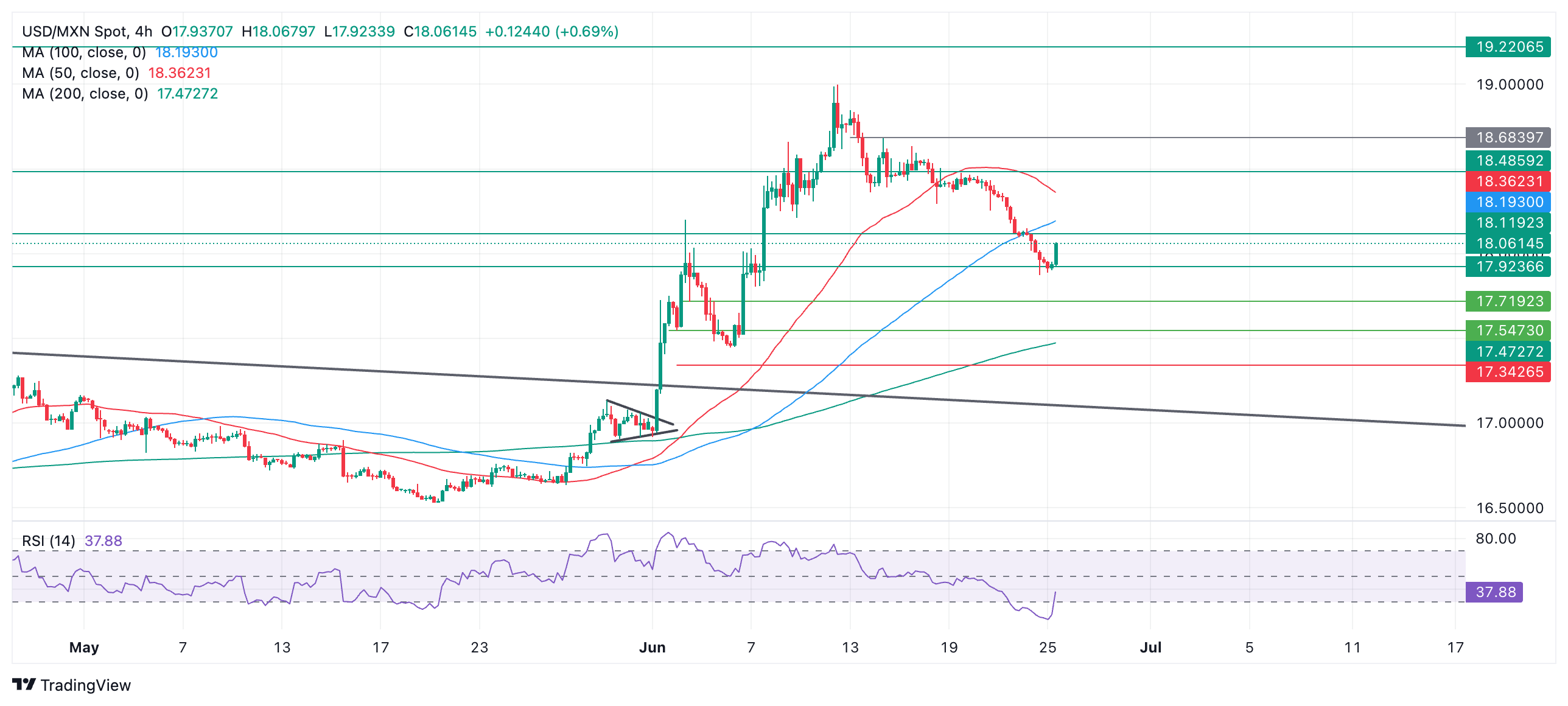
A break below 17.87 (June 24 low) would probably result in a continuation of the short-term downtrend to a target at 17.71 (a low made in the 4-hour chart on June 4), followed by 17.54 if stronger, the June 4 swing low.
The Relative Strength Index (RSI) is oversold but attempting to rise back out of the zone. If it is successful, as it is increasingly likely, it will signal a pullback higher. The 100-period Simple Moving Average in the 4-hour chart at 18.19 offers a possible peak level for the correction before it rolls over and resumes going south.
The direction of the long and intermediate-term trends remains in doubt.
Economic Indicator
Central Bank Interest Rate
The Bank of Mexico announces a key interest rate which affects the whole range of interest rates set by commercial banks, building societies and other institutions for their own savers and borrowers. Generally speaking, if the central bank is hawkish about the inflationary outlook of the economy and rises the interest rates it is positive, or bullish, for the Mexican Peso.
Read more.Next release: Thu Jun 27, 2024 19:00
Frequency: Irregular
Consensus: 11%
Previous: 11%
Source: Banxico
Author

Joaquin Monfort
FXStreet
Joaquin Monfort is a financial writer and analyst with over 10 years experience writing about financial markets and alt data. He holds a degree in Anthropology from London University and a Diploma in Technical analysis.

















