Mexican Peso landslide extends on risk aversion due to controversial reforms

Most recent article: Mexican Peso weakens further on continued political uncertainty
- Mexican Peso continues to depreciate more than 1.20% on Tuesday as investors fear judiciary reform and dissolution of autonomous bodies.
- Sheinbaum’s confirmation of “Plan C” program drives volatility with USD/MXN rallying to 18.57.
- Political uncertainty overshadows Mexico’s economic data; US CPI, Fed decision expected to extend USD/MXN rally.
The Mexican Peso freefall continued Tuesday, following virtual President-Elect Claudia Sheinbaum’s press conference on Monday, during which she reassured voters the judiciary reform is a go, raising investors' fears as the USD/MXN soared. The exotic pair trades at 17.48, posting gains of more than 1.50% after bouncing off lows of 18.19.
The USD/MXN rallied to 18.57 after Sheinbaum confirmed that she would prioritize the so-called “Plan C” program. This program seeks to push changes to the Constitution that involve judiciary reform, the dissolution of autonomous bodies, and the electoral commission, among 15 other reforms.
Joaquin Monfort, analyst at FX Street, writes, “The reform to the judiciary seeks to replace the current system, in which Supreme Court judges are appointed, with judges elected by popular vote. The policy also encompasses the heads of bar associations, law schools and some lower court judges. The reforms stem from criticisms of the current system[,] which it is argued enables corruption and cronyism.”
Meanwhile, President Andres Manuel Lopez Obrador (AMLO), at his usual morning press conference on Tuesday, emphasized that the judiciary reform is urgent and should be approved in September when the newly elected Mexican Congress takes office.
In the meantime, the release of Mexican economic data has taken a backseat amidst political uncertainty. Industrial Production in April plummeted on a monthly basis, yet annual figures expanded above the consensus.
USD/MXN traders should know that the pair will be extremely sensitive and volatile amid political uncertainty in Mexico.
On the US front, the Consumer Price Index (CPI) for May is anticipated to show persistent inflation ahead of the Federal Reserve’s (Fed) monetary policy decision. Recent US data indicates that the Fed will likely keep rates unchanged, maintaining its "higher for longer" approach.
Daily digest market movers: Mexican Peso slides sharply as AMLO’s judiciary reform could be approved in September
- Mexico’s Industrial Production in May came at -0.5% MoM, below estimates of 0.3% and March’s 0.5%. Annually, it grew 5.1%, above the consensus of 4.4% and improved compared to March’s -3.0%.
- In February 2024, AMLO put forward several proposals to the Mexican Congress. These include a Supreme Court reform that suggests electing Supreme Court ministers through popular vote; an electoral reform aimed at electing electoral commission councilors by popular vote and reducing multi-member representation; and a reform of autonomous bodies that proposes dissolving the transparency body.
- Mexican Peso depreciation could weigh on the Bank of Mexico's (Banxico) decision to ease policy, even though last month’s core inflation slowed. Therefore, keeping interest rates higher could prompt deceleration in the economy and increase the odds of a recession.
- Morgan Stanley noted that if Mexico’s upcoming government and Congress adopted an unorthodox agenda, it would undermine Mexican institutions and be bearish for the Mexican Peso, which could weaken to 19.20.
- Last week’s US economic data decreased the odds for a Fed rate cut in September, according to the CME FedWatch Tool, from above 50% to 46.7%.
- December’s 2024 fed funds futures contract hints that investors expect 28 basis points of rate cuts by the Fed through the end of the year.
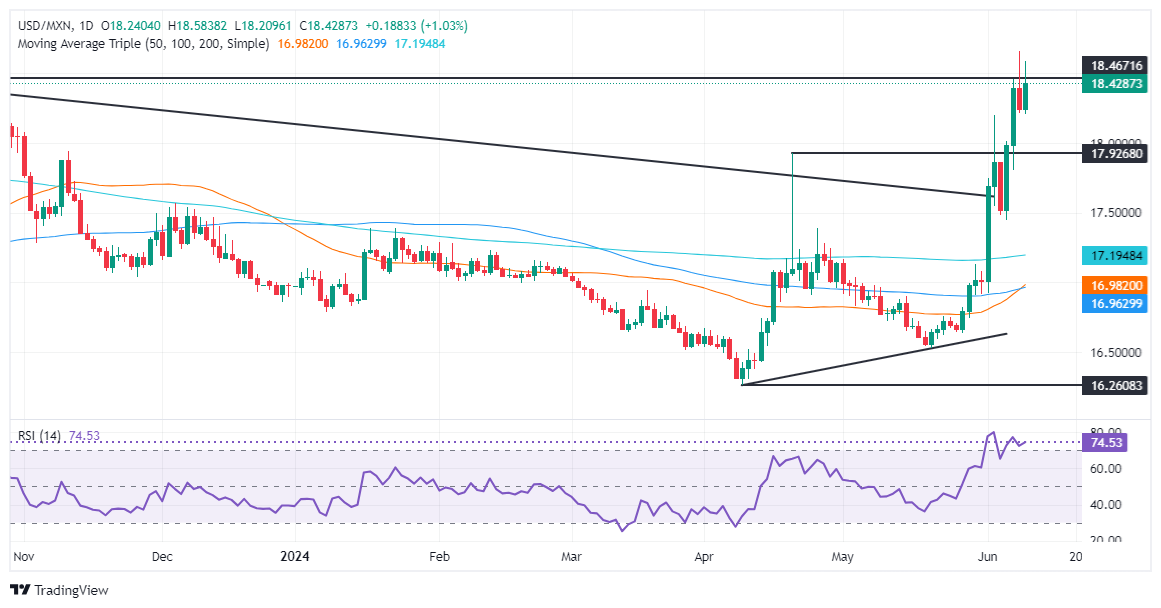
Technical analysis: Mexican Peso slumps sharply with USD/MXN buyers eyeing 19.00
The USD/MXN remains bullishly biased even though the rally stalled after hitting a multi-month high of 18.65, which sponsored a leg down toward the current exchange rate. Last week, I wrote that “a fifth daily close above a four-year-old downslope resistance trendline drawn from all-time highs (ATH) at around $25.77.” So far, price action suggests the exotic pair would continue to trend higher amid political uncertainty.
The USD/MXN's next resistance would be the October 6 high of 18.48, followed by the day’s high of 18.57. Once surpassed, the next ceiling level would be the psychological 19.00 figure. Overhead resistance levels lie ahead, with the March 20, 2023, high of 19.23 up next ahead of the psychological 20.00 mark.
On the other hand, sellers need to push the USD/MXN back below the April 19 high of 18.15 if they want to keep the pair within the 18.00-18.15 trading range.
Mexican Peso FAQs
The Mexican Peso (MXN) is the most traded currency among its Latin American peers. Its value is broadly determined by the performance of the Mexican economy, the country’s central bank’s policy, the amount of foreign investment in the country and even the levels of remittances sent by Mexicans who live abroad, particularly in the United States. Geopolitical trends can also move MXN: for example, the process of nearshoring – or the decision by some firms to relocate manufacturing capacity and supply chains closer to their home countries – is also seen as a catalyst for the Mexican currency as the country is considered a key manufacturing hub in the American continent. Another catalyst for MXN is Oil prices as Mexico is a key exporter of the commodity.
The main objective of Mexico’s central bank, also known as Banxico, is to maintain inflation at low and stable levels (at or close to its target of 3%, the midpoint in a tolerance band of between 2% and 4%). To this end, the bank sets an appropriate level of interest rates. When inflation is too high, Banxico will attempt to tame it by raising interest rates, making it more expensive for households and businesses to borrow money, thus cooling demand and the overall economy. Higher interest rates are generally positive for the Mexican Peso (MXN) as they lead to higher yields, making the country a more attractive place for investors. On the contrary, lower interest rates tend to weaken MXN.
Macroeconomic data releases are key to assess the state of the economy and can have an impact on the Mexican Peso (MXN) valuation. A strong Mexican economy, based on high economic growth, low unemployment and high confidence is good for MXN. Not only does it attract more foreign investment but it may encourage the Bank of Mexico (Banxico) to increase interest rates, particularly if this strength comes together with elevated inflation. However, if economic data is weak, MXN is likely to depreciate.
As an emerging-market currency, the Mexican Peso (MXN) tends to strive during risk-on periods, or when investors perceive that broader market risks are low and thus are eager to engage with investments that carry a higher risk. Conversely, MXN tends to weaken at times of market turbulence or economic uncertainty as investors tend to sell higher-risk assets and flee to the more-stable safe havens.
Author

Christian Borjon Valencia
FXStreet
Markets analyst, news editor, and trading instructor with over 14 years of experience across FX, commodities, US equity indices, and global macro markets.