Mexican Peso nosedives on Morena’s leader remarks, uncertain outlook

Most recent article: Mexican Peso weakens on investor fears over new administration
- Mexican Peso falls sharply against US Dollar, hit a daily high at 18.00.
- Mier's remarks about the September vote on President AMLO’s proposals raise investor fears, driving Peso depreciation.
- Key reforms include changes to the Supreme Court and electoral system, and the dissolution of autonomous bodies, including INAI.
The Mexican Peso depreciated sharply against the US Dollar on Thursday following remarks by Ignacio Mier, Morena’s leader in the Mexican Congress. Mier commented that they will submit for discussion and vote in September reforms presented by President Andres Manuel Lopez Obrador (AMLO) last February. Consequently, investors punished the Mexican currency, and the USD/MXN rallied to a new two-day high of 18.00.
Three days ago, Mexican Finance Minister Rogelio Ramirez de la O capped the Peso’s fall by reassuring investors that the upcoming government would be fiscally disciplined and respect the autonomy of the Bank of Mexico (Banxico).
Nevertheless, traders are turning nervous after Ignacio Mier’s remarks, in which he reassures them they would submit the proposals to the newly established congress in September.
The eighteen proposals include a reform of the Supreme Court, which proposes that the Supreme Court's ministers be elected by popular vote; electoral reform, which seeks to have INE councilors elected by popular vote and reduce multi-membership; and reform of autonomous bodies, which entails the dissolution of INAI, the transparency body.
Data-wise, Mexican Auto Exports increased in May but less than in April, signaling the economy is feeling the impact of higher borrowing costs set by Banxico.
According to a Reuters survey, analysts in Mexico expect an increase in headline inflation in May. The median estimates inflation would hit 4.82%, climbing for the third straight month. However, underlying inflation is foreseen settling at 4.29%, its lowest level since April 2021.
Across the border, the US economic docket revealed that the number of Americans filing for unemployment benefits rose above estimates as traders braced for the latest employment report on Friday.
Daily digest market movers: Mexican Peso tumbles on Morena's leader remarks
- Auto Exports in Mexico increased but trailed April’s 14.4% print, jumping by 13% YoY. Auto Production growth slowed from 21.7% to 4.9% YoY for the same periods.
- Fears that Morena’s majority could push bills that include reducing the number of lawmakers and plans for electing Supreme Court members were the cause behind Mexican Peso’s Black Monday.
- Morgan Stanley noted that if Mexico’s upcoming government and Congress adopted an unorthodox agenda, it would undermine Mexican institutions and be bearish for the Mexican Peso, which could weaken to 19.20.
- Speculation of another Banxico rate cut in June could pave the way for further upside in the USD/MXN.
- The US Bureau of Labor Statistics (BLS) revealed that Initial Jobless Claims for the week ending June 1 were higher than the expected 220K, increasing by 229K above the prior week’s data.
- On Friday, the BLS would feature May’s Nonfarm Payrolls report, which is expected to show the economy added 185K people to the workforce, above the prior month’s 175K.
- The futures market suggests the US Federal Reserve might cut rates by 38 basis points in 2024, according to the December 2024 fed funds future rate contract.
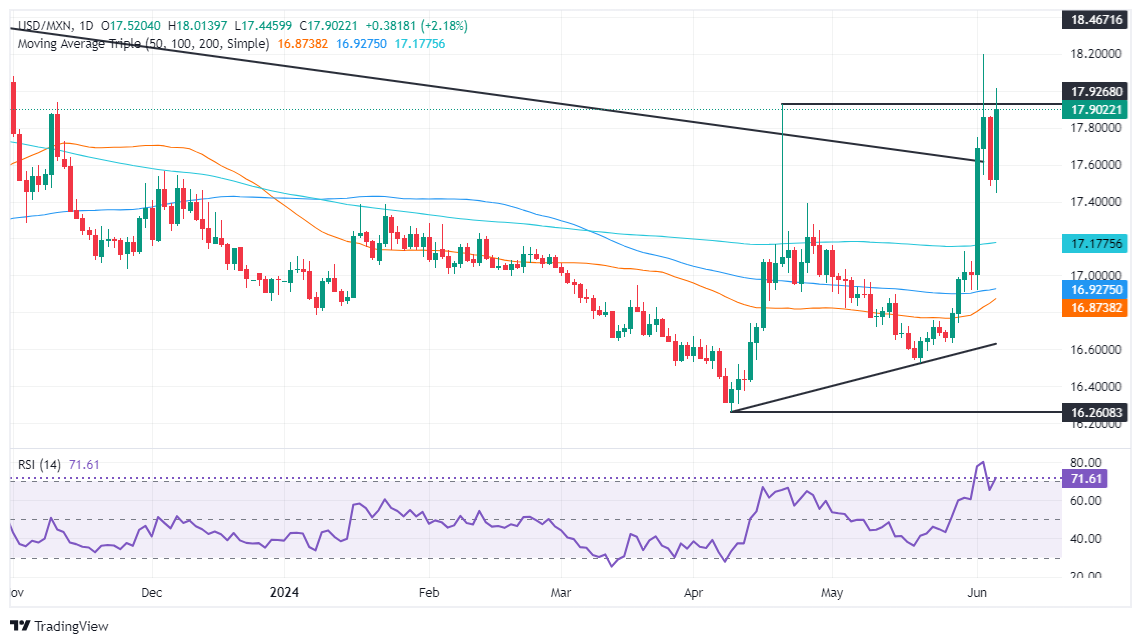
Technical analysis: Mexican Peso plunges as USD/MXN climbs past 17.80
The USD/MXN shifted to a neutral-upward bias, but it could consolidate at around the 17.50 – 18.19 range in the short term. The momentum has changed in favor of US Dollar bulls, as depicted by the Relative Strength Index (RSI) and also by buyers lifting the spot price above the 200-day Simple Moving Average (SMA) of 17.60.
That said, the USD/MXN’s first resistance level would be the June 3 high at 17.74, followed by the 18.00 psychological level. Once surpassed, the next stop would be the year-to-date high of 18.19.
On further weakness, the next support would be the 200-day SMA at 17.16, followed by the 17.00 figure, ahead of the 100-day SMA at 16.91. Once cleared, the 50-day SMA at 16.84 would be next.
Mexican Peso FAQs
The Mexican Peso (MXN) is the most traded currency among its Latin American peers. Its value is broadly determined by the performance of the Mexican economy, the country’s central bank’s policy, the amount of foreign investment in the country and even the levels of remittances sent by Mexicans who live abroad, particularly in the United States. Geopolitical trends can also move MXN: for example, the process of nearshoring – or the decision by some firms to relocate manufacturing capacity and supply chains closer to their home countries – is also seen as a catalyst for the Mexican currency as the country is considered a key manufacturing hub in the American continent. Another catalyst for MXN is Oil prices as Mexico is a key exporter of the commodity.
The main objective of Mexico’s central bank, also known as Banxico, is to maintain inflation at low and stable levels (at or close to its target of 3%, the midpoint in a tolerance band of between 2% and 4%). To this end, the bank sets an appropriate level of interest rates. When inflation is too high, Banxico will attempt to tame it by raising interest rates, making it more expensive for households and businesses to borrow money, thus cooling demand and the overall economy. Higher interest rates are generally positive for the Mexican Peso (MXN) as they lead to higher yields, making the country a more attractive place for investors. On the contrary, lower interest rates tend to weaken MXN.
Macroeconomic data releases are key to assess the state of the economy and can have an impact on the Mexican Peso (MXN) valuation. A strong Mexican economy, based on high economic growth, low unemployment and high confidence is good for MXN. Not only does it attract more foreign investment but it may encourage the Bank of Mexico (Banxico) to increase interest rates, particularly if this strength comes together with elevated inflation. However, if economic data is weak, MXN is likely to depreciate.
As an emerging-market currency, the Mexican Peso (MXN) tends to strive during risk-on periods, or when investors perceive that broader market risks are low and thus are eager to engage with investments that carry a higher risk. Conversely, MXN tends to weaken at times of market turbulence or economic uncertainty as investors tend to sell higher-risk assets and flee to the more-stable safe havens.
Author
Christian Borjon Valencia
FXStreet
Markets analyst, news editor, and trading instructor with over 14 years of experience across FX, commodities, US equity indices, and global macro markets.