Mexican Peso stands firm against US Dollar despite mixed production data

Most recent article: Mexican depreciates against US Dollar, amid higher geopolitical concerns, Fed chatter
- Mexican Peso trims some weekly losses as USD/MXN stays virtually unchanged.
- Mexico's Industrial Production contracts, underscoring economic challenges, while US producer prices suggest softening inflation.
- Fed officials' comments on inflation and monetary policy decisions reflect a cautious optimism.
The Mexican Peso depreciated modestly against the US Dollar for the third straight trading session on Thursday, following a red-hot consumer inflation report on Wednesday. Further economic data from Mexico and the United States (US) keeps the exotic pair within familiar levels, though the downtrend remains intact. The USD/MXN trades at 16.43, virtually unchanged.
Mexico’s economic docket featured the release of Industrial Production for February. The monthly reading missed estimates and contracted. On a yearly basis, data expanded below estimates but surpassed January’s reading.
Across the border, the release of prices paid by producers showed that inflation cooled a little but remains stickier than expected on the annual core reading. Monthly readings showed that the disinflation process continues to show success.
In the meantime, Federal Reserve (Fed) officials crossed newswires. The New York Fed’s Williams and Richmond Fed’s Barkin mentioned that recent data was disappointing, while the Boston Fed’s Collins added that recent data argues against the imminent need to change rates.
Daily digest market movers: Mexican Peso shrugs off hot US inflation data
- Mexico’s Industrial Production edged lower in February from the previous month and shrank -0.1% MoM, below estimates of 0.3% expansion. On a yearly basis, Industrial Production rose by 3.3% compared to the last reading, but forecasts were missed by 3.5%.
- This data, combined with the recent inflation report, which is below estimates, justified the Bank of Mexico's (Banxico) March rate cut. However, not everything was positive news as the yearly CPI exceeded expectations.
- The US Producer Price Index (PPI) rose by 0.2% MoM in March, below the previous month’s reading. The core PPI clocked the same reading of 0.2% MoM, which is below estimates and February’s reading.
- For the twelve months to March, the PPI increased by 2.1%, exceeding February’s data. The core PPI printed above estimates, and the previous reading, at 2.4%, which was above estimates of 2.3% and February’s 2.1%.
- Initial Jobless Claims for the week ending April 6 arrived at 211K, below estimates of 215K and the prior’s reading of 222K.
- Thursday’s data, along with Wednesday’s US inflation report, prompted traders to price in two rate cuts by the Federal Reserve in 2024, according to the Chicago Board of Trade (CBOT). The December 2024 fed funds futures contract depicts it ending the year at 4.975%.
- Federal Reserve officials led by New York President John Williams and Richmond’s Thomas Barkin expressed their disappointment with recent inflation data. Both expressed there’s no need to change policy, given the actual scenario of stickier inflation and robust economic growth.
Technical analysis: Mexican Peso opposes resistance, caps the USD/MXN advance below 16.50
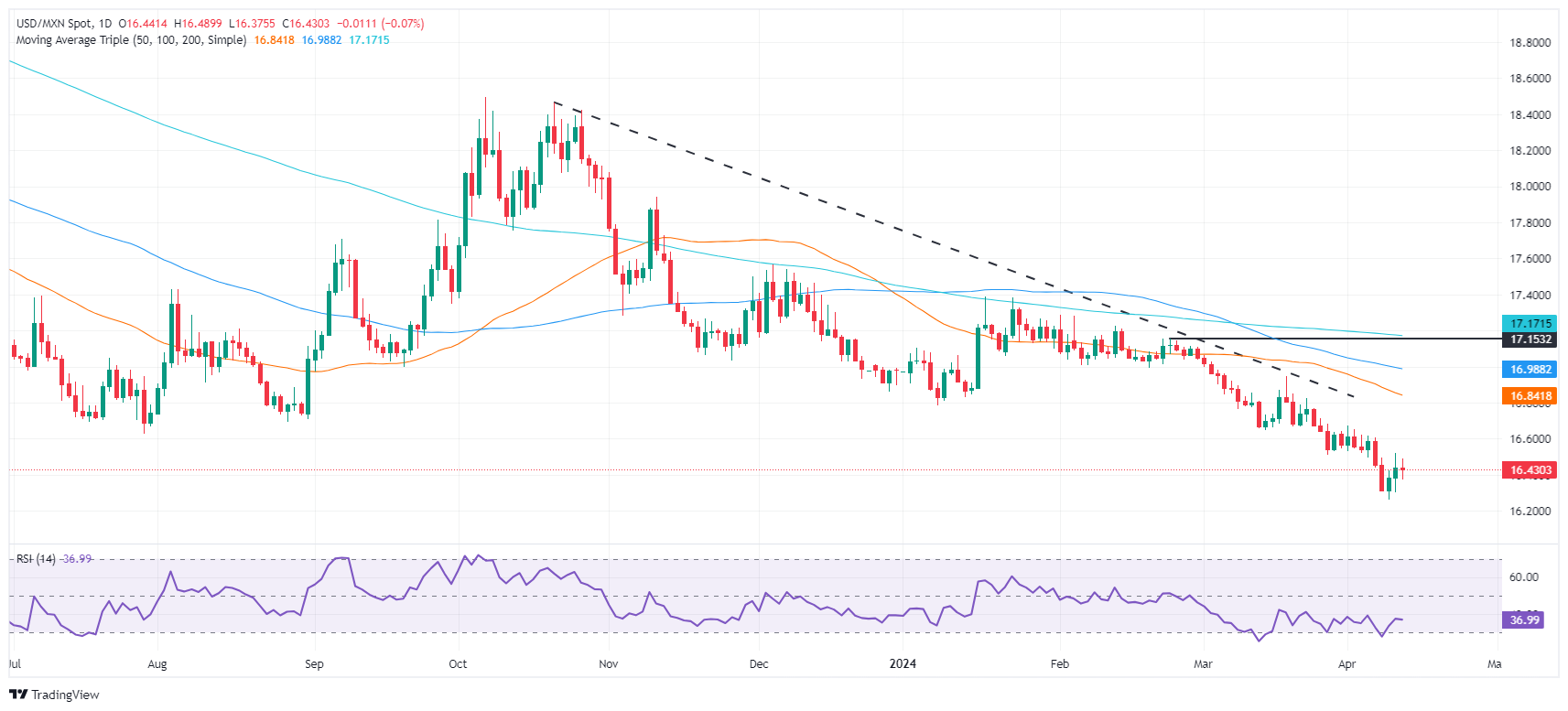
The USD/MXN daily chart depicts the pair consolidating near 16.40, with buyers still unable to crack the current week’s high achieved on Wednesday at 16.52. Once that area is breached, the next supply zone to challenge would be the 16.62 mark, followed by the 50-day Simple Moving Average (SMA) at 16.85 and the 100-day SMA at 16.99.
Failure at 16.50 and the USD/MXN could tumble to October’s 2015 low of 16.32 before retesting the year-to-date (YTD) low of 16.25.
Mexican Peso FAQs
The Mexican Peso (MXN) is the most traded currency among its Latin American peers. Its value is broadly determined by the performance of the Mexican economy, the country’s central bank’s policy, the amount of foreign investment in the country and even the levels of remittances sent by Mexicans who live abroad, particularly in the United States. Geopolitical trends can also move MXN: for example, the process of nearshoring – or the decision by some firms to relocate manufacturing capacity and supply chains closer to their home countries – is also seen as a catalyst for the Mexican currency as the country is considered a key manufacturing hub in the American continent. Another catalyst for MXN is Oil prices as Mexico is a key exporter of the commodity.
The main objective of Mexico’s central bank, also known as Banxico, is to maintain inflation at low and stable levels (at or close to its target of 3%, the midpoint in a tolerance band of between 2% and 4%). To this end, the bank sets an appropriate level of interest rates. When inflation is too high, Banxico will attempt to tame it by raising interest rates, making it more expensive for households and businesses to borrow money, thus cooling demand and the overall economy. Higher interest rates are generally positive for the Mexican Peso (MXN) as they lead to higher yields, making the country a more attractive place for investors. On the contrary, lower interest rates tend to weaken MXN.
Macroeconomic data releases are key to assess the state of the economy and can have an impact on the Mexican Peso (MXN) valuation. A strong Mexican economy, based on high economic growth, low unemployment and high confidence is good for MXN. Not only does it attract more foreign investment but it may encourage the Bank of Mexico (Banxico) to increase interest rates, particularly if this strength comes together with elevated inflation. However, if economic data is weak, MXN is likely to depreciate.
As an emerging-market currency, the Mexican Peso (MXN) tends to strive during risk-on periods, or when investors perceive that broader market risks are low and thus are eager to engage with investments that carry a higher risk. Conversely, MXN tends to weaken at times of market turbulence or economic uncertainty as investors tend to sell higher-risk assets and flee to the more-stable safe havens.
Author

Christian Borjon Valencia
FXStreet
Markets analyst, news editor, and trading instructor with over 14 years of experience across FX, commodities, US equity indices, and global macro markets.