Mexican Peso plummets over 1% daily and almost 4% weekly
- Mexican Peso weakens to a yearly low of 19.22 against the USD amid US economic worries.
- Mixed Mexican data: higher unemployment rate, solid but slowing Gross Fixed Investment.
- US Nonfarm Payrolls and Manufacturing PMI disappoint, heightening recession fears.

The Mexican Peso weakened further throughout the week against the Greenback and hit a new yearly low of 19.22, as fears that the United States (US) economy might slow down further hurt the outlook of its largest partner, Mexico. As market participants shifted risk-averse, the USD/MXN traded above 19.00 and gained over 1% in the day and close to 4% in the week.
Data from Mexico was mixed as the unemployment rate ticked higher by two-tenths, while Gross Fixed Investment remained solid in May, yet trailed April’s double-digit figures. Even though this could’ve boosted the Peso, market players were aware of the release of July’s US employment report.
The US Nonfarm Payrolls (NFP) plunged below estimates and trailed June’s data, while the Unemployment Rate edged up and Average Hourly Earnings dipped. Today’s data, along with Thursday’s dismal Manufacturing PMI figures revealed by the Institute for Supply Management (ISM), reignited recession worries.
Following the data, traders ditched risk-sensitive assets in the FX space, which hurt the Peso's emerging market status. Besides that, market participants expect the Federal Reserve (Fed) to cut rates for the first time at the upcoming September meeting, and even some Wall Street banks consider 50 basis points (bps) of easing.
Recently, some Fed officials had crossed the wires. Richmond’s Fed President Thomas Barkin disregarded a 50 bps cut, saying the Fed considers this “with an economy that feels like it’s deteriorating rapidly.” At the same time, Chicago’s Fed Austan Goolsbee stated, “They’d never want to overreact to one month’s data.”
Daily digest market movers: Mexican Peso extends its weekly losing streak to three
- Mexico’s Unemployment Rate in June was 2.8% MoM, exceeding estimates and May’s 2.6% reading. Further data showed that Gross Fixed Investment in May dropped from 0.8% to 0.7% MoM.
- Mexico’s S&P Global Manufacturing PMI for July contracted to 49.60, below June’s 51.10 expansion, underscoring the economy’s undergoing a slowdown.
- Given the backdrop, Mexico’s economy is beginning to weaken further, which could be the reason the Bank of Mexico (Banxico) needs to cut rates.
- The US Department of Labor revealed that NFPs came at 114K in July, missing estimates of 175K, with previous figures downwardly revised from 206K to 179K. Additional data showed the Unemployment Rate increased from 4.1% to 4.3%, and Average Hourly Earnings dipped from 0.3% to 0.2%.
- The Fed decided to hold rates unchanged yet commented that goodish inflation data and further weakening in the labor market could trigger action.
- Following the data release, most banks anticipate more aggressive monetary policy easing by the Fed. Bank of America now expects the first rate cut in September instead of December, while Citi and JP Morgan project the Fed will lower rates by 50 bps in September and November.
- Data from the Chicago Board of Trade (CBOT) shows that the December 2024 fed funds rates futures contract suggests that policymakers will ease policy at least 117 basis points.
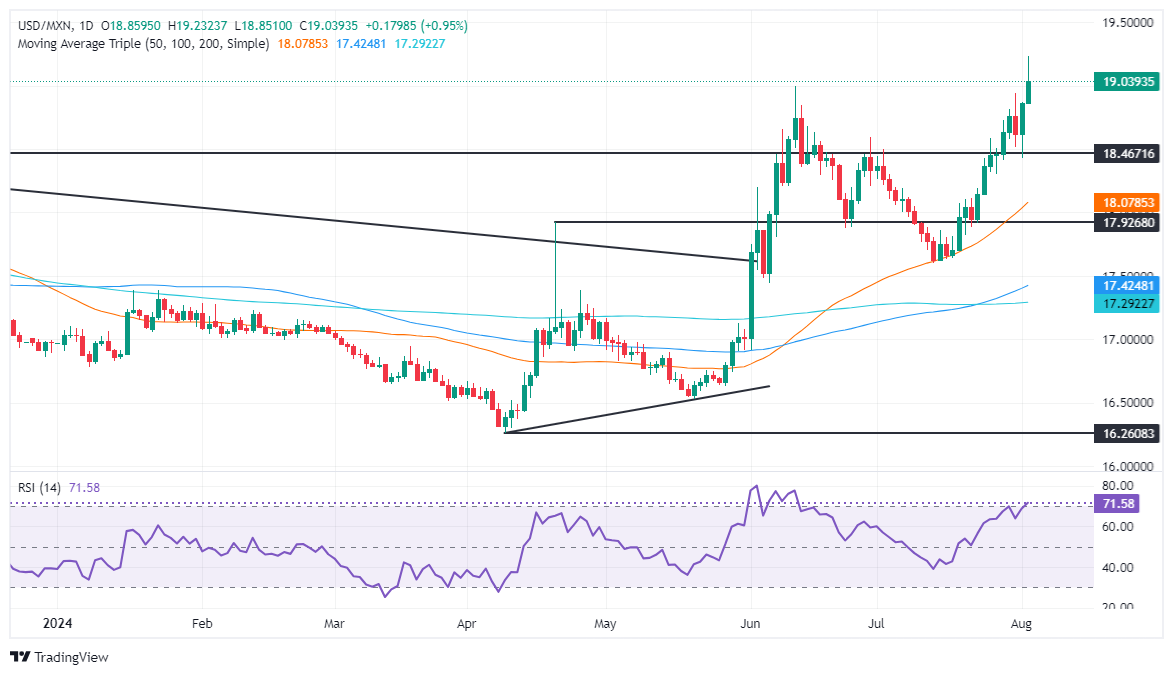
Technical analysis: Mexican Peso depreciates sharply as USD/MXN rises above 19.00
The USD/MXN rallied sharply above the 19.00 psychological level and hit a new year-to-date (YTD) high of 19.22 before retreating to the figure. The Relative Strength Index (RSI) shows momentum favors buyers, as the RSI stands in overbought territory. But due to the strength of the uptrend, the most extreme reading will be 80.
If USD/MXN extends its gains past the YTD high, up next would be the 19.50 area. Once cleared, the next stop would be the 20.00 mark.
Conversely, a drop below the August 1 low of 18.42 could sponsor a dip toward the 50-day Simple Moving Average (SMA) at 17.99. In further weakness, the exotic pair could challenge the 17.50 mark.
Mexican Peso FAQs
The Mexican Peso (MXN) is the most traded currency among its Latin American peers. Its value is broadly determined by the performance of the Mexican economy, the country’s central bank’s policy, the amount of foreign investment in the country and even the levels of remittances sent by Mexicans who live abroad, particularly in the United States. Geopolitical trends can also move MXN: for example, the process of nearshoring – or the decision by some firms to relocate manufacturing capacity and supply chains closer to their home countries – is also seen as a catalyst for the Mexican currency as the country is considered a key manufacturing hub in the American continent. Another catalyst for MXN is Oil prices as Mexico is a key exporter of the commodity.
The main objective of Mexico’s central bank, also known as Banxico, is to maintain inflation at low and stable levels (at or close to its target of 3%, the midpoint in a tolerance band of between 2% and 4%). To this end, the bank sets an appropriate level of interest rates. When inflation is too high, Banxico will attempt to tame it by raising interest rates, making it more expensive for households and businesses to borrow money, thus cooling demand and the overall economy. Higher interest rates are generally positive for the Mexican Peso (MXN) as they lead to higher yields, making the country a more attractive place for investors. On the contrary, lower interest rates tend to weaken MXN.
Macroeconomic data releases are key to assess the state of the economy and can have an impact on the Mexican Peso (MXN) valuation. A strong Mexican economy, based on high economic growth, low unemployment and high confidence is good for MXN. Not only does it attract more foreign investment but it may encourage the Bank of Mexico (Banxico) to increase interest rates, particularly if this strength comes together with elevated inflation. However, if economic data is weak, MXN is likely to depreciate.
As an emerging-market currency, the Mexican Peso (MXN) tends to strive during risk-on periods, or when investors perceive that broader market risks are low and thus are eager to engage with investments that carry a higher risk. Conversely, MXN tends to weaken at times of market turbulence or economic uncertainty as investors tend to sell higher-risk assets and flee to the more-stable safe havens.
Author

Christian Borjon Valencia
FXStreet
Markets analyst, news editor, and trading instructor with over 14 years of experience across FX, commodities, US equity indices, and global macro markets.