Mexican Peso continues weakening after landslide victory for left
- The Mexican Peso continues to fall after plummeting over 4% in key pairs on Monday.
- The possibility of the left-leaning Morena party winning a supermajority sparks fears among investors.
- USD/MXN breaks above a key long-term trendline, transforming the technical picture for the pair.

The Mexican Peso (MXN) is resuming its downtrend on Tuesday following an over 4% decline in its key pairs on Monday. The Peso went into freefall after early indications showed President-elect Claudia Sheinbaum and her Morena party were heading for a landslide victory in the Mexican presidential and congressional elections held on Sunday.
USD/MXN is exchanging hands at 17.79 at the time of writing, EUR/MXN is trading at 19.34 and GBP/MXN at 22.73.
Mexican Peso weakens on fears of a Morena party supermajority
The Mexican Peso plummeted on Monday after a quick count by the National Electoral Institute showed Claudia Sheinbaum leading with at least 59% of the vote in the presidential elections, and her Morena party poised to possibly clinch super majorities in both houses of the Mexican legislature, according to Aljazeera News. The official results will be published after the votes are counted between June 5-8.
The Mexican Peso weakened significantly after investors became nervous Sheinbaum’s Morena party could win super majorities – defined as a majority of two thirds – in both the Congress and the Senate. This would enable them to enact proposed reforms to the Mexican constitution, such as the election of the judiciary by popular vote and the preferential treatment of state-owned energy companies over private corporations. Critics argue such changes could be anti-democratic and market unfriendly.
According to estimates by Bloomberg Economics, Morena will probably win a super majority in Congress but fall four-seats short of one in the Senate.
“Although that doesn’t immediately allow Sheinbaum to make changes to the constitution that have eluded [current President] Andres Manuel Lopez Obrador, it leaves her in the position to negotiate with just a few senators to pass key reforms,” said Bloomberg News’ Economy and Government reporter Alex Vasquez.
Yet not all of Sheinbaum’s policies will necessarily hurt the Mexican Peso. Her pledge to increase the minimum wage by around 11%, better welfare benefits and government-led investment could increase consumer spending and economic growth, forcing the Banco de México (Banxico) to maintain high interest rates, according to Kimberley Sperrfechter, Emerging Markets Economist at Capital Economics.
Since relatively high interest rates attract more foreign capital inflows, the Peso could remain well-supported despite investor fears.
Technical Analysis: USD/MXN breaks decisively above major trendline
USD/MXN – or the number of Pesos that can be bought with one US Dollar – breaks above a long-term trendline, marking a major shift in the outlook for the pair and probably reversing the intermediate-term downtrend to an uptrend.
With both the short and intermediate trends bullish, the odds favor more upside over those time frames (up to six months).
USD/MXN 4-hour Chart
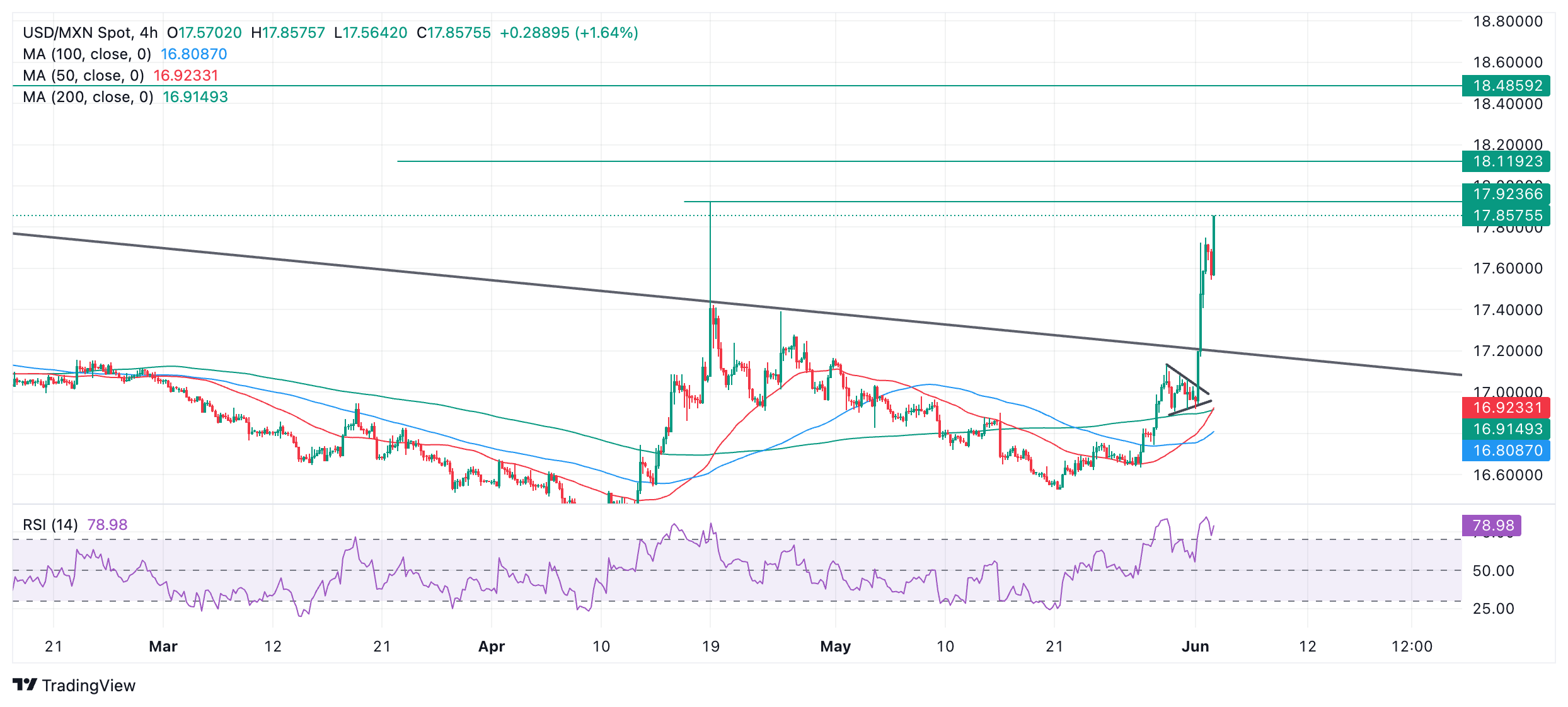
Further upside could see USD/MXN reach the April highs at around 17.92, followed by resistance at 18.12 (100-week Simple Moving Average) and then 18.49 (October 2023 high).
The long-term trend is probably still bearish, however, suggesting a risk of a reversal lower if the uptrend runs out of steam. There are no signs of that happening yet from price action, however, which remains resolutely bullish.
Banxico FAQs
The Bank of Mexico, also known as Banxico, is the country’s central bank. Its mission is to preserve the value of Mexico’s currency, the Mexican Peso (MXN), and to set the monetary policy. To this end, its main objective is to maintain low and stable inflation within target levels – at or close to its target of 3%, the midpoint in a tolerance band of between 2% and 4%.
The main tool of the Banxico to guide monetary policy is by setting interest rates. When inflation is above target, the bank will attempt to tame it by raising rates, making it more expensive for households and businesses to borrow money and thus cooling the economy. Higher interest rates are generally positive for the Mexican Peso (MXN) as they lead to higher yields, making the country a more attractive place for investors. On the contrary, lower interest rates tend to weaken MXN. The rate differential with the USD, or how the Banxico is expected to set interest rates compared with the US Federal Reserve (Fed), is a key factor.
Banxico meets eight times a year, and its monetary policy is greatly influenced by decisions of the US Federal Reserve (Fed). Therefore, the central bank’s decision-making committee usually gathers a week after the Fed. In doing so, Banxico reacts and sometimes anticipates monetary policy measures set by the Federal Reserve. For example, after the Covid-19 pandemic, before the Fed raised rates, Banxico did it first in an attempt to diminish the chances of a substantial depreciation of the Mexican Peso (MXN) and to prevent capital outflows that could destabilize the country.
Author

Joaquin Monfort
FXStreet
Joaquin Monfort is a financial writer and analyst with over 10 years experience writing about financial markets and alt data. He holds a degree in Anthropology from London University and a Diploma in Technical analysis.

















