Mexican Peso struggling to reverse Thursday's losses on the last trading day of 2023
Most recent article: Mexican Peso falls back to kick off the new trading year
- The Mexican Peso is rebounding from Thursday’s US session backslide.
- Mexico's government budget balance to wrap up economic calendar for 2023.
- US data continues to print in the red, US Chicago PMI misses the mark.
The Mexican Peso (MXN) is back on the rise for the last trading day of 2023, recovering modestly after a late-day topside break in the US Dollar on Thursday sparked by a broad-market pause in risk appetite after US Treasury yields briefly spiked. A late-Friday reversal pulled the US Dollar (USD) back into the high side just ahead of the year's closing bell, but the USD still remains firmly embedded in bear country.
Market risk sentiment recovered on Friday, dragging the MXN back into familiar levels to wrap up the 2023 trading year. After Friday’s MXN Fiscal Balance, economic data from Mexico will be on pause until Mexico's Consumer Confidence figures print on January 8.
US economic calendar figures broadly missed the mark on Thursday, and the trend continued into Friday after the US Chicago Purchasing Managers’ Index (PMI) declined in December, slipping back from an 18-month high in November as a global economic slowdown continues to loom ahead.
Daily digest market movers: Mexican Peso squeezing back into the top end to wrap up the year
- The Mexican Peso is recovering from Thursday’s backslide, sticking close to the high side against the US Dollar as broad market sentiment holds steady.
- US data continues to miss the mark, but investors continue to focus solely on whatever will kickstart a rate-cutting cycle.
- The US Chicago Purchasing Managers’ Index (PMI) declined to 46.9 in December, falling back from November’s 18-month high of 55.8 and passing straight through the median forecast of 51.0.
- Softening economic conditions in the US continue to bolster market hopes of an accelerated pace of rate cuts from the US Federal Reserve (Fed) as investors bet that what’s bad for the goose is good for the gander.
- Mexico’s Fiscal Balance in Peso terms will round out the year’s economic calendar for the MXN.
- The Mexican government’s budget update last showed a MXN 29.58 billion deficit.
US Dollar price this week
The table below shows the percentage change of US Dollar (USD) against listed major currencies this week. US Dollar was the weakest against the Swiss Franc.
| USD | EUR | GBP | CAD | AUD | JPY | NZD | CHF | |
| USD | -0.23% | -0.29% | -0.28% | -0.30% | -1.05% | -0.43% | -1.80% | |
| EUR | 0.32% | -0.03% | 0.06% | -0.02% | -0.79% | -0.09% | -1.48% | |
| GBP | 0.40% | -0.04% | 0.26% | -0.02% | -0.79% | 0.03% | -1.65% | |
| CAD | 0.28% | -0.25% | -0.05% | -0.28% | -0.75% | 0.04% | -1.66% | |
| AUD | 0.30% | 0.02% | 0.01% | 0.02% | -0.77% | -0.07% | -1.66% | |
| JPY | 1.04% | 0.83% | 0.58% | 1.04% | 0.80% | 0.80% | -0.90% | |
| NZD | 0.40% | 0.13% | 0.15% | 0.12% | 0.07% | -0.70% | -1.32% | |
| CHF | 1.95% | 1.44% | 1.33% | 1.64% | 1.69% | 0.90% | 1.40% |
The heat map shows percentage changes of major currencies against each other. The base currency is picked from the left column, while the quote currency is picked from the top row. For example, if you pick the Euro from the left column and move along the horizontal line to the Japanese Yen, the percentage change displayed in the box will represent EUR (base)/JPY (quote).
Technical Analysis: Mexican Peso looking to recover into recent highs as the year draws to a close
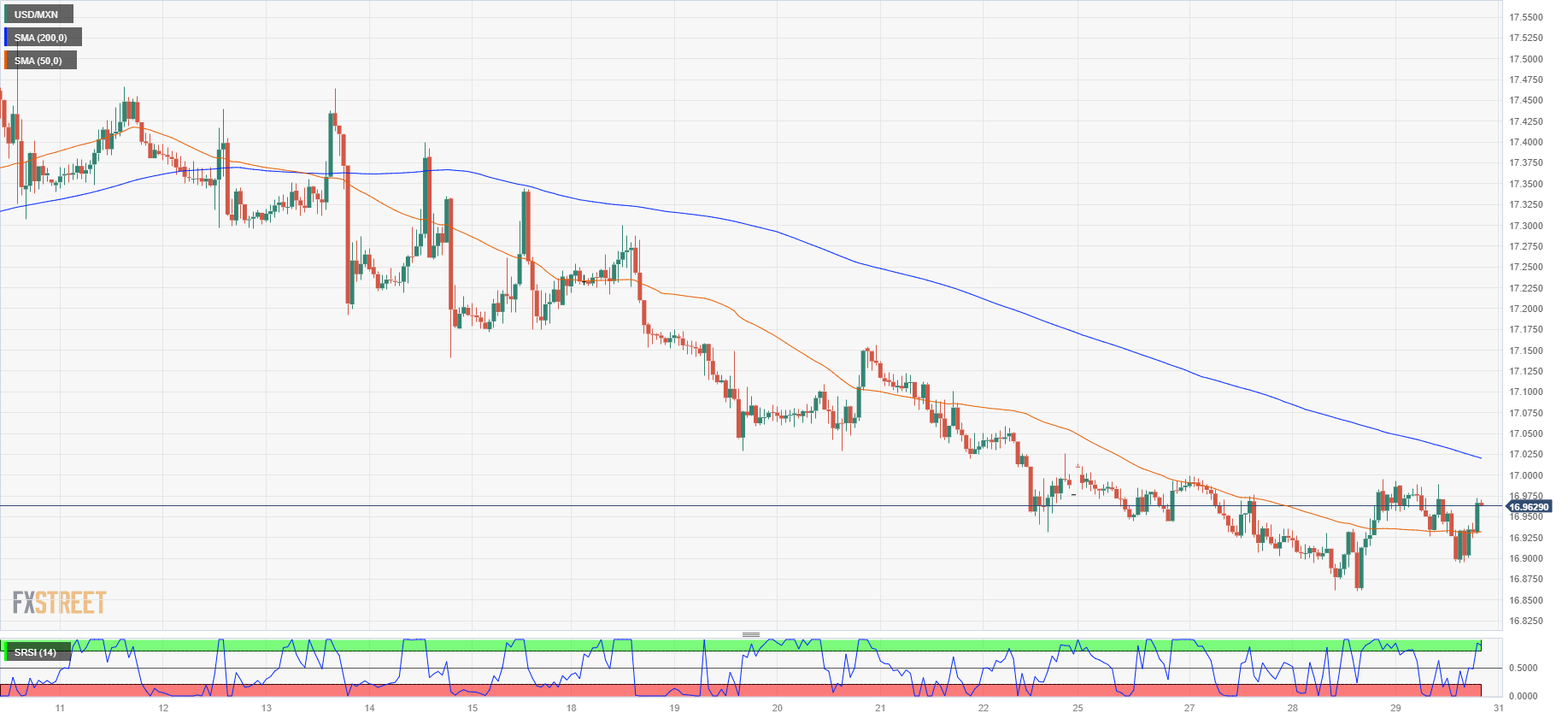
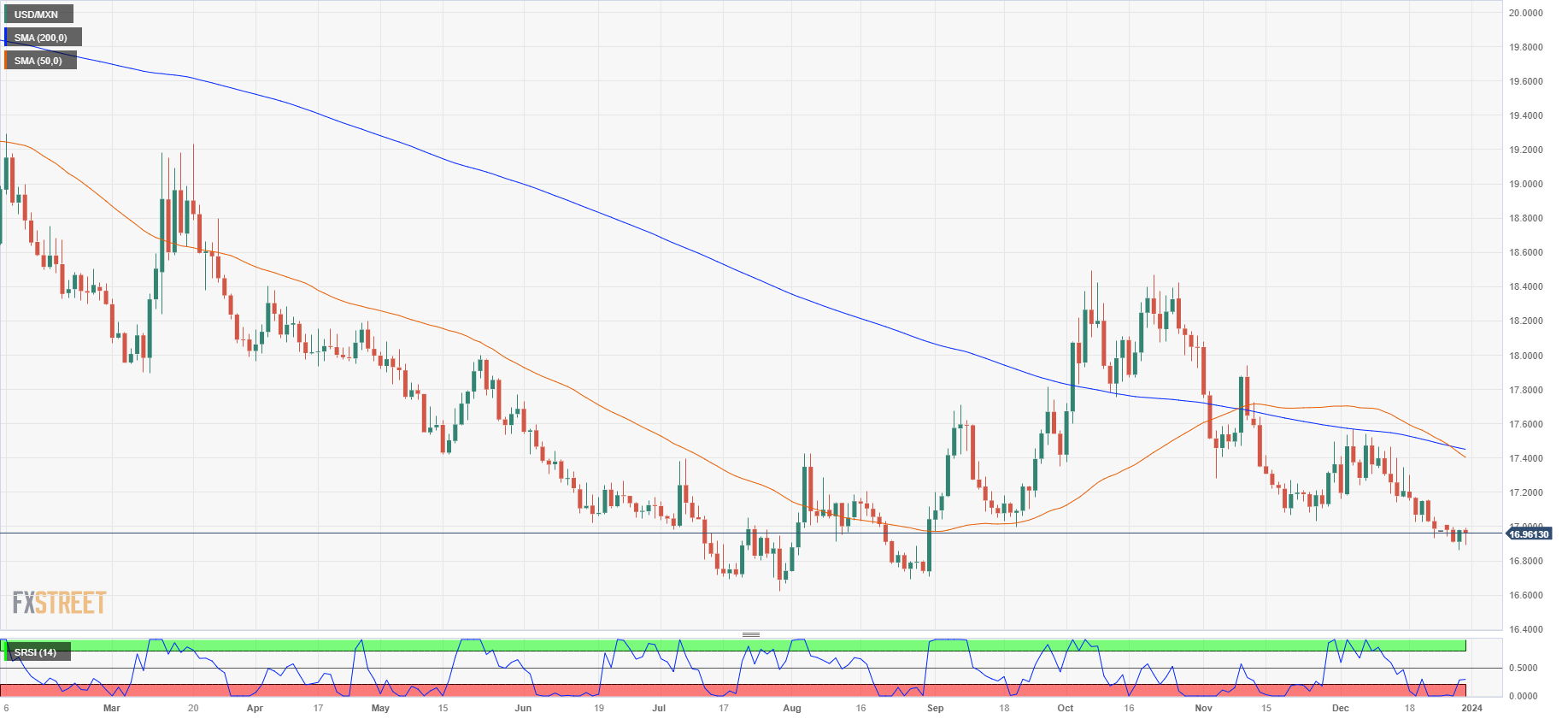
The Mexican Peso (MXN) is trading into familiar levels on Friday after Thursday’s test into a new multi-month high against the US Dollar (USD) with broad-market risk flows setting the direction of USD-based currency pairs.
A brief pullback saw the USD/MXN retreat to a near-term falling trendline before returning to the low side amidst market-wide short pressure on the Greenback.
Despite the USD/MXN firmly pinned into the low end and the 50-day Simple Moving Average (SMA) confirming a bearish cross of the long-term 200-day SMA near 17.45, technical traders will note that indicators have been hovering into oversold conditions for some time, leaving the USD/MXN exposed to an extended recovery until hitting technical resistance at the 200-day SMA. The last swing high region is also priced in near 17.50.
USD/MXN Hourly Chart
USD/MXN Daily Chart
Mexican Peso FAQs
What key factors drive the Mexican Peso?
The Mexican Peso (MXN) is the most traded currency among its Latin American peers. Its value is broadly determined by the performance of the Mexican economy, the country’s central bank’s policy, the amount of foreign investment in the country and even the levels of remittances sent by Mexicans who live abroad, particularly in the United States. Geopolitical trends can also move MXN: for example, the process of nearshoring – or the decision by some firms to relocate manufacturing capacity and supply chains closer to their home countries – is also seen as a catalyst for the Mexican currency as the country is considered a key manufacturing hub in the American continent. Another catalyst for MXN is Oil prices as Mexico is a key exporter of the commodity.
How do decisions of the Banxico impact the Mexican Peso?
The main objective of Mexico’s central bank, also known as Banxico, is to maintain inflation at low and stable levels (at or close to its target of 3%, the midpoint in a tolerance band of between 2% and 4%). To this end, the bank sets an appropriate level of interest rates. When inflation is too high, Banxico will attempt to tame it by raising interest rates, making it more expensive for households and businesses to borrow money, thus cooling demand and the overall economy. Higher interest rates are generally positive for the Mexican Peso (MXN) as they lead to higher yields, making the country a more attractive place for investors. On the contrary, lower interest rates tend to weaken MXN.
How does economic data influence the value of the Mexican Peso?
Macroeconomic data releases are key to assess the state of the economy and can have an impact on the Mexican Peso (MXN) valuation. A strong Mexican economy, based on high economic growth, low unemployment and high confidence is good for MXN. Not only does it attract more foreign investment but it may encourage the Bank of Mexico (Banxico) to increase interest rates, particularly if this strength comes together with elevated inflation. However, if economic data is weak, MXN is likely to depreciate.
How does broader risk sentiment impact the Mexican Peso?
As an emerging-market currency, the Mexican Peso (MXN) tends to strive during risk-on periods, or when investors perceive that broader market risks are low and thus are eager to engage with investments that carry a higher risk. Conversely, MXN tends to weaken at times of market turbulence or economic uncertainty as investors tend to sell higher-risk assets and flee to the more-stable safe havens.
Author

Joshua Gibson
FXStreet
Joshua joins the FXStreet team as an Economics and Finance double major from Vancouver Island University with twelve years' experience as an independent trader focusing on technical analysis.

















