Japanese Yen flirts with multi-month low against USD; seems vulnerable ahead of US NFP
- The Japanese Yen continues to be weighed down by doubts over the timing of the next BoJ rate hike.
- The recent widening of the US-Japan yield differential further undermined the lower-yielding JPY.
- The USD holds steady near a two-year peak and also supports USD/JPY ahead of the US NFP report.

The Japanese Yen (JPY) remains on the back foot against its American counterpart heading into the European session on Friday, with the USD/JPY pair trading just below a multi-month peak touched earlier this week. Despite signs of broadening inflationary pressures in Japan, investors remain skeptical about the likely timing of when the Bank of Japan (BoJ) will hike rates again. Furthermore, the Federal Reserve's (Fed) hawkish shift led to the widening of the US-Japan yield differential, which turns out to be another factor undermining the lower-yielding JPY.
That said, the cautious market mood, along with trade war fears and persistent geopolitical risks stemming from the protracted Russia-Ukraine war, could support the safe-haven JPY. Apart from this, speculations that Japanese authorities might intervene in the markets to prop up the domestic currency might hold back the JPY bears from placing aggressive bets. The downside for the USD/JPY pair, however, remains cushioned amid a bullish US Dollar (USD) and ahead of the release of the US monthly jobs data – popularly known as the Nonfarm Payrolls (NFP) report.
Japanese Yen selling bias remains unabated doubts over BoJ's rate hike plans
- Japan's Economy Minister Ryosei Akazawa said this Friday that Japan's economy is at a 'critical stage' in eradicating the public's deflationary mindset and shifting to a phase where growth is spearheaded by higher wages and investment.
- Government data released earlier today showed that inflation-adjusted household spending in Japan – a key indicator of private consumption – fell for the fourth month, by 0.4% in November from a year earlier amid stubbornly high prices.
- This comes on top of a drop in real wages for the fourth consecutive month in November and points to broadening inflationary pressure, which keeps the door open for another interest rate hike by the Bank of Japan in January or March.
- Some investors, however, are betting that the BoJ may wait until April to seek confirmation that strong wage momentum will carry over into the spring negotiations between companies and labor unions before pulling the trigger.
- The yield on the benchmark 10-year US government bond remains well within striking distance of its highest levels since the middle of last year touched last week amid the Federal Reserve's hawkish shift after the December meeting.
- Boston Fed President Susan Collins said on Thursday that the economy is on gradual, uneven trajectory back towards the 2% inflation target and the current outlook calls for a gradual and a patient approach to interest rate cuts.
- Philadelphia Fed President Patrick Harker noted that it is taking longer to get back to 2% inflation than expected. He added that the US central bank is still expected to continue to cut rates but explained that the path will depend on data.
- Kansas Fed President Jeffrey Schmid noted that inflation is moving toward target and growth is showing momentum, while the jobs market is weaker but still healthy. Any further interest rate cuts should be gradual and data-driven.
- Fed Board of Governors member Michelle Bowman said that the current stance of policy may not be as restrictive as others may see it and pent-up demand following the election could pose inflationary risks.
- The US Dollar stands tall near a two-year peak and assists the USD/JPY pair to hold steady above the 158.00 mark as traders keenly await the release of the US jobs data – popularly known as the Nonfarm Payrolls report later today.
USD/JPY bulls have the upper hand, might aim to reclaim the 159.00 mark
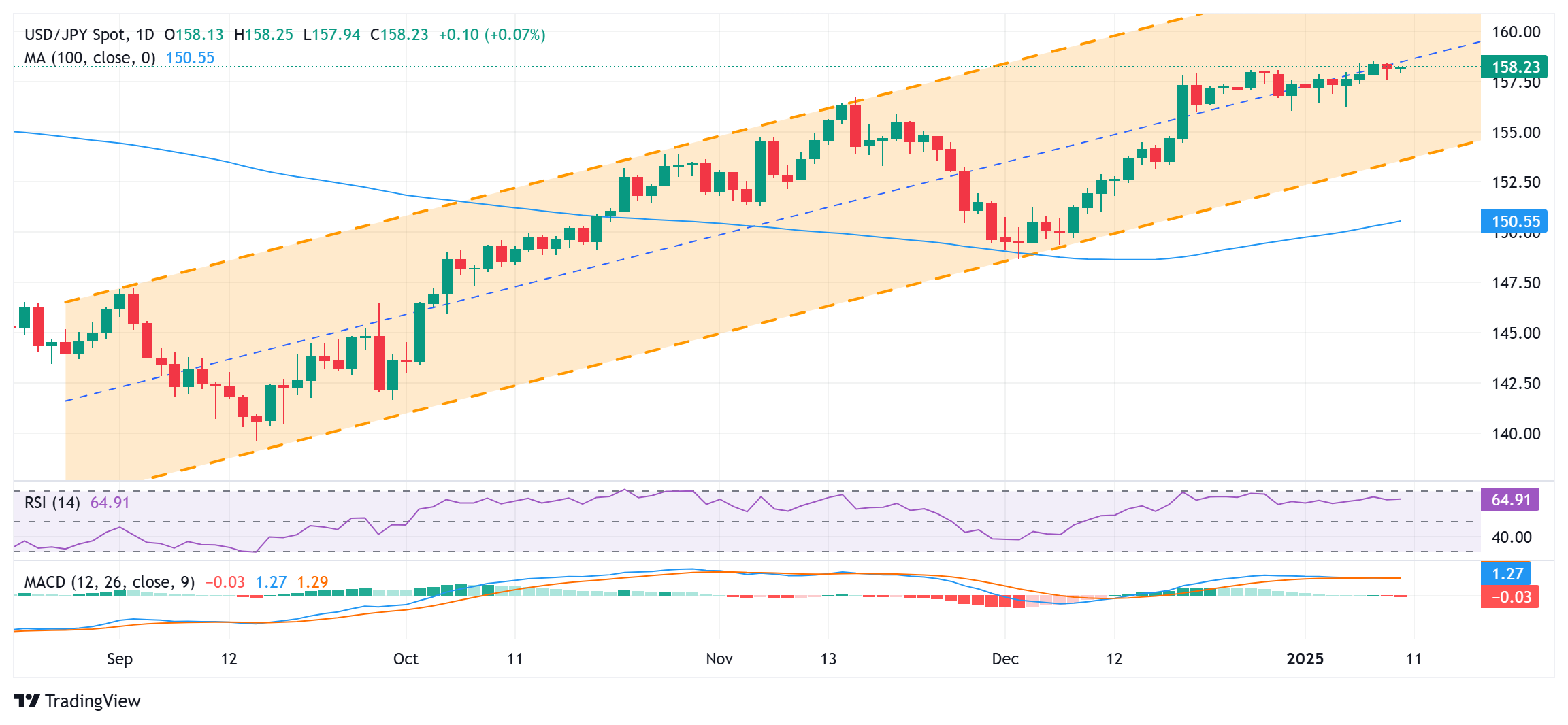
From a technical perspective, the near-term bias remains tilted in favor of bullish traders, though the recent range-bound price action makes it prudent to wait for some meaningful buying before positioning for any further gains. The 158.55 area, or the multi-month top touched on Wednesday, could act as an immediate hurdle, above which the USD/JPY pair could aim to reclaim the 159.00 mark. The momentum could extend further towards the 159.45 intermediate hurdle en route to the 160.00 psychological mark.
On the flip side, the overnight swing low, around the 157.60-157.55 region, might continue to protect the immediate downside. Some follow-through selling, however, could make the USD/JPY pair vulnerable to accelerate the slide towards the 157.00 mark en route to the next relevant support near the 156.75 region and the weekly low, around the 156.25-156.20 area. This is followed by the 156.00 mark, which if broken decisively might shift the near-term bias in favor of bearish traders and pave the way for deeper losses.
Economic Indicator
Nonfarm Payrolls
The Nonfarm Payrolls release presents the number of new jobs created in the US during the previous month in all non-agricultural businesses; it is released by the US Bureau of Labor Statistics (BLS). The monthly changes in payrolls can be extremely volatile. The number is also subject to strong reviews, which can also trigger volatility in the Forex board. Generally speaking, a high reading is seen as bullish for the US Dollar (USD), while a low reading is seen as bearish, although previous months' reviews and the Unemployment Rate are as relevant as the headline figure. The market's reaction, therefore, depends on how the market assesses all the data contained in the BLS report as a whole.
Read more.Next release: Fri Jan 10, 2025 13:30
Frequency: Monthly
Consensus: 160K
Previous: 227K
Source: US Bureau of Labor Statistics
America’s monthly jobs report is considered the most important economic indicator for forex traders. Released on the first Friday following the reported month, the change in the number of positions is closely correlated with the overall performance of the economy and is monitored by policymakers. Full employment is one of the Federal Reserve’s mandates and it considers developments in the labor market when setting its policies, thus impacting currencies. Despite several leading indicators shaping estimates, Nonfarm Payrolls tend to surprise markets and trigger substantial volatility. Actual figures beating the consensus tend to be USD bullish.
Author

Haresh Menghani
FXStreet
Haresh Menghani is a detail-oriented professional with 10+ years of extensive experience in analysing the global financial markets.

















