Japanese Yen hangs near daily low, around mid-153.00s against USD amid BoJ uncertainty
- The Japanese Yen weakened after the BoJ summary showed that policymakers were divided on rate hike timing.
- Japan's Prime Minister Ishiba faces a leadership vote, adding another layer of uncertainty and undermining the JPY.
- The Trump optimism continues to underpin the USD and further contributes to the USD/JPY pair’s positive move.

The Japanese Yen (JPY) attracts some sellers on the first day of a new week after the Bank of Japan (BoJ) Summary of Opinions from the October meeting showed that policymakers were divided on rate hike timing. This, along with the political uncertainty in Japan, raises doubts over the BoJ's ability to tighten its monetary policy further, which keeps the JPY depressed against its American counterpart heading into the European session. Apart from this, fears that US President-elect Donald Trump might again hit Japan with protectionist trade measures further dent demand for the JPY.
That said, the recent verbal intervention by Japanese authorities, along with the cautious market mood, could help limit further losses for the safe-haven JPY. Investors might also opt to move to the sidelines ahead of this week's important macro releases – the US consumer inflation figures and the prelim Q3 GDP report from Japan. This, along with Federal Reserve (Fed) Chair Jerome Powell's speech, will provide a fresh impetus to the USD/JPY pair. In the meantime, expectations that Trump's policies would boost inflation and restrict the Fed's ability to ease policy act as a tailwind for the US Dollar (USD).
Japanese Yen bears have the upper hand amid doubts over BoJ's rate-hike plans
- The Summary of Opinions from the Bank of Japan's October 30-31 meeting revealed that members discussed the potential impact of changes in the US economy and policies as the central bank moves toward further interest rate increases.
- Japan's Prime Minister Ishiba faces a leadership vote in parliament today after the ruling Liberal Democratic Party (LDP) lost its lower house majority held since 2012 and might now be looking to form a government with the support of minor parties.
- Meanwhile, the prospect of a fragile minority government in Japan raises doubts about the BoJ's ability to hike interest rates further, which, along with the upbeat market mood, undermines the safe-haven Japanese Yen at the start of a new week.
- The US Dollar is seen consolidating its recent strong gains and remains well within the striking distance of a four-month high touched in the euphoric market reaction to Donald Trump's victory in the US presidential election last Wednesday.
- Investors now seem convinced that US President-elect Donald Trump's expansionary policies would boost inflation and restrict the Federal Reserve's (Fed) ability to ease policy aggressively, which continues to underpin the Greenback.
- Minneapolis Fed President Neel Kashkari said over the weekend that the central bank wants to have confidence and needs to see more evidence that inflation will return to the 2% target before deciding on interest rate cuts going forward.
- Investors now look to this week's release of the US consumer inflation figures on Wednesday and the US Producer Price Index (PPI) on Thursday, which will be followed by the prelim Q3 GDP print from Japan and US Retail Sales figures on Friday.
- Apart from this, speeches by influential FOMC members, including Fed Chair Jerome Powell on Friday, will play a key role in influencing the USD price dynamics and determining the next leg of a directional move for the currency pair.
Technical Outlook: USD/JPY could aim to surpass the 154.00 mark and test multi-month top
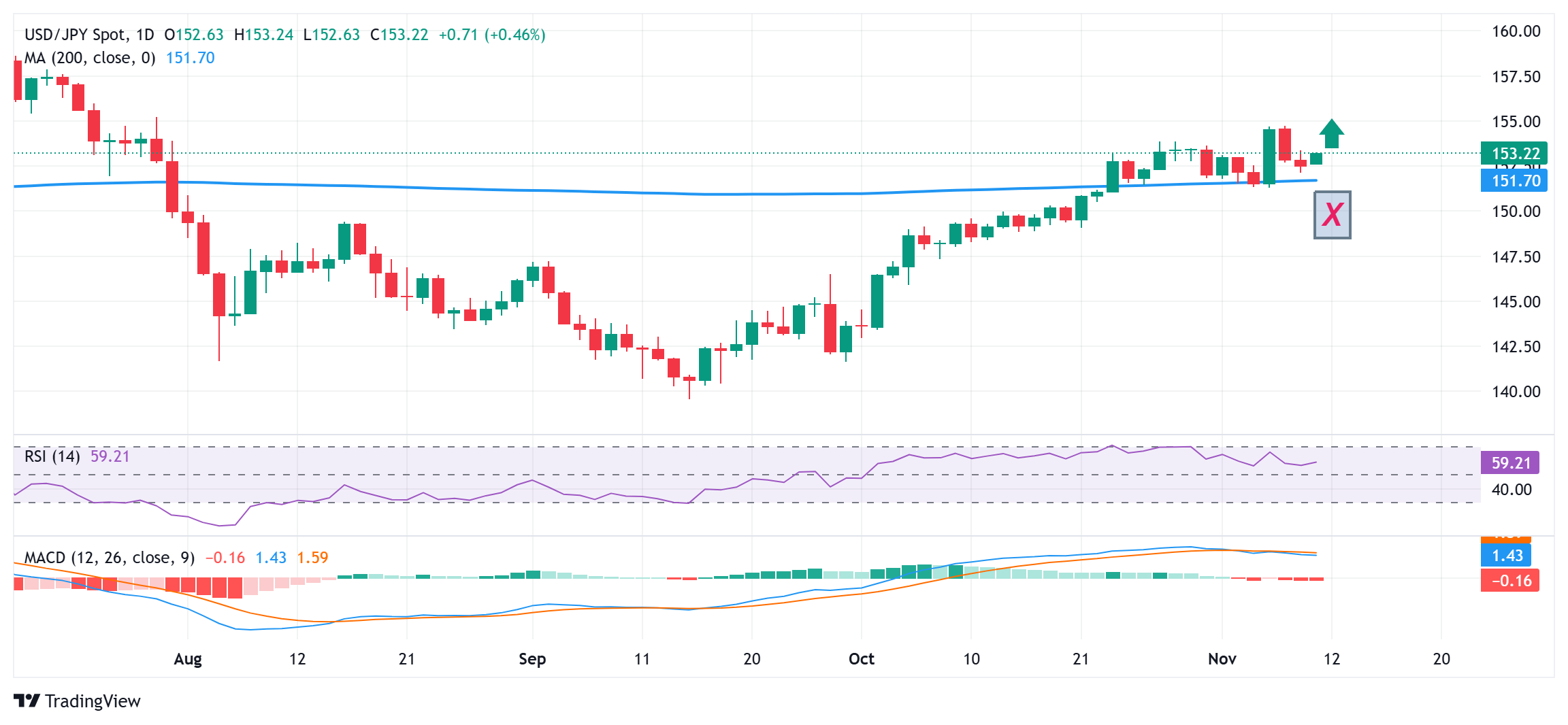
The USD/JPY pair, so far, has managed to hold above the very important 200-day Simple Moving Average (SMA) resistance breakpoint, which should act as a key pivotal point. This, along with positive oscillators on the daily chart, suggests that the path of least resistance for spot prices is to the upside. Any further move-up, however, is likely to confront some resistance ahead of the mid-153.00s. A sustained strength beyond could be seen as a fresh trigger for bulls and pave the way for a move towards reclaiming the 154.00 mark en route to the 154.70 area, or the multi-month top touched last week.
On the flip side, the Asian session low, around the 152.60 area, now seems to protect the immediate downside. Some follow-through selling could drag the USD/JPY pair below the 152.00 round figure, towards the 151.70 region (200-day SMA). A convincing break below the latter will suggest that the recent strong move up from the September low has run out of steam and shift the near-term bias in favor of bearish traders.
US Dollar FAQs
The US Dollar (USD) is the official currency of the United States of America, and the ‘de facto’ currency of a significant number of other countries where it is found in circulation alongside local notes. It is the most heavily traded currency in the world, accounting for over 88% of all global foreign exchange turnover, or an average of $6.6 trillion in transactions per day, according to data from 2022. Following the second world war, the USD took over from the British Pound as the world’s reserve currency. For most of its history, the US Dollar was backed by Gold, until the Bretton Woods Agreement in 1971 when the Gold Standard went away.
The most important single factor impacting on the value of the US Dollar is monetary policy, which is shaped by the Federal Reserve (Fed). The Fed has two mandates: to achieve price stability (control inflation) and foster full employment. Its primary tool to achieve these two goals is by adjusting interest rates. When prices are rising too quickly and inflation is above the Fed’s 2% target, the Fed will raise rates, which helps the USD value. When inflation falls below 2% or the Unemployment Rate is too high, the Fed may lower interest rates, which weighs on the Greenback.
In extreme situations, the Federal Reserve can also print more Dollars and enact quantitative easing (QE). QE is the process by which the Fed substantially increases the flow of credit in a stuck financial system. It is a non-standard policy measure used when credit has dried up because banks will not lend to each other (out of the fear of counterparty default). It is a last resort when simply lowering interest rates is unlikely to achieve the necessary result. It was the Fed’s weapon of choice to combat the credit crunch that occurred during the Great Financial Crisis in 2008. It involves the Fed printing more Dollars and using them to buy US government bonds predominantly from financial institutions. QE usually leads to a weaker US Dollar.
Quantitative tightening (QT) is the reverse process whereby the Federal Reserve stops buying bonds from financial institutions and does not reinvest the principal from the bonds it holds maturing in new purchases. It is usually positive for the US Dollar.
Author

Haresh Menghani
FXStreet
Haresh Menghani is a detail-oriented professional with 10+ years of extensive experience in analysing the global financial markets.