Japanese Yen holds ground as Tokyo CPI data support likelihood of BoJ rate hike in January
- The Japanese Yen appreciated following the release of Tokyo CPI inflation data, which showed a rise in December.
- The Tokyo Consumer Price Index increased to 3.0% YoY in December, up from 2.6% in November.
- The US Dollar edges higher amid rising odds of fewer rate cuts by the Federal Reserve.

The Japanese Yen (JPY) gains ground against the US Dollar (USD) on Friday. The USD/JPY pair pulls back from its recent gains as the Japanese Yen (JPY) strengthens following the release of Tokyo Consumer Price Index (CPI) inflation data. The data is expected to keep the Bank of Japan (BoJ) on track for an interest rate hike in January.
The headline Tokyo CPI inflation rose to 3.0% YoY in December, up from 2.6% in November. Meanwhile, the Tokyo CPI excluding Fresh Food and Energy increased to 2.4% YoY in December, compared to 2.2% the previous month. The Tokyo CPI excluding Fresh Food also climbed 2.4% YoY in December, slightly below the expected 2.5% but higher than the 2.2% recorded in November.
The Bank of Japan (BoJ) released the Summary of Opinions from its December monetary policy meeting on Friday, highlighting plans to adjust easing measures if economic conditions align with expectations. One BoJ board member emphasized the importance of monitoring wage negotiation momentum, while another stressed the need for scrutiny of data to determine any changes to monetary support.
Japanese Yen appreciates due to rising odds of BoJ’s interest rate hike in January
- The US Dollar Index (DXY), which measures the value of the US Dollar (USD) against its six major peers, trades around 108.10, slightly below its highest level since November 2022. However, the upside of the Greenback could be restrained as US Treasury bond yields remain subdued on Friday. 2-year and 10-year yields stand at 4.32% and 4.57%, respectively, at the time of writing.
- The downside of the USD/JPY pair could be limited as the US Dollar receives support from growing expectations of fewer rate cuts by the US Federal Reserve (Fed). In its December meeting, the Fed reduced interest rates by a quarter point and revised its 2025 projection to include only two rate cuts, down from the previously forecasted four. However, the likelihood of additional rate cuts next year was tempered by moderate US PCE inflation data.
- On Friday, Japan's Finance Minister Katsunobu Kato said that he recently saw one-sided and sharp foreign exchange (FX) moves. Kato further stated that the official will take suitable measures against excessive foreign exchange movements.
- The Bank of Japan October meeting Minutes released this Tuesday reiterated the possibility of gradual rate hikes if inflation trends align with expectations, with a potential path to 1.0% by late fiscal 2025. The Minutes also emphasized a cautious approach to monetary policy, wage-driven economic growth amid domestic and global uncertainties, and fiscal measures to counter deflationary pressures.
- BoJ Governor Kazuo Ueda said last week that the central bank expects the Japanese economy to move closer to sustainably achieving the BoJ's 2% inflation target next year. Ueda also added, "The timing and pace of adjusting the degree of monetary accommodation will depend on developments in economic activity and prices as well as financial conditions going forward."
USD/JPY remains below 158.00, monthly highs
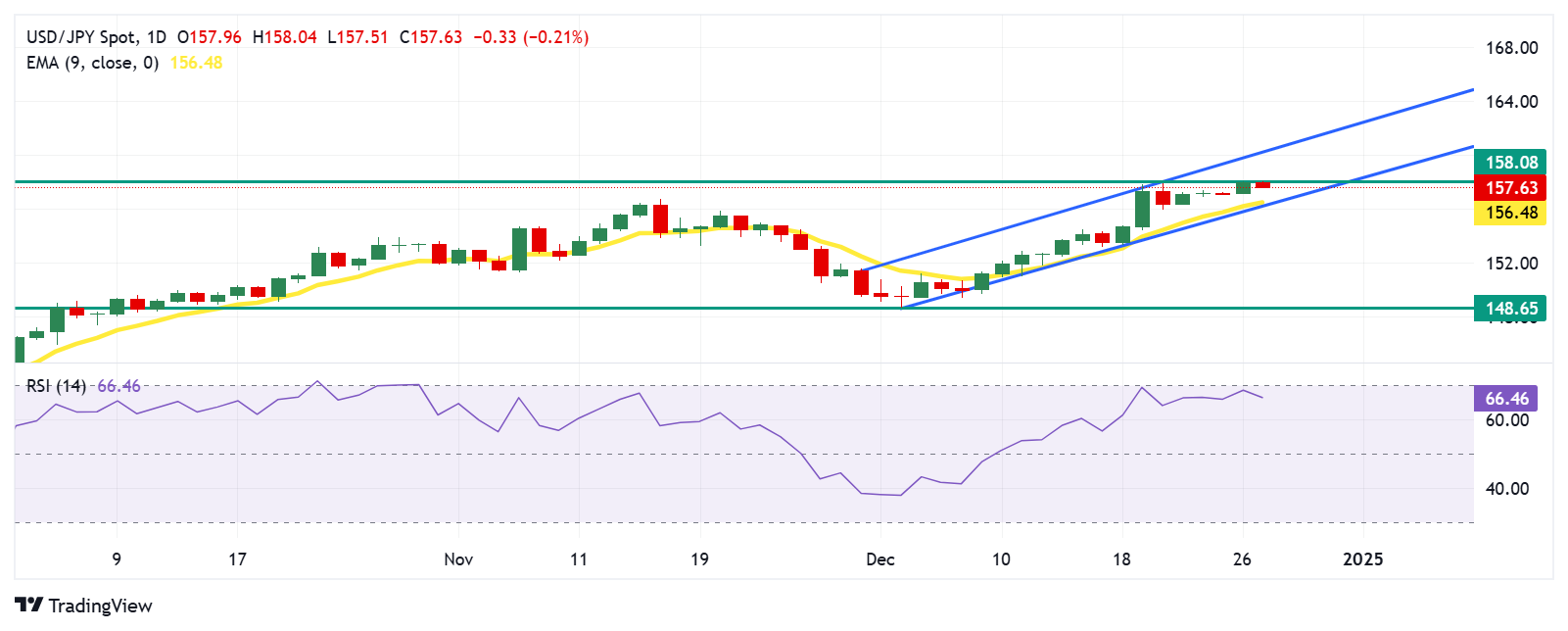
The USD/JPY trades around 157.70 on Friday. Daily chart analysis indicates a continued bullish trend, with the pair moving upwards within an ascending channel pattern. The 14-day Relative Strength Index (RSI) is just below the 70 level, reinforcing the bullish outlook. A breakout above the 70 mark could signal an overbought condition, which might lead to a potential downward correction for the pair.
The USD/JPY pair could test its monthly high at 158.08, reached on Thursday. A break above this level could support the pair to target the upper boundary of the ascending channel near the 160.30 level.
On the downside, the USD/JPY pair could find primary support at the nine-day Exponential Moving Average (EMA) around 156.48, aligned with the ascending channel’s lower boundary.
USD/JPY: Daily Chart
Japanese Yen PRICE Today
The table below shows the percentage change of Japanese Yen (JPY) against listed major currencies today. Japanese Yen was the strongest against the Australian Dollar.
| USD | EUR | GBP | JPY | CAD | AUD | NZD | CHF | |
|---|---|---|---|---|---|---|---|---|
| USD | 0.10% | 0.00% | -0.11% | -0.05% | 0.11% | -0.08% | 0.14% | |
| EUR | -0.10% | -0.10% | -0.21% | -0.15% | 0.01% | -0.18% | 0.04% | |
| GBP | -0.00% | 0.10% | -0.12% | -0.05% | 0.11% | -0.08% | 0.14% | |
| JPY | 0.11% | 0.21% | 0.12% | 0.06% | 0.21% | -0.08% | 0.16% | |
| CAD | 0.05% | 0.15% | 0.05% | -0.06% | 0.15% | -0.03% | 0.19% | |
| AUD | -0.11% | -0.01% | -0.11% | -0.21% | -0.15% | -0.19% | 0.03% | |
| NZD | 0.08% | 0.18% | 0.08% | 0.08% | 0.03% | 0.19% | 0.22% | |
| CHF | -0.14% | -0.04% | -0.14% | -0.16% | -0.19% | -0.03% | -0.22% |
The heat map shows percentage changes of major currencies against each other. The base currency is picked from the left column, while the quote currency is picked from the top row. For example, if you pick the Japanese Yen from the left column and move along the horizontal line to the US Dollar, the percentage change displayed in the box will represent JPY (base)/USD (quote).
Japanese Yen FAQs
The Japanese Yen (JPY) is one of the world’s most traded currencies. Its value is broadly determined by the performance of the Japanese economy, but more specifically by the Bank of Japan’s policy, the differential between Japanese and US bond yields, or risk sentiment among traders, among other factors.
One of the Bank of Japan’s mandates is currency control, so its moves are key for the Yen. The BoJ has directly intervened in currency markets sometimes, generally to lower the value of the Yen, although it refrains from doing it often due to political concerns of its main trading partners. The BoJ ultra-loose monetary policy between 2013 and 2024 caused the Yen to depreciate against its main currency peers due to an increasing policy divergence between the Bank of Japan and other main central banks. More recently, the gradually unwinding of this ultra-loose policy has given some support to the Yen.
Over the last decade, the BoJ’s stance of sticking to ultra-loose monetary policy has led to a widening policy divergence with other central banks, particularly with the US Federal Reserve. This supported a widening of the differential between the 10-year US and Japanese bonds, which favored the US Dollar against the Japanese Yen. The BoJ decision in 2024 to gradually abandon the ultra-loose policy, coupled with interest-rate cuts in other major central banks, is narrowing this differential.
The Japanese Yen is often seen as a safe-haven investment. This means that in times of market stress, investors are more likely to put their money in the Japanese currency due to its supposed reliability and stability. Turbulent times are likely to strengthen the Yen’s value against other currencies seen as more risky to invest in.
Author

Akhtar Faruqui
FXStreet
Akhtar Faruqui is a Forex Analyst based in New Delhi, India. With a keen eye for market trends and a passion for dissecting complex financial dynamics, he is dedicated to delivering accurate and insightful Forex news and analysis.