Japanese Yen pares intraday losses; USD/JPY trades with modest gains around 150.00 mark
- The Japanese Yen weakens against the USD and is weighed down by a combination of factors.
- Rebounding US bond yields and a positive risk tone drive flows away from the safe-haven JPY.
- A strong pickup in the USD demand contributes to USD/JPY’s move back above mid-150.00s.

The Japanese Yen (JPY) trims a part of heavy intraday losses against its American counterpart amid bets that the Bank of Japan (BoJ) will hike interest rates again in December. Apart from this, a softer risk tone and persistent geopolitical tensions turn out to be another factor offering some support to the safe-haven JPY. That said, rebounding US Treasury bond yields, bolstered by expectations for a less dovish Federal Reserve (Fed), should cap the upside for the lower-yielding yellow metal.
Investors seem convinced that US President-elect Donald Trump's tariff plans could boost inflation and limit the scope for the Fed to cut interest rates. This, in turn, triggers a goodish move up in the US bond yields, which helps revive the US Dollar (USD) demand and assists the USD/JPY pair to defend the 150.00 psychological mark through the early European session. Traders now look forward to the US ISM Manufacturing PMI for short-term opportunities at the start of a critical week.
Japanese Yen draws support from bets for another BoJ rate hike in December, lacks bullish conviction
- US President-elect Donald Trump threatened a 100% tariff on the so-called 'BRICS' nations – Brazil, Russia, India, China, and South Africa – if they replace the US Dollar with another currency for international transactions.
- This comes on top of Trump's pledge to impose big tariffs against America’s three biggest trading partners – Mexico, Canada and China – and adds to market concerns about the second wave of a global trade war.
- Investors now seem convinced that Trump's tariff plans and expansionary policy could push consumer prices higher, setting the stage for the Federal Reserve to stop cutting interest rates or possibly raise them again.
- The prospects for a less dovish Fed trigger a fresh leg up in the US bond yields, which assists the USD to recover from a near three-week low and is seen driving flows away from the lower-yielding Japanese Yen.
- Friday's stronger consumer inflation figures from Tokyo, Japan's capital, signaled that the underlying inflation is gaining momentum and backed the case for another rate hike by the Bank of Japan in December.
- BoJ Governor Kazuo Ueda said on Saturday that the next interest rate hikes are nearing in the sense that economic data are on track, though he would like to see what kind of momentum the fiscal 2025 Shunto creates.
- Japan's Ministry of Finance reported this Monday that Capital Spending rose 8.1% year-on-year in the third quarter, signaling that strong domestic demand was underpinning the fragile economic recovery.
- Russian and Syrian jets have carried out a series of air strikes on Syrian rebels led by the jihadi group Hayat Tahrir al-Sham, who took over most of Aleppo in a shock offensive on Saturday and also entered the city of Hama.
- Ukrainian President Volodymyr Zelenskyy has stated that he is willing to give up occupied Ukrainian territory to Russia, albeit with some conditions, in order to reach a ceasefire agreement and achieve peace.
- China’s official Manufacturing Purchasing Managers' Index (PMI) edged up to 50.3 in November from 50.2, while the NBS Non-Manufacturing PMI eased to 50.0 during the reported month from October’s 50.2.
- China's Caixin Manufacturing Purchasing Managers' Index (PMI) jumped to 51.5 in November after recording 50.3 in October amid hopes that the government will introduce more stimulus to bolster domestic demand.
- Investors now look to this week's important US macro releases, including the closely watched US monthly employment details (NFP) report, for cues about the Fed's future rate-cut path and some meaningful impetus.
USD/JPY could resume the recent corrective fall once Friday's swing low, near 149.45 area is broken
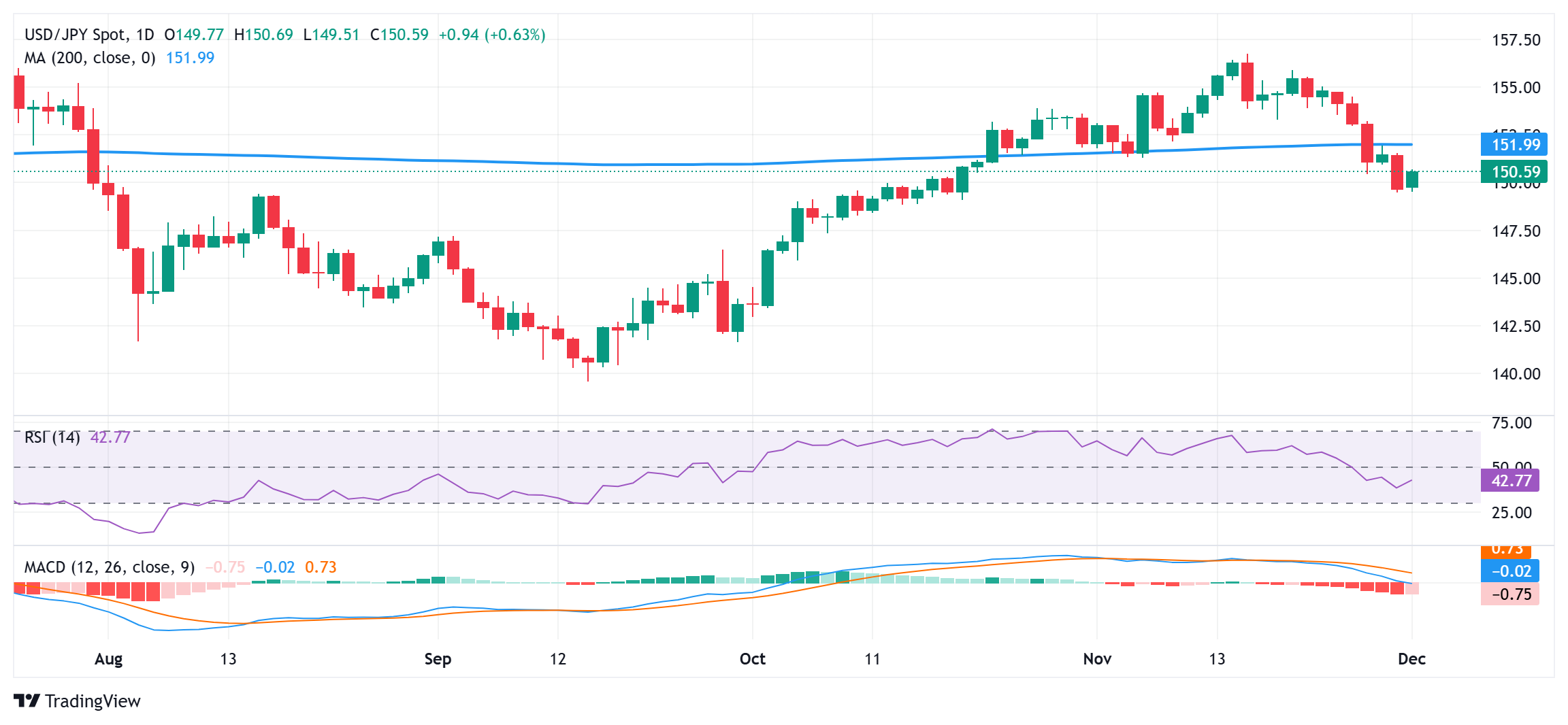
From a technical perspective, any further move up is likely to confront stiff resistance near the 151.00 round-figure mark amid negative oscillators on the daily chart. A sustained strength beyond, however, could trigger a short-covering rally and lift the USD/JPY pair to the 151.65 intermediate hurdle en route to the 152.00 mark. The latter represents the very important 200-day Simple Moving Average (SMA) and should act as a key pivotal point. Some follow-through buying will suggest that the recent corrective pullback from a multi-month top has run its course and shift the near-term bias back in favor of bullish traders.
On the flip side, the 150.00 psychological mark now seems to protect the immediate downside ahead of Friday's swing low, around the 149.45 region. Some follow-through selling has the potential to drag the USD/JPY pair further towards the 149.00 round figure en route to the next relevant support 147.60-147.55 support and the 148.00 mark (50% retracement level of the September-November rally).
Fed FAQs
Monetary policy in the US is shaped by the Federal Reserve (Fed). The Fed has two mandates: to achieve price stability and foster full employment. Its primary tool to achieve these goals is by adjusting interest rates. When prices are rising too quickly and inflation is above the Fed’s 2% target, it raises interest rates, increasing borrowing costs throughout the economy. This results in a stronger US Dollar (USD) as it makes the US a more attractive place for international investors to park their money. When inflation falls below 2% or the Unemployment Rate is too high, the Fed may lower interest rates to encourage borrowing, which weighs on the Greenback.
The Federal Reserve (Fed) holds eight policy meetings a year, where the Federal Open Market Committee (FOMC) assesses economic conditions and makes monetary policy decisions. The FOMC is attended by twelve Fed officials – the seven members of the Board of Governors, the president of the Federal Reserve Bank of New York, and four of the remaining eleven regional Reserve Bank presidents, who serve one-year terms on a rotating basis.
In extreme situations, the Federal Reserve may resort to a policy named Quantitative Easing (QE). QE is the process by which the Fed substantially increases the flow of credit in a stuck financial system. It is a non-standard policy measure used during crises or when inflation is extremely low. It was the Fed’s weapon of choice during the Great Financial Crisis in 2008. It involves the Fed printing more Dollars and using them to buy high grade bonds from financial institutions. QE usually weakens the US Dollar.
Quantitative tightening (QT) is the reverse process of QE, whereby the Federal Reserve stops buying bonds from financial institutions and does not reinvest the principal from the bonds it holds maturing, to purchase new bonds. It is usually positive for the value of the US Dollar.
Author

Haresh Menghani
FXStreet
Haresh Menghani is a detail-oriented professional with 10+ years of extensive experience in analysing the global financial markets.