Japanese Yen declines after the release of mixed inflation data
- The Japanese Yen extends losses after the release of mixed inflation data on Friday.
- Japan's National Consumer Price Index held steady at 2.8% in June, remaining at the highest level since February.
- The US Dollar extends gains as Treasury yields appreciate.

The Japanese Yen (JPY) continues to lose ground following the release of the latest inflation data on Friday. Japan's National Consumer Price Index (CPI) for June held steady at 2.8%, matching the previous month's figure and remaining at the highest level since February. Meanwhile, Core CPI inflation rose to 2.6%, slightly above the previous reading of 2.5% but just below the consensus estimate of 2.7%.
Japan’s 10-year government bond yield trades at approximately 1.04%, recovering from three-week lows. This rebound follows Digital Minister Taro Kono's statement to Bloomberg that the Bank of Japan (BoJ) should raise interest rates again in July to support the Yen. Additionally, the BoJ is anticipated to show its bond purchase tapering plans this month.
Later, Minister Kono clarified that he is not directly requesting the Bank of Japan (BoJ) to raise rates at present, stating, “Monetary policy decisions are up to the BoJ.” In response, Finance Minister Suzuki criticized Kono, remarking, "Incumbent ministers should be mindful of how their comments affect the markets and be cautious about making statements."
The USD/JPY pair has retreated by as much as 4% from a 38-year high of 161.95 during July. Analysts attribute this decline to interventions by Japanese authorities. Traders remain vigilant about the possibility of further interventions.
The US Dollar receives support as US Treasury yields continue to appreciate. However, the Greenback may limit its upside as soft labor data bolster market expectations of a September rate-cut decision by the Federal Reserve (Fed).
Daily Digest Market Movers: Japanese Yen declines despite intervention threat
- Japan’s CPI inflation, less both food and energy prices, ticks higher in June and grew 2.2% YoY rate from the previous 2.1%.
- JP Morgan has anticipated no rate hike from the Bank of Japan (BoJ) in July or at any point in 2024. A July rate increase is not their base case, and they do not expect any hikes for the remainder of 2024. They believe it is too early to adopt a bullish stance on the Yen.
- US Initial Jobless Claims increased more than expected, data showed on Thursday, adding 243K new unemployment benefits seekers for the week ended July 12 compared to the expected 230K, and rising above the previous week’s revised 223K.
- Kazushige Kamiyama, a senior Bank of Japan (BoJ) official and the central bank’s Osaka branch manager, said on Thursday that the BoJ wants to maintain an accommodative monetary environment as much as possible, per Jiji News Agency.
- Japan's Merchandise Trade Balance Total for the year ended in June climbed to a surplus of ¥224 billion against the expected deficit of ¥240 billion and ¥-1,220.1 billion prior.
- On Wednesday, Fed Governor Christopher Waller said that the US central bank is ‘getting closer’ to an interest rate cut. Meanwhile, Richmond Fed President Thomas Barkin stated that easing in inflation had begun to broaden and he would like to see it continue,” per Reuters.
- Reuters cited Kyodo News, reporting that Japan's top currency diplomat Masato Kanda said on Wednesday he would have to respond if speculators cause "excessive" moves in the currency market and that there was no limit to how often authorities could intervene.
- During an interview with Bloomberg News on Tuesday, Donald Trump cautioned Fed Chair Jerome Powell against cutting US interest rates before November’s presidential vote. However, Trump also indicated that if re-elected, he would allow Powell to complete his term if he continued to "do the right thing" at the Federal Reserve.
- Data released on Tuesday showed that the Bank of Japan (BoJ) entered the foreign exchange market on consecutive trading days last Thursday and Friday. The current account balance data from the BoJ, released on Tuesday, indicates an anticipated liquidity drain of approximately ¥2.74 trillion ($17.3 billion) from the financial system on Wednesday due to various government sector transactions, according to Nikkei Asia.
- Fed Chair Jerome Powell mentioned earlier this week that the three US inflation readings of this year "add somewhat to confidence" that inflation is on course to meet the Fed’s target sustainably, suggesting that a shift to interest rate cuts may not be far off.
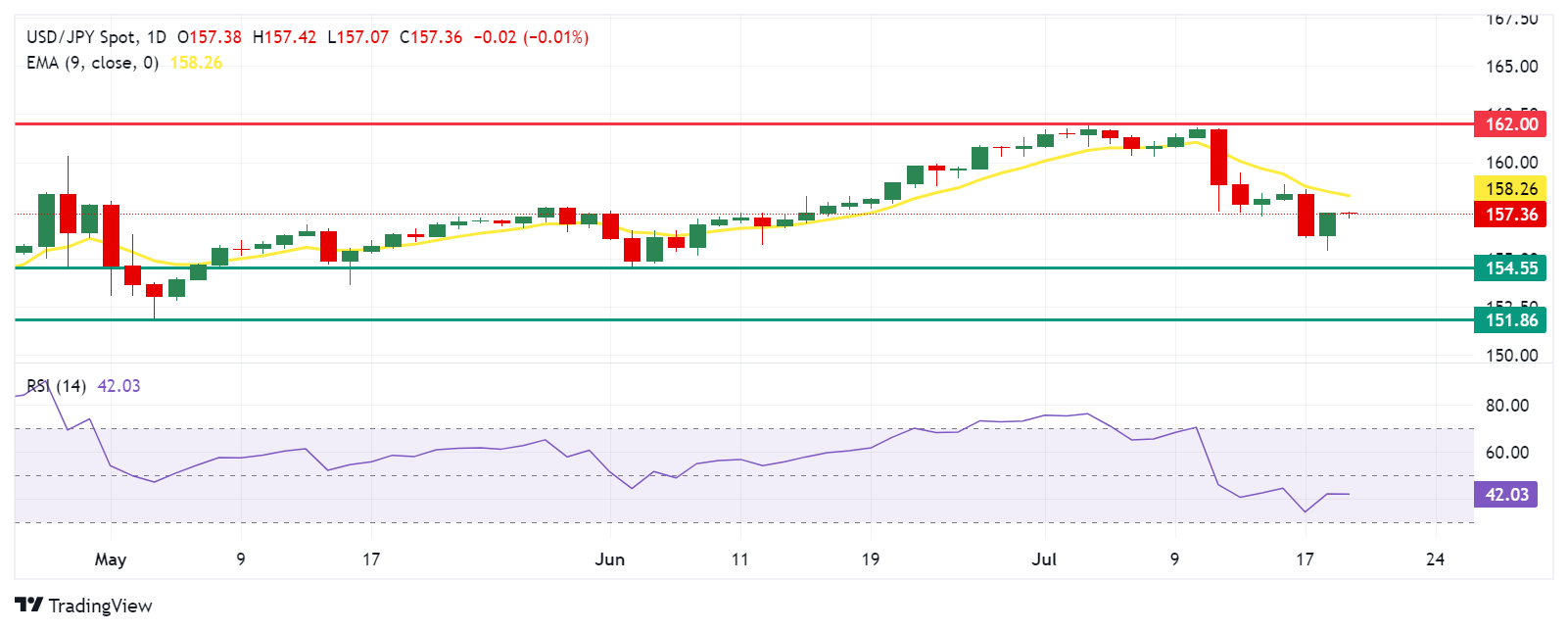
Technical Analysis: USD/JPY hovers around 157.50
USD/JPY trades around 157.40 on Friday. The daily chart analysis indicates that the USD/JPY pair is below its 9-day Exponential Moving Average (EMA), suggesting short-term downward momentum. This implies waiting for signs of a trend reversal before buying. Additionally, the 14-day Relative Strength Index (RSI) is below 50, confirming a bearish bias.
The pair could find key support around June's low of 154.55. A break below this level could push the pair towards May’s low of 151.86.
On the upside, immediate resistance is noted around the 9-day EMA at 158.25. If the pair breaks above this level, it could revisit the pullback resistance around the psychological level of 162.00.
USD/JPY: Daily Chart
Japanese Yen PRICE Today
The table below shows the percentage change of Japanese Yen (JPY) against listed major currencies today. Japanese Yen was the weakest against the US Dollar.
| USD | EUR | GBP | JPY | CAD | AUD | NZD | CHF | |
|---|---|---|---|---|---|---|---|---|
| USD | 0.09% | 0.06% | 0.24% | 0.00% | 0.07% | 0.32% | 0.19% | |
| EUR | -0.09% | -0.03% | 0.14% | -0.12% | -0.03% | 0.23% | 0.10% | |
| GBP | -0.06% | 0.03% | 0.02% | -0.09% | 0.01% | 0.28% | 0.12% | |
| JPY | -0.24% | -0.14% | -0.02% | -0.23% | -0.15% | 0.11% | -0.03% | |
| CAD | -0.01% | 0.12% | 0.09% | 0.23% | 0.06% | 0.33% | 0.18% | |
| AUD | -0.07% | 0.03% | -0.01% | 0.15% | -0.06% | 0.26% | 0.11% | |
| NZD | -0.32% | -0.23% | -0.28% | -0.11% | -0.33% | -0.26% | -0.15% | |
| CHF | -0.19% | -0.10% | -0.12% | 0.03% | -0.18% | -0.11% | 0.15% |
The heat map shows percentage changes of major currencies against each other. The base currency is picked from the left column, while the quote currency is picked from the top row. For example, if you pick the Japanese Yen from the left column and move along the horizontal line to the US Dollar, the percentage change displayed in the box will represent JPY (base)/USD (quote).
Japanese Yen FAQs
The Japanese Yen (JPY) is one of the world’s most traded currencies. Its value is broadly determined by the performance of the Japanese economy, but more specifically by the Bank of Japan’s policy, the differential between Japanese and US bond yields, or risk sentiment among traders, among other factors.
One of the Bank of Japan’s mandates is currency control, so its moves are key for the Yen. The BoJ has directly intervened in currency markets sometimes, generally to lower the value of the Yen, although it refrains from doing it often due to political concerns of its main trading partners. The current BoJ ultra-loose monetary policy, based on massive stimulus to the economy, has caused the Yen to depreciate against its main currency peers. This process has exacerbated more recently due to an increasing policy divergence between the Bank of Japan and other main central banks, which have opted to increase interest rates sharply to fight decades-high levels of inflation.
The BoJ’s stance of sticking to ultra-loose monetary policy has led to a widening policy divergence with other central banks, particularly with the US Federal Reserve. This supports a widening of the differential between the 10-year US and Japanese bonds, which favors the US Dollar against the Japanese Yen.
The Japanese Yen is often seen as a safe-haven investment. This means that in times of market stress, investors are more likely to put their money in the Japanese currency due to its supposed reliability and stability. Turbulent times are likely to strengthen the Yen’s value against other currencies seen as more risky to invest in.
Author

Akhtar Faruqui
FXStreet
Akhtar Faruqui is a Forex Analyst based in New Delhi, India. With a keen eye for market trends and a passion for dissecting complex financial dynamics, he is dedicated to delivering accurate and insightful Forex news and analysis.

















