Japanese Yen retreats from one-month top against USD; USD/JPY flat lines above mid-155.00s
- The Japanese Yen pulls back after rising to over a one-month high against the USD.
- The initial reaction to Trump’s tariff remarks fades amid bets for another BoJ rate hike.
- A modest USD recovery from a two-week low acts as a tailwind for the USD/JPY pair.

The Japanese Yen (JPY) retreats after touching a one-month high against its American counterpart and flat lines during the early European session on Tuesday. A generally positive tone around the equity markets turns out to be a key factor undermining the safe-haven JPY. This, along with a modest US Dollar (USD) recovery from a two-week low assists the USD/JPY pair to move back above the mid-155.00s.
Any meaningful JPY depreciation, however, seems limited in the wake of rising bets that the Bank of Japan (BoJ) will hike rates later this week. Furthermore, US President Donald Trump's tariff remarks revived trade war fears, which, along with declining US Treasury bond yields, should contribute to limiting losses for the JPY. Traders might also opt to wait for the crucial two-day BoJ meeting starting Thursday.
Japanese Yen seesaws between tepid gains/minor losses against USD amid mixed cues
- The recent hawkish comments from Bank of Japan Governor Kazuo Ueda and Deputy Governor Ryozo Himino, along with the broadening inflationary pressure in Japan, raised the odds for an imminent rate hike by the Japanese central bank. The markets are pricing in an 80% chance of a rate hike later this week.
- According to people familiar with the matter, BoJ will reach the final conclusion after examining economic data, markets and the implications of US economic policies. The view among the officials is that US President Donald Trump could ruffle markets or change expectations about the global economy.
- Trump said this Tuesday that he intends to impose 25% tariffs on Canada and Mexico, and the target date for tariffs would be as soon as early February. Trump's remarks revive inflation concerns, which could force the Federal Reserve to stick to its hawkish stance and prompt a sharp US Dollar recovery from a two-week low.
- Japan’s Finance Minister Katsunobu Kato said on Tuesday that expect the BoJ to conduct monetary policies appropriately to achieve 2% inflation target. Kato added that Japan will respond appropriately after examining new US President’s policies and will closely monitor impact of US policies on world economy, Japan.
- Atsushi Mimura, Japan’s Vice Finance Minister For International Affairs and top foreign exchange official, said on Tuesday that US economy outlook’s up to Trump’s macroeconomic policies. Need to closely watch if China’s recent export strength will continue, Mimura added further.
- The US Producer Price Index (PPI) and Consumer Price Index (CPI) released last week pointed to signs of abating inflation. This suggests that the Fed may not exclude the possibility of rate cuts by the end of this year, which keeps the US Treasury bond yields depressed and acts as a headwind for the Greenback.
- There isn't any relevant market-moving economic data due for release on Tuesday, either from Japan or the US. Moreover, the focus remains glued to the highly-anticipated two-day BoJ policy meeting starting on Thursday, which will play a key role in determining the near-term trajectory for the Japanese Yen.
USD/JPY continues to show some resilience below asending trend-channel support
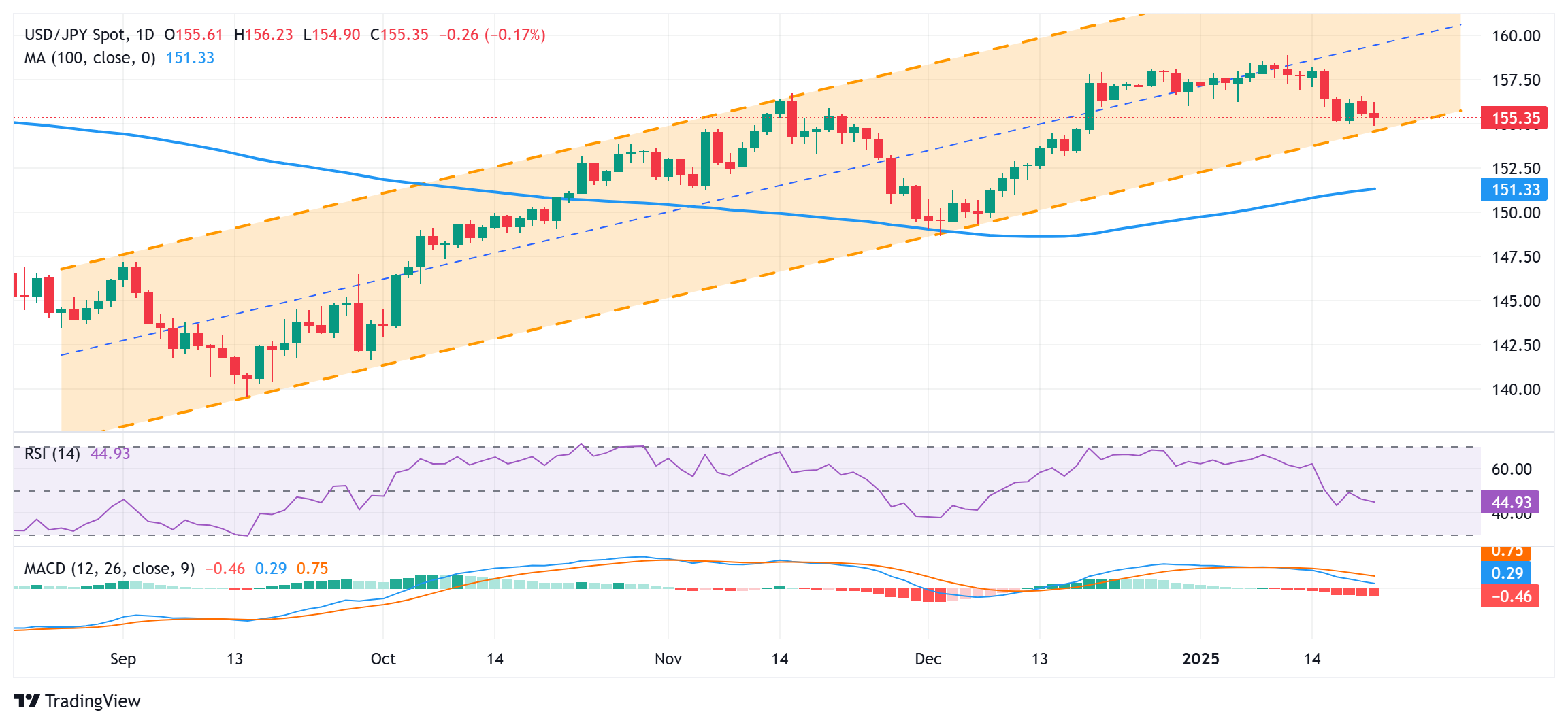
From a technical perspective, the USD/JPY pair continues to show some resilience below the 155.00 mark and so far, has managed to defend a support representing the lower boundary of a multi-month-old ascending channel. This makes it prudent to wait for a convincing breakdown and acceptance below the said support levels before positioning for an extension of the recent downfall from a multi-month top. Spot prices might then accelerate the slide towards the 154.50-154.45 intermediate support en route to the 154.00 round figure, the mid-153.00s, and the 153.00 mark.
On the flip side, the Asian session peak, around the 156.25 region, now seems to act as an immediate hurdle. Some follow-through buying beyond the overnight swing high, around the 156.58-156.60 area, could allow the USD/JPY pair to reclaim the 157.00 mark. The recovery momentum could extend further towards the 157.25-157.30 area en route to the 157.60 region and the 158.00 round figure. A sustained strength beyond the latter could set the stage for a move towards retesting the multi-month peak, around the 159.00 neighborhood touched on January 10.
Economic Indicator
BoJ Interest Rate Decision
The Bank of Japan (BoJ) announces its interest rate decision after each of the Bank’s eight scheduled annual meetings. Generally, if the BoJ is hawkish about the inflationary outlook of the economy and raises interest rates it is bullish for the Japanese Yen (JPY). Likewise, if the BoJ has a dovish view on the Japanese economy and keeps interest rates unchanged, or cuts them, it is usually bearish for JPY.
Read more.Next release: Fri Jan 24, 2025 03:00
Frequency: Irregular
Consensus: 0.5%
Previous: 0.25%
Source: Bank of Japan
Author

Haresh Menghani
FXStreet
Haresh Menghani is a detail-oriented professional with 10+ years of extensive experience in analysing the global financial markets.