Japanese Yen bulls regain control on BoJ Governor Ueda's hawkish remarks, intervention fears
- The Japanese Yen attracts fresh buyers in reaction to BoJ Governor Ueda's hawkish remarks.
- Intervention fears also underpin the JPY and weigh on USD/JPY amid subdued USD demand.
- The risk-on mood and the recent widening of the US-Japan yield differential could cap the JPY.

The Japanese Yen (JPY) builds on the intraday ascent against its American counterpart heading into the European session in the wake of Bank of Japan (BoJ) Governor Kazuo Ueda's hawkish remarks. Adding to this, comments from Japan’s Finance Minister Katsunobu Kato revived fears of a possible government intervention and provided an additional boost to the JPY. This, along with subdued US Dollar (USD) price action, drags the USD/JPY pair to the 157.20 area, or a fresh daily low in the last hour.
Meanwhile, some investors are betting that the BoJ may wait until the spring negotiations before pulling the trigger. Moreover, the recent widening of the US-Japan yield differential, bolstered by the Federal Reserve's (Fed) hawkish shift, might hold back traders from placing bullish aggressive bets around the lower-yielding JPY. Apart from this, the risk-on mood might contribute to capping the safe-haven JPY and lend support to the USD/JPY pair as traders look to the US consumer inflation data for a fresh impetus.
Japanese Yen draws support from hawkish comments from BoJ's Ueda and intervention fears
- Japan’s Finance Minister Katsunobu Kato reiterated on Wednesday that we are alarmed over FX moves, including those driven by speculators, and will take appropriate action against excessive FX moves.
- A fall in Japan's household spending and real wages for the fourth successive month in November amid higher prices, keeping the door open for a rate hike by the Bank of Japan in January or March.
- BoJ Deputy Governor Ryozo Himino said on Tuesday that the central bank will discuss potentially raising the policy rate at the January meeting, though he did not strongly signal a hike next week.
- BoJ Governor Kazuo Ueda reiterated this Wednesday that the central bank will raise rates and adjust degree of monetary support if improvement in economy and price conditions continues.
- Some economists think that the BoJ will assess US President-elect Donald Trump's economic policies and wait until the results of Japan's annual spring wage negotiations become available in March.
- The Reuters Tankan poll showed that Japanese manufacturers' sentiment recovered in January after a dip last month, but their outlook remains flat due to uncertainty over proposed Trump policies.
- The yield on the benchmark 10-year US government bond remains close to a 14-month high in the wake of growing acceptance that the Federal Reserve will pause its rate-cutting cycle later this month.
- Against the backdrop of the upbeat US Nonfarm Payrolls report released on Friday, a moderate rise in the US producer prices makes it difficult for investors to project the Fed's next moves on interest rates.
- The Bureau of Labor Statistics (BLS) reported that the Producer Price Index rose 3.3% in December from a year earlier, marking a notable uptick from 3.0% previous, though it fell short of the 3.4% expected.
- The US Dollar extended Monday's retracement slide from over a two-year peak and acts as a headwind for the USD/JPY pair as traders now look to the US Consumer Price Index for a fresh impetus.
- The headline US CPI is expected to rise 0.3% in December and the yearly rate to 2.9% from 2.7% in November. The core CPI, meanwhile, is anticipated to hold steady and come in at a 3.3% YoY rate.
USD/JPY could accelerate the downfall once the 157.00 pivotal support is broken decisively
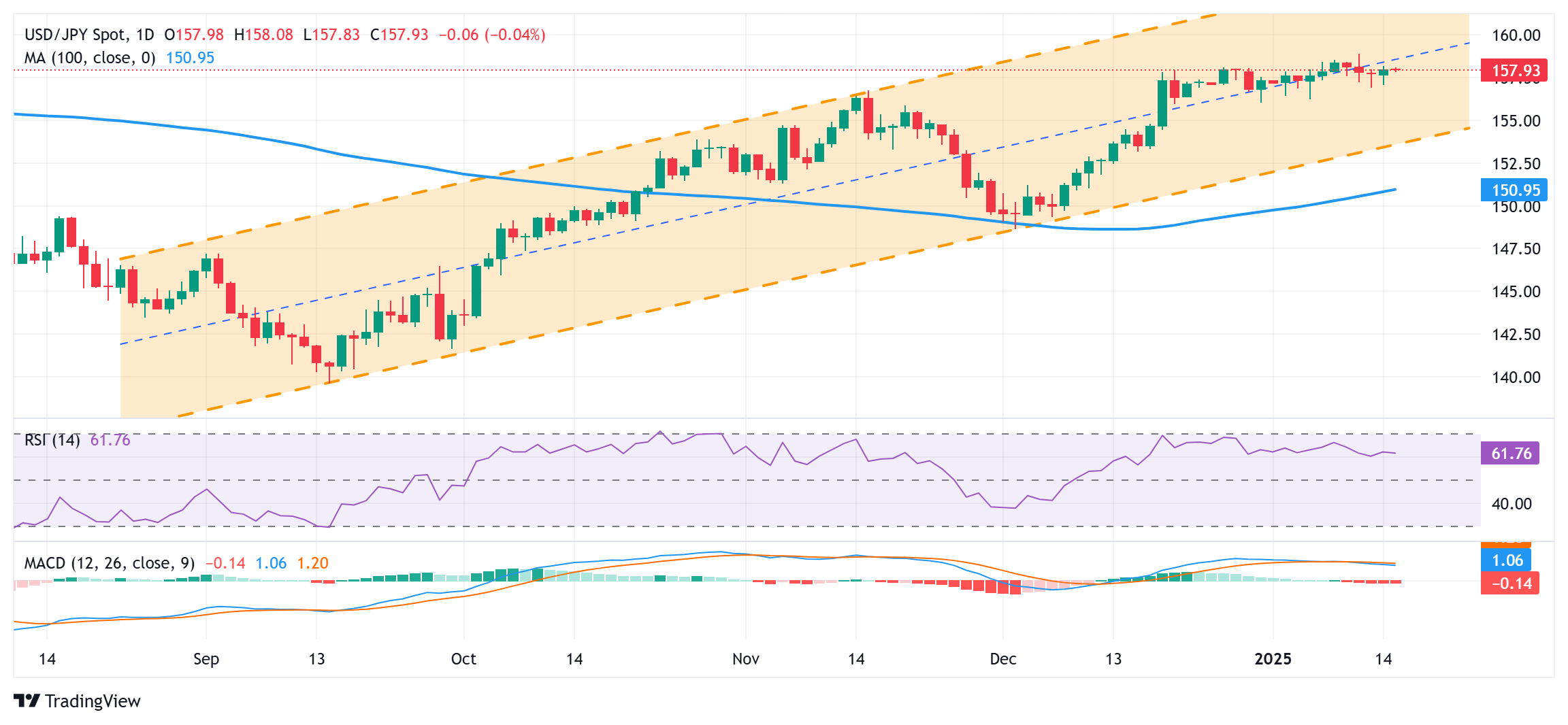
From a technical perspective, bulls are likely to wait for sustained strength and acceptance above the 158.00 mark before placing fresh bets. Given that oscillators on the daily chart are holding in positive territory and are still a distance away from being in the overbought zone, the USD/JPY pair might then aim to retest the multi-month top, around the 158.85-158.90 zone. Some follow-through buying above the 159.00 mark will set the stage for further gains towards the next relevant hurdle near the mid-159.00s before spot prices aim to reclaim the 160.00 psychological mark.
On the flip side, the 157.45 area now seems to protect the immediate downside ahead of the 157.00 mark. Any further slide could be seen as a buying opportunity around the 156.25-156.20 area, or last week's swing low. This should help limit the downside for the USD/JPY pair near the 156.00 mark, which if broken decisively might shift the near-term bias in favor of bearish traders and pave the way for some meaningful corrective decline.
Economic Indicator
Consumer Price Index (YoY)
Inflationary or deflationary tendencies are measured by periodically summing the prices of a basket of representative goods and services and presenting the data as The Consumer Price Index (CPI). CPI data is compiled on a monthly basis and released by the US Department of Labor Statistics. The YoY reading compares the prices of goods in the reference month to the same month a year earlier.The CPI is a key indicator to measure inflation and changes in purchasing trends. Generally speaking, a high reading is seen as bullish for the US Dollar (USD), while a low reading is seen as bearish.
Read more.Next release: Wed Jan 15, 2025 13:30
Frequency: Monthly
Consensus: 2.9%
Previous: 2.7%
Source: US Bureau of Labor Statistics
The US Federal Reserve has a dual mandate of maintaining price stability and maximum employment. According to such mandate, inflation should be at around 2% YoY and has become the weakest pillar of the central bank’s directive ever since the world suffered a pandemic, which extends to these days. Price pressures keep rising amid supply-chain issues and bottlenecks, with the Consumer Price Index (CPI) hanging at multi-decade highs. The Fed has already taken measures to tame inflation and is expected to maintain an aggressive stance in the foreseeable future.
Author

Haresh Menghani
FXStreet
Haresh Menghani is a detail-oriented professional with 10+ years of extensive experience in analysing the global financial markets.

















