Japanese Yen loses ground ahead of US CPI data
- The Japanese Yen holds losses ahead of the release of US CPI data on Thursday.
- The Japanese government's 10-year JGB yield remains stable at around 1.09%, close to its recent high of 1.10%.
- Fed Chair Powell highlighted the urgent need to monitor the deteriorating labor market.

The Japanese Yen (JPY) extends its losses for the third successive day as traders adopt caution ahead of upcoming US Consumer Price Index (CPI) data for June, scheduled for release on Thursday, for more clarity on the Federal Reserve's (Fed) monetary policy direction.
The JPY could limit its downside due to the rising speculation of the Bank of Japan (BoJ) raising interest rates at its upcoming July meeting. This development supported the JPY while weakening the USD/JPY pair.
The Japanese government's 10-year JGB yield holds steady at approximately 1.09%, near its peak of 1.1% recorded on July 3. The stability comes amidst selling pressure on Japanese government bonds, reflecting overseas investors' anticipation that the Bank of Japan may raise interest rates in response to a weakening Japanese Yen, as reported by Nikkei Asia.
The US Dollar (USD) recovers losses due to improved US Treasury yields. Federal Reserve (Fed) Chairman Jerome Powell highlighted the urgent need to monitor the deteriorating labor market on Wednesday. Additionally, Powell expressed confidence in the downward trend of inflation, following his remarks on Tuesday that emphasized the necessity of further data to strengthen confidence in the inflation outlook.
Daily Digest Market Movers: Japanese Yen edges lower ahead of US inflation
- Peter Boockvar, chief financial officer at US-based Bleakley Financial Group, said that the Yen's weakness will trigger the BoJ to "react sooner rather than later," per Reuters.
- Reuters reported on Wednesday, citing unnamed sources, the Bank of Japan will likely trim this year's economic growth forecast and project inflation will stay around its 2% target in coming years at its meeting this month.
- Fed Chair Jerome Powell stated in his Congressional testimony on Tuesday, "More good data would strengthen our confidence in inflation." Powell emphasized that a "Policy rate cut is not appropriate until the Fed gains greater confidence that inflation is headed sustainably toward 2%." He also noted that "first-quarter data did not support the greater confidence in the inflation path that the Fed needs to cut rates."
- According to a Bloomberg report on Tuesday, the Bank of Japan is conducting three in-person meetings with banks, securities firms, and financial institutions over the next few days. The purpose of these meetings is to assess a feasible pace for scaling back its purchases of Japanese Government Bonds.
- On Tuesday, Japan's Finance Minister Shunichi Suzuki underscored the significance of maintaining fiscal discipline to bolster confidence in long-term fiscal health. Suzuki also mentioned monitoring closely the discussions at the BoJ meeting concerning the bond market, as reported by Reuters.
- The Japanese Yen may struggle due to overseas asset purchases by Japanese individuals through the newly revamped tax-free investment scheme, the Nippon Individual Savings Account (NISA) program. According to Nikkei Asia, the scale of these purchases is expected to exceed the country's trade deficit during the first half of this year.
- Japan’s Ministry of Finance reported on Monday that Japanese investment trust management companies and asset management firms bought ¥6.16 trillion ($38 billion) more in offshore equities and investment fund shares than they sold during the first six months of the year.
Technical Analysis: USD/JPY hovers around 161.50
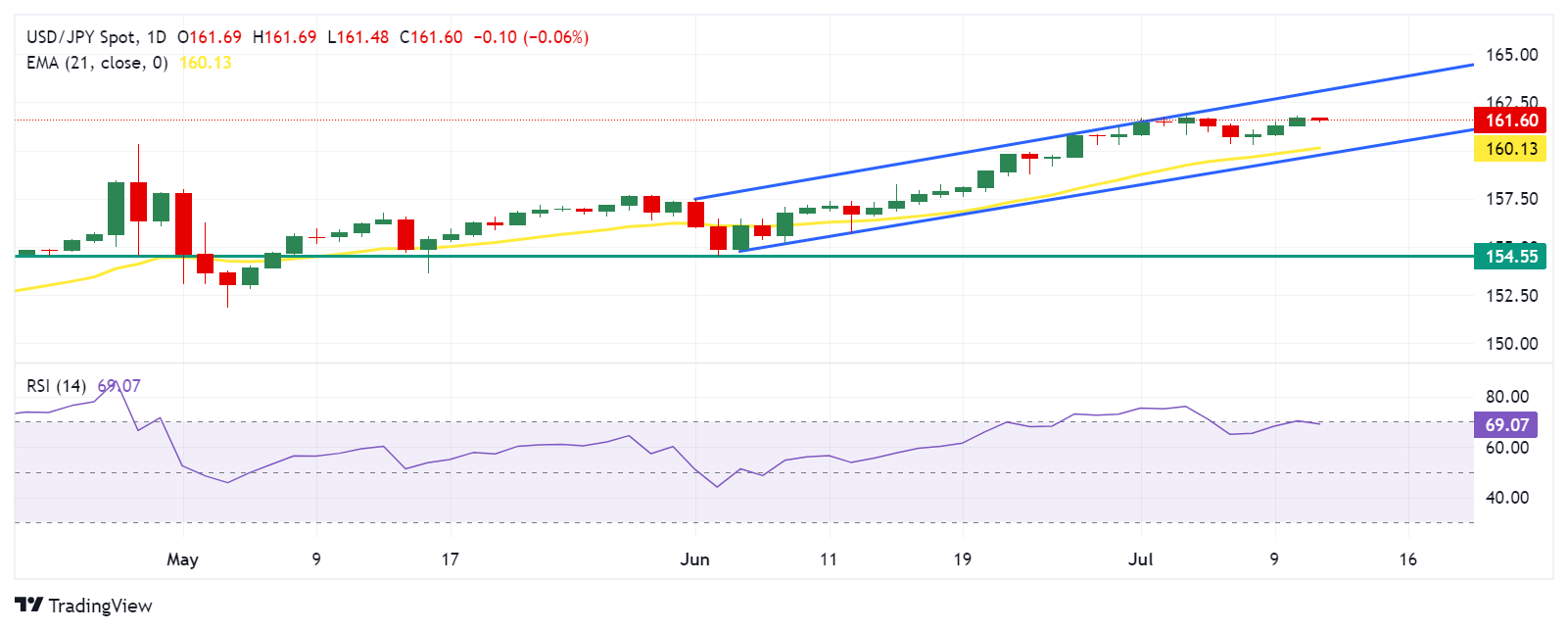
USD/JPY trades around 161.60 on Thursday, maintaining an upward trajectory within an ascending channel pattern, indicating a bullish bias according to daily chart analysis. Supporting this outlook, the 14-day Relative Strength Index (RSI) sits just below the 70 level, suggesting potential overbought conditions. A breach above this level could signal a need for caution and a possible correction.
The USD/JPY pair may aim for psychological resistance near 163.00, located at the upper boundary of the ascending channel. A successful breakout above this level could reinforce bullish sentiment, potentially pushing the pair toward significant resistance around 163.50.
Conversely, initial support is expected around the 21-day Exponential Moving Average (EMA) at 160.13. A drop below this level might trigger selling pressure, testing the lower boundary of the ascending channel near the psychological level of 160.00. A further decline below this channel support could see the pair revisiting June's low around 154.55.
USD/JPY: Daily Chart
Japanese Yen PRICE Today
The table below shows the percentage change of Japanese Yen (JPY) against listed major currencies today. Japanese Yen was the weakest against the New Zealand Dollar.
| USD | EUR | GBP | JPY | CAD | AUD | NZD | CHF | |
|---|---|---|---|---|---|---|---|---|
| USD | -0.03% | -0.11% | 0.00% | 0.07% | -0.10% | -0.15% | -0.01% | |
| EUR | 0.03% | -0.07% | 0.04% | 0.11% | -0.06% | -0.10% | 0.00% | |
| GBP | 0.11% | 0.07% | 0.10% | 0.18% | 0.00% | -0.04% | 0.10% | |
| JPY | 0.00% | -0.04% | -0.10% | 0.04% | -0.11% | -0.19% | -0.03% | |
| CAD | -0.07% | -0.11% | -0.18% | -0.04% | -0.19% | -0.22% | -0.09% | |
| AUD | 0.10% | 0.06% | -0.01% | 0.11% | 0.19% | -0.05% | 0.09% | |
| NZD | 0.15% | 0.10% | 0.04% | 0.19% | 0.22% | 0.05% | 0.14% | |
| CHF | 0.00% | -0.01% | -0.10% | 0.03% | 0.09% | -0.09% | -0.14% |
The heat map shows percentage changes of major currencies against each other. The base currency is picked from the left column, while the quote currency is picked from the top row. For example, if you pick the Japanese Yen from the left column and move along the horizontal line to the US Dollar, the percentage change displayed in the box will represent JPY (base)/USD (quote).
Japanese Yen FAQs
The Japanese Yen (JPY) is one of the world’s most traded currencies. Its value is broadly determined by the performance of the Japanese economy, but more specifically by the Bank of Japan’s policy, the differential between Japanese and US bond yields, or risk sentiment among traders, among other factors.
One of the Bank of Japan’s mandates is currency control, so its moves are key for the Yen. The BoJ has directly intervened in currency markets sometimes, generally to lower the value of the Yen, although it refrains from doing it often due to political concerns of its main trading partners. The current BoJ ultra-loose monetary policy, based on massive stimulus to the economy, has caused the Yen to depreciate against its main currency peers. This process has exacerbated more recently due to an increasing policy divergence between the Bank of Japan and other main central banks, which have opted to increase interest rates sharply to fight decades-high levels of inflation.
The BoJ’s stance of sticking to ultra-loose monetary policy has led to a widening policy divergence with other central banks, particularly with the US Federal Reserve. This supports a widening of the differential between the 10-year US and Japanese bonds, which favors the US Dollar against the Japanese Yen.
The Japanese Yen is often seen as a safe-haven investment. This means that in times of market stress, investors are more likely to put their money in the Japanese currency due to its supposed reliability and stability. Turbulent times are likely to strengthen the Yen’s value against other currencies seen as more risky to invest in.
Author

Akhtar Faruqui
FXStreet
Akhtar Faruqui is a Forex Analyst based in New Delhi, India. With a keen eye for market trends and a passion for dissecting complex financial dynamics, he is dedicated to delivering accurate and insightful Forex news and analysis.
















