Japanese Yen remains weaker ahead of US economic data
- The Japanese Yen edges lower as the US Dollar improves due to higher Treasury yields.
- Japanese Chief Cabinet Secretary Yoshimasa Hayashi has expressed readiness to utilize all available measures concerning forex matters.
- Fed’s Goolsbee stated that the US economy appears to be on track to achieve 2% inflation.

The Japanese Yen (JPY) trims its gains as the US Dollar (USD) strengthens, buoyed by improved Treasury yields. However, the JPY's volatility is anticipated to persist amid speculation of intervention by Japanese authorities following weaker-than-anticipated US Consumer Price Index (CPI) figures. Traders await the Michigan Consumer Sentiment Index and US Producer Price Index (PPI), due on Friday, to gain further impetus on the US economy.
According to data released by the Bank of Japan (BoJ) on Friday, Japanese authorities may have expended between JPY3.37 trillion to JPY3.57 trillion on July 11 in efforts to curb the rapid depreciation of the local currency, as reported by Reuters.
Japanese Chief Cabinet Secretary Yoshimasa Hayashi stated his readiness to employ all available measures regarding forex. Hayashi noted that the Bank of Japan (BoJ) would determine the specifics of monetary policy. He expects that the BoJ will implement appropriate measures to sustainably and steadily achieve the 2% price target, reported by Reuters on Friday.
The Bank of Japan (BoJ) could raise interest rates at its upcoming July meeting. This expectation bolstered the JPY, contributing to a decline in the USD/JPY pair.
Daily Digest Market Movers: Japanese Yen experiences fluctuations amid intervention threats
- The Japanese government typically releases its economic growth forecasts twice a year, in January and July. Reuters reported, citing two government sources, that the upcoming forecast, expected next week, is likely to revise growth expectations to around 1.0% for the fiscal year ending March 2025, down from the current forecast of 1.3%.
- On Friday, Japanese Finance Minister Shunichi Suzuki emphasized that rapid foreign exchange (FX) movements are undesirable. Suzuki refrained from commenting on FX intervention and declined to address media reports regarding Japan's FX rate checks, as reported by Reuters.
- Federal Reserve Bank of Chicago President Austan Goolsbee said on Thursday that the US economy appears to be on track to achieve 2% inflation. Goolsbee stated "My view is, this is what the path to 2% looks like," according to Reuters.
- The US Consumer Price Index (CPI) declined by 0.1% month-over-month in June, marking its lowest level in over three years. The headline CPI increased by 3.0% MoM in June, down from a 3.3% rise in May and below the market consensus of 3.1%.
- The core CPI, which excludes volatile food and energy prices, rose by 3.3% year-over-year in June, compared to May's increase of 3.4% and the same expectation. Meanwhile, the core CPI increased by 0.1% month-over-month, against the expected and prior reading of 0.2%.
- Peter Boockvar, chief financial officer at US-based Bleakley Financial Group, said that the Yen's weakness will trigger the BoJ to "react sooner rather than later," per Reuters.
- Reuters reported on Wednesday, citing unnamed sources, the Bank of Japan will likely trim this year's economic growth forecast and project inflation will stay around its 2% target in coming years at its meeting this month.
- Federal Reserve Chairman Jerome Powell highlighted the urgent need to monitor the deteriorating labor market on Wednesday. Additionally, Powell expressed confidence in the downward trend of inflation, following his remarks on Tuesday that emphasized the necessity of further data to strengthen confidence in the inflation outlook.
- According to a Bloomberg report on Tuesday, the Bank of Japan is conducting three in-person meetings with banks, securities firms, and financial institutions over the next few days. These meetings aim to assess a feasible pace for scaling back its purchases of Japanese Government Bonds.
Technical Analysis: USD/JPY rebounds toward 159.50
USD/JPY trades around 159.30 on Friday. The daily chart analysis shows a weakening bullish bias as it breached the lower boundary of an ascending channel pattern. Additionally, the 14-day Relative Strength Index (RSI) was slightly below the 50 level, indicating a decline in the momentum of the pair's price.
The USD/JPY pair may find initial support near the psychological level of 159.00. A break below this level could reinforce bearish sentiment, potentially prompting a revisit to June's low near 154.55.
On the upside, immediate resistance is seen around the 21-day Exponential Moving Average (EMA) at 159.82, followed by the lower boundary of the ascending channel near 159.95. A return to within the ascending channel would likely improve sentiment for the USD/JPY pair, potentially targeting the upper boundary of the channel around the 163.20 level.
USD/JPY: Daily Chart
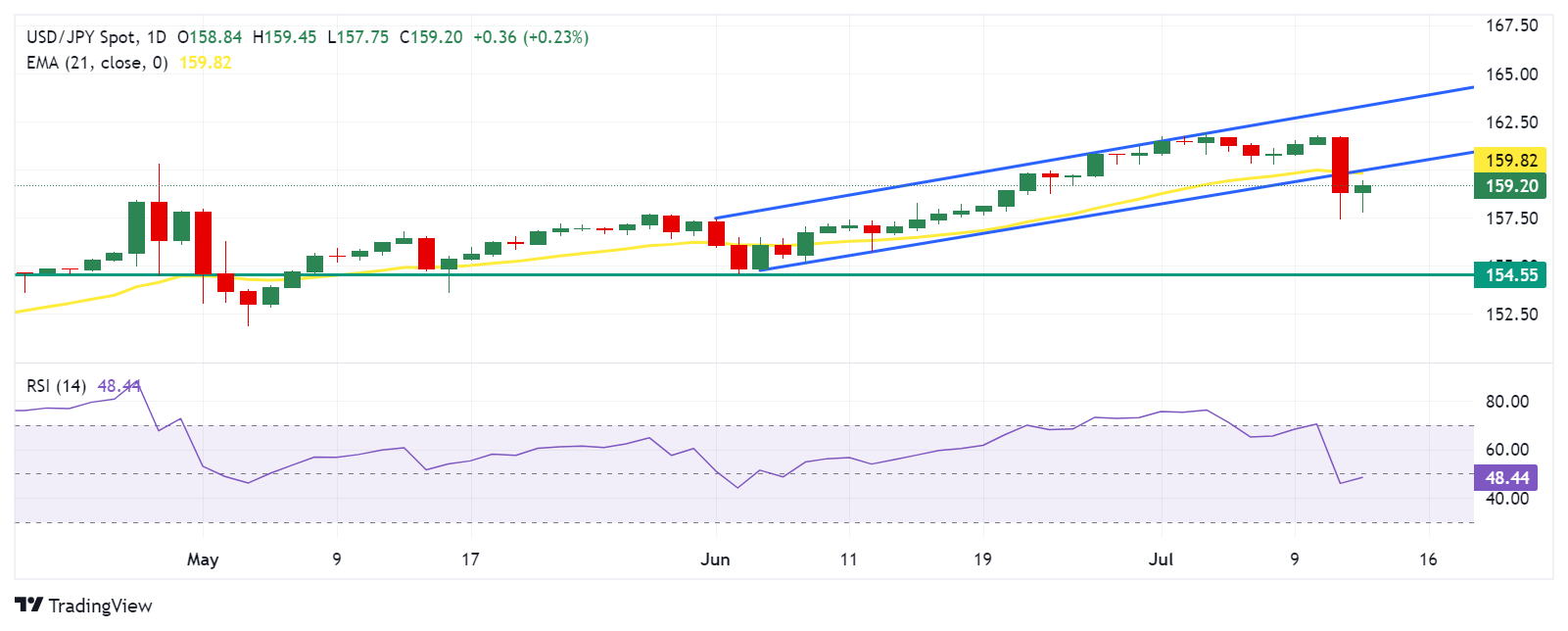
(This story was corrected on July 15 at 08:50 GMT to say, in the second paragraph of technical analysis, "prompting a revisit to June's low near 154.55, not 109.55.)
Japanese Yen PRICE Today
The table below shows the percentage change of Japanese Yen (JPY) against listed major currencies today. Japanese Yen was the weakest against the British Pound.
| USD | EUR | GBP | JPY | CAD | AUD | NZD | CHF | |
|---|---|---|---|---|---|---|---|---|
| USD | -0.18% | -0.26% | 0.11% | -0.13% | -0.26% | -0.24% | -0.02% | |
| EUR | 0.18% | -0.08% | 0.33% | 0.04% | -0.09% | -0.08% | 0.13% | |
| GBP | 0.26% | 0.08% | 0.41% | 0.12% | -0.02% | -0.00% | 0.21% | |
| JPY | -0.11% | -0.33% | -0.41% | -0.31% | -0.40% | -0.40% | -0.18% | |
| CAD | 0.13% | -0.04% | -0.12% | 0.31% | -0.13% | -0.12% | 0.09% | |
| AUD | 0.26% | 0.09% | 0.02% | 0.40% | 0.13% | 0.01% | 0.23% | |
| NZD | 0.24% | 0.08% | 0.00% | 0.40% | 0.12% | -0.01% | 0.22% | |
| CHF | 0.02% | -0.13% | -0.21% | 0.18% | -0.09% | -0.23% | -0.22% |
The heat map shows percentage changes of major currencies against each other. The base currency is picked from the left column, while the quote currency is picked from the top row. For example, if you pick the Japanese Yen from the left column and move along the horizontal line to the US Dollar, the percentage change displayed in the box will represent JPY (base)/USD (quote).
Bank of Japan FAQs
The Bank of Japan (BoJ) is the Japanese central bank, which sets monetary policy in the country. Its mandate is to issue banknotes and carry out currency and monetary control to ensure price stability, which means an inflation target of around 2%.
The Bank of Japan has embarked in an ultra-loose monetary policy since 2013 in order to stimulate the economy and fuel inflation amid a low-inflationary environment. The bank’s policy is based on Quantitative and Qualitative Easing (QQE), or printing notes to buy assets such as government or corporate bonds to provide liquidity. In 2016, the bank doubled down on its strategy and further loosened policy by first introducing negative interest rates and then directly controlling the yield of its 10-year government bonds.
The Bank’s massive stimulus has caused the Yen to depreciate against its main currency peers. This process has exacerbated more recently due to an increasing policy divergence between the Bank of Japan and other main central banks, which have opted to increase interest rates sharply to fight decades-high levels of inflation. The BoJ’s policy of holding down rates has led to a widening differential with other currencies, dragging down the value of the Yen.
A weaker Yen and the spike in global energy prices have led to an increase in Japanese inflation, which has exceeded the BoJ’s 2% target. Still, the Bank judges that the sustainable and stable achievement of the 2% target has not yet come in sight, so any sudden change in the current policy looks unlikely.
Author

Akhtar Faruqui
FXStreet
Akhtar Faruqui is a Forex Analyst based in New Delhi, India. With a keen eye for market trends and a passion for dissecting complex financial dynamics, he is dedicated to delivering accurate and insightful Forex news and analysis.