Japanese Yen sticks to intraday losses, hovers around 156.00 against USD
- The Japanese Yen continues losing ground amid the BoJ rate-hike uncertainty.
- The bullish USD contributes to the USD/JPY pair’s move-up to a multi-month top.
- The JPY bears shrug off the possibility of an intervention by Japanese authorities.

The Japanese Yen (JPY) remains on the back foot against its American counterpart for the fourth successive day on Thursday and slides below the 156.00 mark for the first time since July 23. Despite a rise in Japan's Producer Price Index (PPI), by the fastest annual pace in more than a year during October, Japan's political landscape continues to fuel uncertainty about the Bank of Japan's (BoJ) rate-hike plans. Adding to this, concerns over the impact of potential US President-elect Donald Trump's trade tariffs on the Japanese economy undermine the JPY.
Meanwhile, expectations that expansionary policies by the incoming Trump administration will stimulate inflation could force the Federal Reserve (Fed) to pause its easing cycle. Moreover, the US Consumer Price Index (CPI) released on Wednesday pointed to a slower progress toward bringing inflation down and could result in fewer interest rate cuts next year. This, in turn, remains supportive of elevated US Treasury bond yields, which lift the US Dollar (USD) to a fresh year-to-date high and contribute to driving flows away from the lower-yielding JPY.
However, speculations that Japanese authorities might intervene in the FX market to prop up the domestic currency might hold back the JPY bears from placing fresh bets. Nevertheless, the aforementioned fundamental backdrop suggests that the path of least resistance for the USD/JPY pair remains to the upside. Moving ahead, the US Weekly Jobless Claims and the Producer Price Index (PPI) might provide some impetus to the USD/JPY pair ahead of Fed Chair Jerome Powell's speech and the prelim Q3 GDP print from Japan, due for release on Friday.
Japanese Yen is pressured by combination of factors; seems vulnerable ahead of Fed's Powell
- A rise in Japan's wholesale inflation in October complicates the Bank of Japan's (BoJ) decision regarding the timing of a potential interest rate hike amid mounting domestic economic concerns.
- The Japanese government is reportedly making arrangements to compile a supplementary budget to fund a stimulus package to help low-income households and offset rising prices.
- Masato Kanda, now a special advisor to Japan's Prime Minister Shigeru Ishiba, said that authorities will act appropriately against excess movements in the FX market.
- The US Bureau of Labor Statistics reported on Wednesday that the headline US Consumer Price Index (CPI) rose by 0.2% in October and by 2.6% over the last twelve months.
- Meanwhile, the core CPI — which excludes the more volatile food and energy categories — recorded an increase of 3.3% as compared to the same time period last year.
- The data did not change expectations that the US Federal Reserve would deliver a third interest rate cut in December against the backdrop of a softening labor market.
- The continuation of the so-called Trump trade keeps the US Treasury bond yields elevated near a four-month peak and lifts the US Dollar to a fresh year-to-date high.
- Traders now look forward to the release of the usual US Weekly Initial Jobless Claims data and the US Producer Price Index (PPI) for short-term opportunities.
- The focus will then shift to Fed Chair Jerome Powell's speech, which should influence the USD/JPY pair ahead of the Prelim Q3 GDP print from Japan on Friday.
USD/JPY dip-buying should help limit any corrective decline amid a bullish technical setup
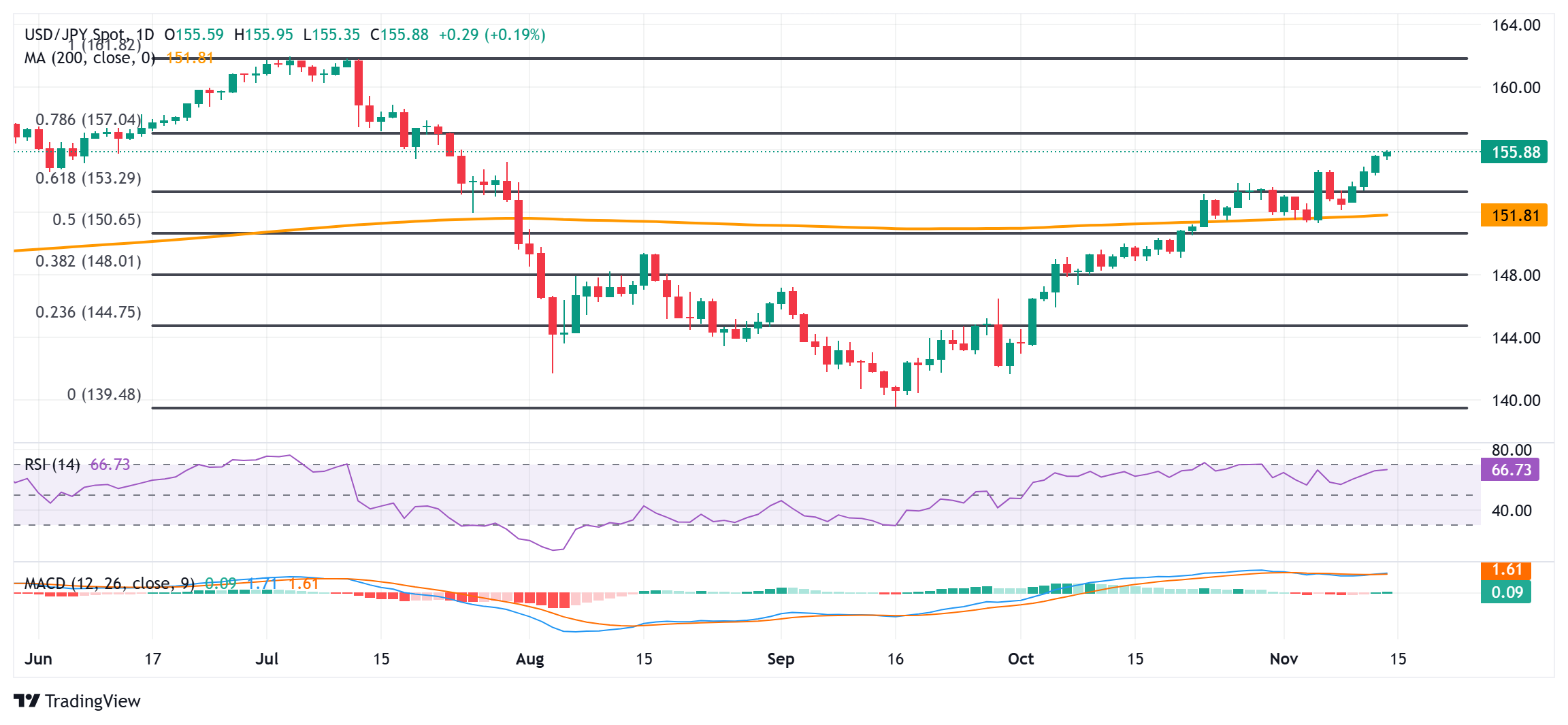
From a technical perspective, the recent breakout through the 61.8% Fibonacci retracement level of the July-September decline and the subsequent close above the 155.00 psychological mark on Wednesday favor bullish traders. Moreover, oscillators on the daily chart are holding comfortably in positive territory and are still away from being in the overbought zone. This, in turn, suggests that the path of least resistance for the USD/JPY pair remains to the upside. Hence, some follow-through strength beyond the 156.00 mark, towards testing the next relevant hurdle near the 156.55-156.60 area, looks like a distinct possibility. The upward trajectory could extend further towards the 157.00 round figure en route to the 157.30-157.35 supply zone.
On the flip side, the Asian session low, around the 155.35-155.30 region, now seems to protect the immediate downside ahead of the 155.00 mark. A sustained break below the latter might prompt some technical selling and drag the USD/JPY pair to the 154.55-154.50 intermediate support en route to the 154.00 round figure and the 153.80 support. This is followed by support near the 153.45 region, which if broken decisively might shift the near-term bias in favor of bearish traders.
Economic Indicator
Fed's Chair Powell speech
Jerome H. Powell took office as a member of the Board of Governors of the Federal Reserve System on May 25, 2012, to fill an unexpired term. On November 2, 2017, President Donald Trump nominated Powell to serve as the next Chairman of the Federal Reserve. Powell assumed office as Chair on February 5, 2018.
Read more.Next release: Thu Nov 14, 2024 20:00
Frequency: Irregular
Consensus: -
Previous: -
Source: Federal Reserve
Author

Haresh Menghani
FXStreet
Haresh Menghani is a detail-oriented professional with 10+ years of extensive experience in analysing the global financial markets.

















