Japanese Yen extends the range play amid doubts over BoJ's rate-hike plans
- The Japanese Yen attracts some haven flows on Tuesday, albeit lacking follow-through.
- The BoJ rate-hike uncertainty acts as a headwind for the JPY amid renewed USD buying.
- A fresh leg up in the US bond yields also contributes to capping the lower-yielding JPY.

The Japanese Yen (JPY) struggles to capitalize on modest intraday gains against its American counterpart and remains confined in a familiar range held over the past week or so amid the uncertainty tied to the Bank of Japan's (BoJ) rate-hike plans. Investors now seem convinced that increased political uncertainty in Japan could restrict the BoJ from tightening its monetary policy. This, along with the underlying bullish sentiment around the equity markets, continues to undermine the safe-haven JPY.
Apart from this, a fresh leg up in the US Treasury bond yields, bolstered by concerns that Trump's inflationary policies will limit the scope for the Federal Reserve (Fed) to cut interest rates, contributes to capping the lower-yielding JPY. Meanwhile, bets for a less dovish Fed revive the US Dollar (USD) demand and assist the USD/JPY pair to rebound nearly 50 pips from the daily trough. Traders now look to the FOMC minutes for cues about the future rate-cut path and some meaningful impetus.
In the meantime, US President-elect Donald Trump's tariff threats could weigh on investors' sentiment and keep a lid on any optimism in the market. This, in turn, benefits the JPY's relative-safe-haven status and warrants some caution before placing aggressive bullish bets around the USD/JPY pair amid fears that Japanese authorities might intervene in the markets to prop up the domestic currency.
Japanese Yen continues with its struggle to gain any meaningful traction
- Data published by the Bank of Japan this Tuesday showed that the Services Producer Price Index (PPI) rose 2.9% YoY in October as compared to 2.6% in the previous month.
- This comes after last week's stronger consumer inflation figures from Japan and BoJ Governor Kazuo Ueda's hawkish remarks and keeps the door open for a December rate hike.
- BoJ Governor Kazuo Ueda has stressed the bank's readiness to raise interest rates again if inflation becomes driven more by robust domestic demand and higher wages.
- Meanwhile, investors have been scaling back their bets for another 25-basis-points rate by the BoJ in December in the wake of increased domestic political uncertainty.
- US President-elect Donald Trump said that he will charge Mexico and Canada a 25% tariff on all products coming into the US and will charge China an additional 10% tariff.
- Concerns about the economic impact of increased duties temper investors' appetite for riskier assets and drive some haven flows towards the Japanese Yen on Tuesday.
- The yield on the benchmark 10-year US government bond fell by the most since early August on Monday in response to Scott Bessent's nomination as the US Treasury secretary.
- Chicago Fed President Austan Goolsbee said on Monday that barring some convincing evidence of overheating, he foresees the central bank continuing to lower rates.
- Separately, Minneapolis Fed President Neel Kashkari said that it is still appropriate to consider another interest-rate reduction at the December FOMC policy meeting.
- Traders have been paring back their expectations for an interest-rate cut by the Federal Reserve in December amid concerns that Trump's policies could boost inflation.
- The US Dollar regains positive traction following the previous day's slide amid a fresh leg up in the US bond yields, which, in turn, should cap the lower-yielding JPY.
- Traders now look forward to the release of the FOMC meeting minutes for cues about the future rate-cut path and determining the near-term trajectory for the Greenback.
- This week's US economic docket also features the first revision of the US Q3 GDP print and the US Personal Consumption and Expenditure (PCE) price Index.
USD/JPY might continue to find support ahead of last week's swing low
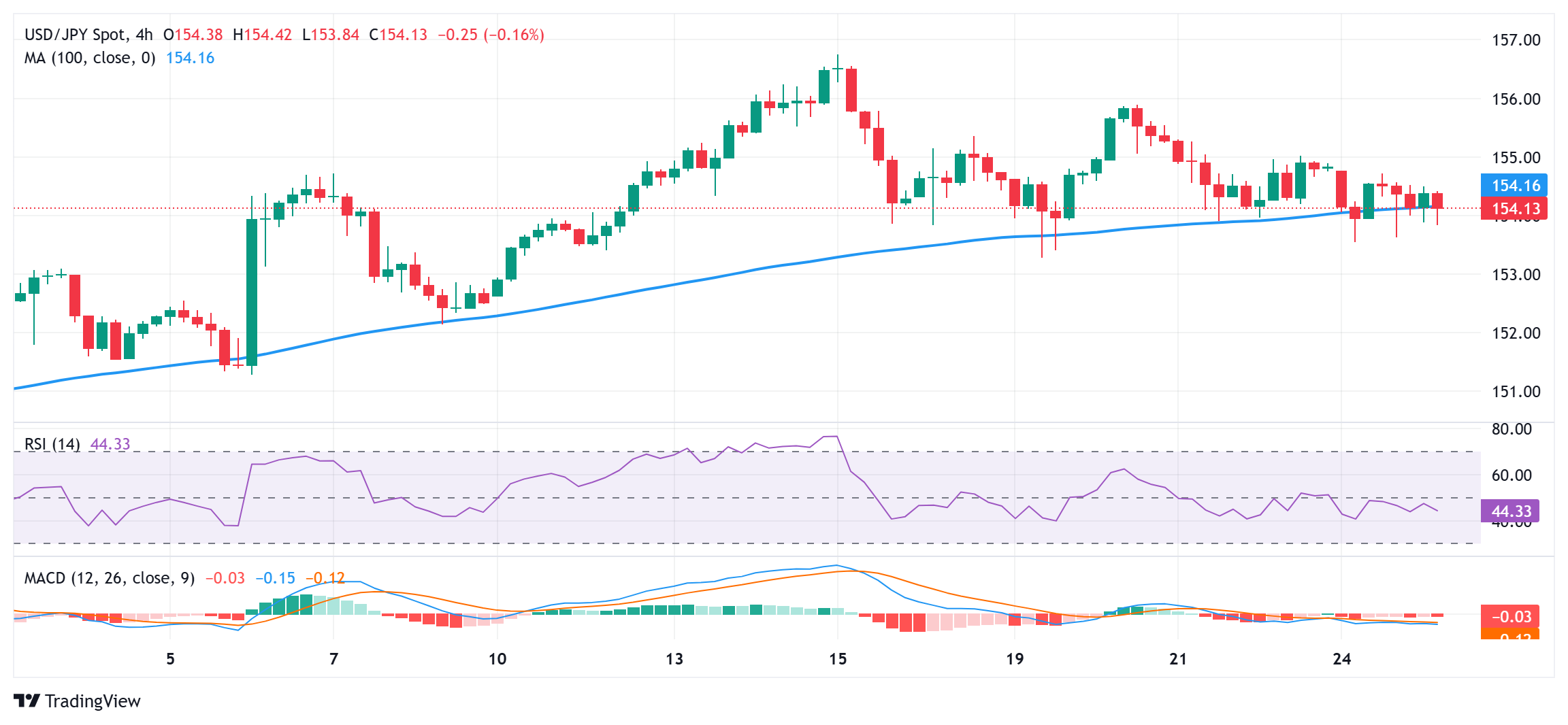
The USD/JPY pair has been consolidating near the 100-period Simple Moving Average (SMA) on the 4-hour chart. Moreover, mixed oscillators on daily and hourly charts make it prudent to wait for some follow-through selling below last week's swing low, around the 153.30-153.25 region, before positioning for any further losses. Spot prices might then weaken further below the 153.00 mark, towards the next relevant support near mid-152.00s en route to the very important 200-day SMA, currently around the 152.00 mark.
On the flip side, the 154.75-154.80 area now seems to have emerged as an immediate strong barrier. A sustained move beyond, leading to a subsequent strength above the 155.00 psychological mark, could lift the USD/JPY pair to the 155.40-155.50 supply zone. The momentum could extend further towards reclaiming the 156.00 mark before spot prices aim to retest the multi-month top, around the 156.75 region touched on November 15.
Economic Indicator
FOMC Minutes
FOMC stands for The Federal Open Market Committee that organizes 8 meetings in a year and reviews economic and financial conditions, determines the appropriate stance of monetary policy and assesses the risks to its long-run goals of price stability and sustainable economic growth. FOMC Minutes are released by the Board of Governors of the Federal Reserve and are a clear guide to the future US interest rate policy.
Read more.Next release: Tue Nov 26, 2024 19:00
Frequency: Irregular
Consensus: -
Previous: -
Source: Federal Reserve
Minutes of the Federal Open Market Committee (FOMC) is usually published three weeks after the day of the policy decision. Investors look for clues regarding the policy outlook in this publication alongside the vote split. A bullish tone is likely to provide a boost to the greenback while a dovish stance is seen as USD-negative. It needs to be noted that the market reaction to FOMC Minutes could be delayed as news outlets don’t have access to the publication before the release, unlike the FOMC’s Policy Statement.
Author

Haresh Menghani
FXStreet
Haresh Menghani is a detail-oriented professional with 10+ years of extensive experience in analysing the global financial markets.