Japanese Yen remains weaker ahead of US PPI
- The downside of the Japanese Yen could be restrained by safe-haven flows amid Middle East tensions.
- Japan's parliament will hold a special session to discuss the BoJ’s last interest rate hike.
- CME’s FedWatch Tool suggests odds of a 50 basis points cut by the Fed in September have dropped to 50%.

The Japanese Yen (JPY) extends its losses against the US Dollar (USD) on Tuesday. The safe-haven flows might limit the downside for the Yen, which could be attributed to rising geopolitical tensions in the Middle East.
Japan's parliament is scheduled to hold a special session on August 23 to discuss the Bank of Japan's (BoJ) decision to raise interest rates last month. The session, organized by the lower house financial affairs committee, is expected to invite BoJ Governor Kazuo Ueda to attend, according to government sources cited by Reuters.
The USD/JPY pair receives support as the pressure on the US Dollar eases due to decreased expectations for a 50 basis point interest rate cut by the US Federal Reserve (Fed) in September. According to CME’s FedWatch Tool, the probability of 50 basis points (bps) cut in September has dropped to 50%, down from 85% last week. However, the rate markets continue to price in a 100% chance of at least a 25 bps cut at the upcoming meeting.
Investors will likely focus on US Producer Price Index (PPI) data set to be released on Tuesday and Consumer Price Index (CPI) figures on Wednesday. Traders are looking for confirmation that price growth remains stable in the United States.
Daily Digest Market Movers: Japanese Yen declines as odds of a 50 bps Fed rate cut diminish
- On Sunday, Federal Reserve Governor Michelle Bowman stated that she continues to see upside risks for inflation and ongoing strength in the labor market. Bowman suggested that the Federal Reserve may not be prepared to cut rates at its next meeting in September, according to Bloomberg.
- As per a Bloomberg report last week, JP Morgan Asset Management (JPAM) believes the Bank of Japan is unlikely to raise interest rates in the near term. According to JPAM, the BoJ may only consider further rate hikes if the Federal Reserve cuts rates and the US economy stabilizes. They anticipate that any additional tightening by the BoJ is more likely to occur in 2025, provided the global economic environment remains stable.
- The Bank of Japan’s Summary of Opinions from the Monetary Policy Meeting on July 30 and 31 indicated that several members believe economic activity and prices are evolving as expected by the BoJ. They are aiming for a neutral rate of "at least around 1%" as a medium-term target.
- Last week, BoJ Deputy Governor Shinichi Uchida also noted that BoJ's interest rate strategy will adapt if market volatility alters economic forecasts, risk assessments, or projections. Given recent market volatility, he emphasized the need for careful monitoring of the economic and price impacts of their policies, stating, “We must maintain the current degree of monetary easing for the time being.”
- The minutes from the Bank of Japan's June meeting indicated that some members voiced concerns about rising import prices due to the recent decline in the JPY, which could present an upside risk to inflation. One member highlighted that cost-push inflation might exacerbate underlying inflation if it leads to increased inflation expectations and wage hikes.
Technical Analysis: USD/JPY tests 147.50; next barrier at nine-day EMA
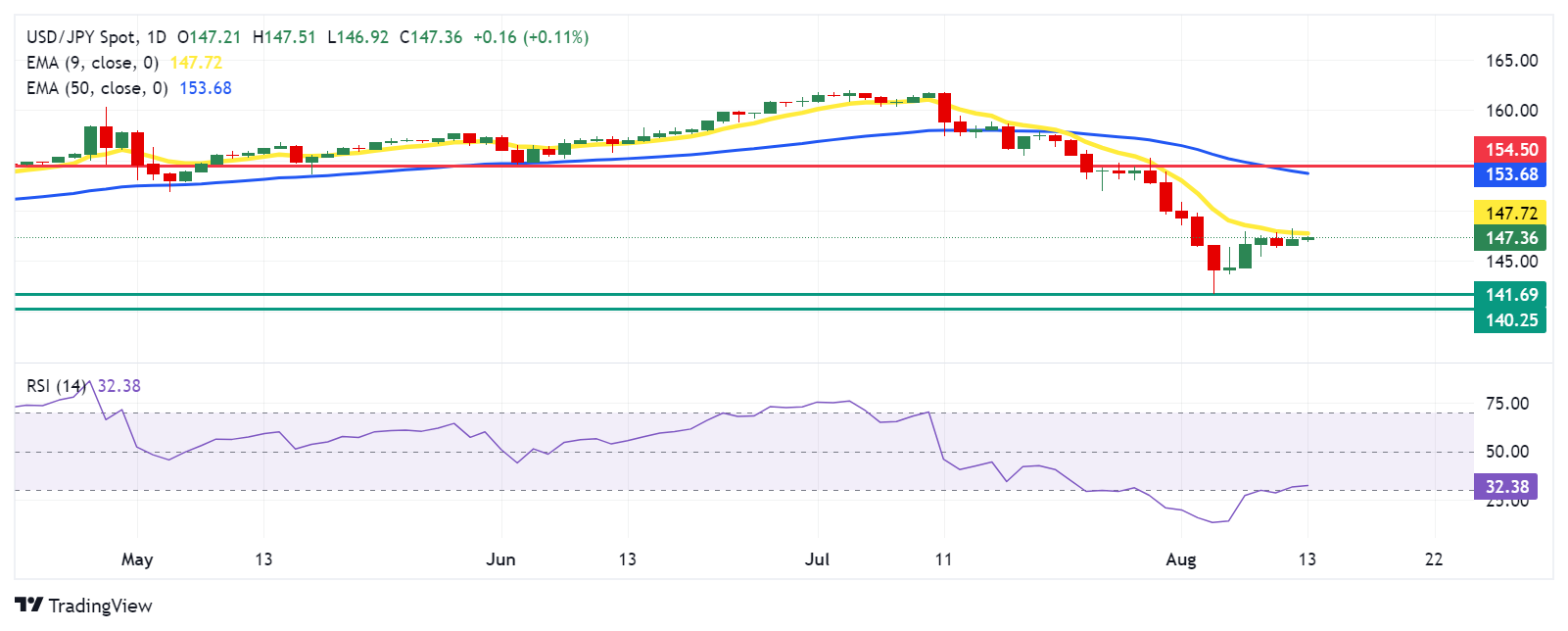
USD/JPY trades around 147.40 on Tuesday. The daily chart analysis shows that the pair remains below the nine-day Exponential Moving Average (EMA), suggesting a bearish trend in the short term. Moreover, the 14-day Relative Strength Index (RSI) has breached above the 30 level, suggesting a potential for a correction. If the RSI moves toward the 50 level, it could signal a potential improvement in the pair's momentum.
For support levels, the USD/JPY pair may test a seven-month low at 141.69, recorded on August 5, followed by the throwback support at 140.25.
On the upside, the USD/JPY pair could test the immediate barrier at the nine-day EMA around the 147.72 level. A breakout above this level could diminish bearish momentum and allow the pair to approach the 50-day EMA at 153.68, followed by the "throwback support turned resistance" at 154.50.
USD/JPY: Daily Chart
Japanese Yen PRICE Today
The table below shows the percentage change of Japanese Yen (JPY) against listed major currencies today. Japanese Yen was the weakest against the New Zealand Dollar.
| USD | EUR | GBP | JPY | CAD | AUD | NZD | CHF | |
|---|---|---|---|---|---|---|---|---|
| USD | 0.02% | -0.29% | 0.43% | -0.09% | -0.22% | 0.10% | 0.18% | |
| EUR | -0.02% | -0.32% | 0.39% | -0.14% | -0.25% | -0.42% | 0.12% | |
| GBP | 0.29% | 0.32% | 0.70% | 0.19% | 0.06% | -0.09% | 0.47% | |
| JPY | -0.43% | -0.39% | -0.70% | -0.54% | -0.63% | -0.81% | -0.25% | |
| CAD | 0.09% | 0.14% | -0.19% | 0.54% | -0.13% | -0.30% | 0.26% | |
| AUD | 0.22% | 0.25% | -0.06% | 0.63% | 0.13% | -0.15% | 0.41% | |
| NZD | -0.10% | 0.42% | 0.09% | 0.81% | 0.30% | 0.15% | 0.56% | |
| CHF | -0.18% | -0.12% | -0.47% | 0.25% | -0.26% | -0.41% | -0.56% |
The heat map shows percentage changes of major currencies against each other. The base currency is picked from the left column, while the quote currency is picked from the top row. For example, if you pick the Japanese Yen from the left column and move along the horizontal line to the US Dollar, the percentage change displayed in the box will represent JPY (base)/USD (quote).
Japanese Yen FAQs
The Japanese Yen (JPY) is one of the world’s most traded currencies. Its value is broadly determined by the performance of the Japanese economy, but more specifically by the Bank of Japan’s policy, the differential between Japanese and US bond yields, or risk sentiment among traders, among other factors.
One of the Bank of Japan’s mandates is currency control, so its moves are key for the Yen. The BoJ has directly intervened in currency markets sometimes, generally to lower the value of the Yen, although it refrains from doing it often due to political concerns of its main trading partners. The current BoJ ultra-loose monetary policy, based on massive stimulus to the economy, has caused the Yen to depreciate against its main currency peers. This process has exacerbated more recently due to an increasing policy divergence between the Bank of Japan and other main central banks, which have opted to increase interest rates sharply to fight decades-high levels of inflation.
The BoJ’s stance of sticking to ultra-loose monetary policy has led to a widening policy divergence with other central banks, particularly with the US Federal Reserve. This supports a widening of the differential between the 10-year US and Japanese bonds, which favors the US Dollar against the Japanese Yen.
The Japanese Yen is often seen as a safe-haven investment. This means that in times of market stress, investors are more likely to put their money in the Japanese currency due to its supposed reliability and stability. Turbulent times are likely to strengthen the Yen’s value against other currencies seen as more risky to invest in.
Author

Akhtar Faruqui
FXStreet
Akhtar Faruqui is a Forex Analyst based in New Delhi, India. With a keen eye for market trends and a passion for dissecting complex financial dynamics, he is dedicated to delivering accurate and insightful Forex news and analysis.