Japanese Yen bears turn cautious ahead of crucial FOMC/BoJ policy decisions
- The Japanese Yen attracts some sellers following the release of Japanese Trade Balance data.
- Bets that the BoJ will keep rates unchanged and elevated US bond yields also weigh on the JPY.
- Traders keenly await the crucial FOMC decision, ahead of the BoJ policy update on Thursday.

The Japanese Yen (JPY) recovers modest Asian session losses against its American counterpart, though any meaningful upside seems elusive amid expectations that the Bank of Japan (BoJ) will hold rates steady later this week. Furthermore, the recent rally in the US Treasury bond yields, fueled by bets that the Federal Reserve (Fed) will adopt a more cautious stance on cutting interest rates, should contribute to capping the lower-yielding JPY.
That said, persistent geopolitical risks, trade war fears and the cautious market mood could act as a tailwind for the safe-haven JPY. Traders might also refrain from placing aggressive directional bets ahead of the key central bank event risks – the outcome of the highly-anticipated two-day FOMC meeting later this Wednesday and the BoJ decision on Thursday. Nevertheless, the fundamental backdrop seems tilted in favor of the JPY bears.
Japanese Yen bears have the upper hand ahead of key central bank event risks
- A report published by Japan's Ministry of Finance showed on Wednesday that the country's trade deficit unexpectedly improved in November and came in at ¥117.6 billion compared to October’s deficit of ¥462.1 billion.
- The improvement was driven by strong growth in exports, which increased by 3.8% year-on-year in November amid a weaker Japanese Yen and a pickup in demand from Japan’s biggest trading partners – the US and China.
- The upbeat reading, however, was offset by a 3.8% decline in Japanese imports, which, along with expectations that the Bank of Japan will not hike interest rates later this week, attracts fresh sellers around the JPY.
- The yield on the benchmark 10-year US government bond shot to its highest level since November 22 following the release of US Retail Sales data, which underscored robust consumer spending and economic resilience.
- The Commerce Department reported that sales at the retail level increased by 0.7% in November compared to the 0.5% growth recorded in the previous month, while sales ex Autos fell short of expectations and rose 0.2%.
- The report, meanwhile, had little impact on market expectations that the Federal Reserve will lower borrowing costs for the third time, by 25 basis points at the end of a two-day policy meeting later this Wednesday.
- However, signs that the progress towards bringing inflation back to the central bank's 2% target suggest that the Fed could adopt a more cautious stance and pause its rate-cutting cycle at the January policy meeting.
- Hence, investors will scrutinize the updated economic projections, which include the so-called dot plot, and Fed Chair Jerome Powell's comments at the post-meeting press conference for cues about the rate-cut path.
- The market attention will then shift to the crucial BoJ policy decision, scheduled during the Asian session on Thursday, which should further contribute to providing a fresh directional impetus to the USD/JPY pair.
USD/JPY dips might still be seen as buying opportunity and remain limited
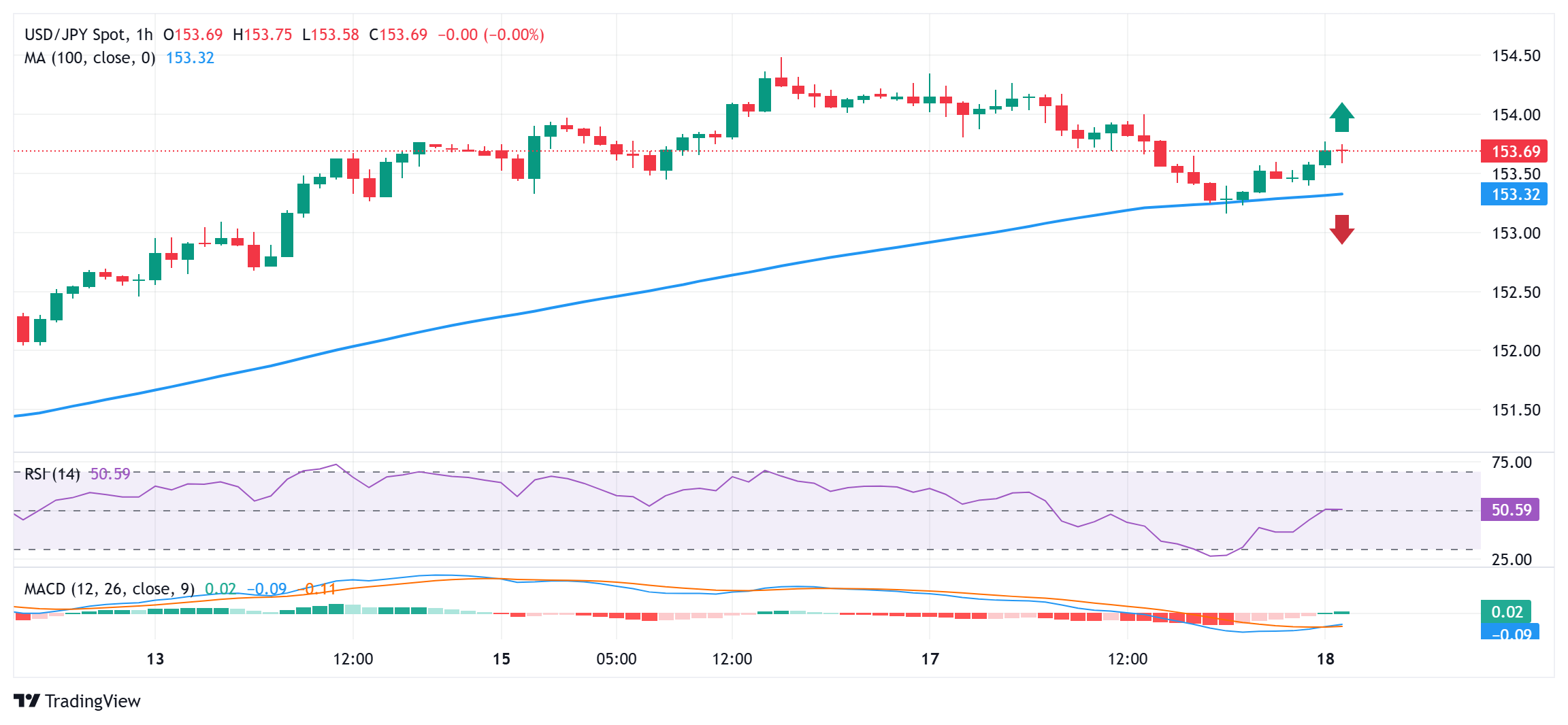
From a technical perspective, the emergence of some dip-buying on Wednesday comes on top of the recent breakout through the very important 200-day Simple Moving Average (SMA) and favors bullish traders. Moreover, oscillators on the daily chart have been gaining positive traction and are still far from being in the overbought territory, suggesting that the path of least resistance for the USD/JPY pair is to the upside. Any further move up, however, might face some resistance near the 154.00 mark ahead of the 154.45-154.50 region, or a three-week top touched on Monday. A sustained move beyond the latter should pave the way for a move towards reclaiming the 155.00 psychological mark. The momentum could extend further towards the next relevant hurdle near mid-155.00s en route to the 156.00 mark and the 156.25 supply zone.
On the flip side, the 153.15 area, or the overnight swing low, now seems to protect the immediate downside. Some follow-through selling below the 153.00 mark could drag the USD/JPY pair back towards the 200-day SMA pivotal support, near the 152.15 region. Failure to defend the said support levels might shift the bias in favor of bearish traders and make spot prices vulnerable to accelerate the slide towards the 151.00 round figure en route to the 150.00 psychological mark.
Economic Indicator
Fed Interest Rate Decision
The Federal Reserve (Fed) deliberates on monetary policy and makes a decision on interest rates at eight pre-scheduled meetings per year. It has two mandates: to keep inflation at 2%, and to maintain full employment. Its main tool for achieving this is by setting interest rates – both at which it lends to banks and banks lend to each other. If it decides to hike rates, the US Dollar (USD) tends to strengthen as it attracts more foreign capital inflows. If it cuts rates, it tends to weaken the USD as capital drains out to countries offering higher returns. If rates are left unchanged, attention turns to the tone of the Federal Open Market Committee (FOMC) statement, and whether it is hawkish (expectant of higher future interest rates), or dovish (expectant of lower future rates).
Read more.Next release: Wed Dec 18, 2024 19:00
Frequency: Irregular
Consensus: 4.5%
Previous: 4.75%
Source: Federal Reserve
Author

Haresh Menghani
FXStreet
Haresh Menghani is a detail-oriented professional with 10+ years of extensive experience in analysing the global financial markets.

















