Gold price holds firm despite higher US Treasury yields
- Gold price holds steady, unfazed by the US Dollar's drop and higher Treasury yields.
- US Dollar Index dips to a five-day low, amidst speculation of fiscal policy changes driving inflation fears.
- Fed's cautious stance on rate cuts highlighted by Governor Cook in light of ongoing economic slowdown and persistent inflation.

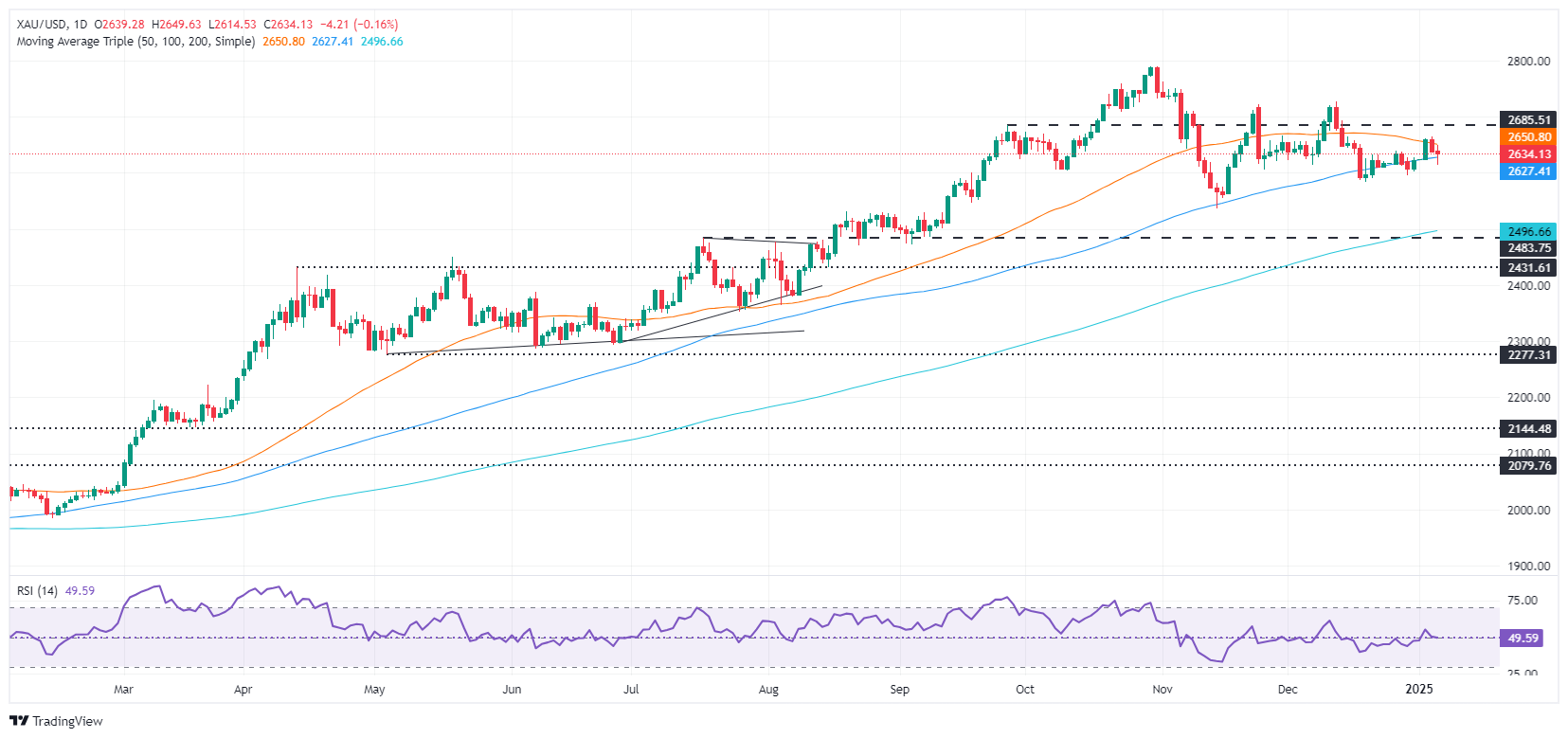
Gold prices remained flat at the beginning of the week even though the Greenback is getting battered. Higher United States (US) Treasury bond yields kept the non-yielding metal pressured while US President-elect Donald Trump grabbed the headlines amid confusion on his tariff plans. The XAU/USD trades at $2,638, virtually unchanged.
Yellow Metal failed to capitalize on the sudden weakness of the US Dollar. Speculation that the upcoming Trump administration agenda could reignite inflation spurred a jump in US Treasury yields amid fears that a Republican-controlled Congress could increase the Government’s budget deficit.
The US Dollar Index (DXY), which tracks the buck’s performance against a basket of six currencies, fell to a five-day low of 107.75 and is down 0.60% at 108.27 at the time of writing.
US data revealed during the day reaffirmed that the economy continues to slow down amid a “timid” reacceleration of inflation. S&P Global reported that business activity in the services segment dipped, while the US Census Bureau announced that Factory Orders plunged in November after hitting a record high in the previous month.
In the central bank space, Federal Reserve (Fed) Governor Lisa Cook said they could adopt a gradual approach to reducing interest rates. She explained that due to the resilience of the labor market and persistent inflation, policymakers can be more cautious.
This week, the US economic docket will feature the ISM Services PMI, the Federal Open Market Committee (FOMC) meeting minutes, Initial Jobless Claims and December’s US Nonfarm Payrolls report.
Daily digest market movers: Gold price steadies at around $2,630
- Gold remains pressured as US real yields rise four basis points (bps) up to 2.26%.
- The US 10-year T-note yield edges up two and a half bps to 4.628%.
- US S&P Global Services PMI in December slowed from 58.5 to 56.8, exceeding estimates of 56.1.
- US Factory Orders in November dropped by 0.4% MoM from October’s upwardly revised figures of 0.5%. Economists expected a contraction of -0.3%.
- At the time of writing, the CME Fed Watch Tool shows that investors have pushed back the odds of the Fed's first rate cut until the May 7 meeting.
- Goldman Sachs modified its forecast to gold prices and doesn’t expect the yellow metal to reach $3,000 an ounce by the end of 2025, based on the expectation that the Fed will make fewer rate cuts.
XAU/USD technical outlook: Gold price set to challenge $2,650
Gold price ended 2024 trapped within the $2,600 - $2,620 range amid a robust US Dollar on fears of Trump’s agenda. Nevertheless, the non-yielding metal has broken the top of that range, which opened the door to XAU/USD to exchange hands at around the $2,630 - $2,650 level, with the 50-day Simple Moving Average (SMA) meandering around $2,652.
If bulls clear the 50-day SMA, the next key resistance level would be $2,700 ahead of challenging the December 12 peak at $2,726. If surpassed, the next stop would be the record high at $2,790.
Conversely, if sellers drag the XAU/USD below the 100-day SMA, look for a test of $2,500 before Gold extends its losses to the 200-day SMA at $2,494.
Gold FAQs
Gold has played a key role in human’s history as it has been widely used as a store of value and medium of exchange. Currently, apart from its shine and usage for jewelry, the precious metal is widely seen as a safe-haven asset, meaning that it is considered a good investment during turbulent times. Gold is also widely seen as a hedge against inflation and against depreciating currencies as it doesn’t rely on any specific issuer or government.
Central banks are the biggest Gold holders. In their aim to support their currencies in turbulent times, central banks tend to diversify their reserves and buy Gold to improve the perceived strength of the economy and the currency. High Gold reserves can be a source of trust for a country’s solvency. Central banks added 1,136 tonnes of Gold worth around $70 billion to their reserves in 2022, according to data from the World Gold Council. This is the highest yearly purchase since records began. Central banks from emerging economies such as China, India and Turkey are quickly increasing their Gold reserves.
Gold has an inverse correlation with the US Dollar and US Treasuries, which are both major reserve and safe-haven assets. When the Dollar depreciates, Gold tends to rise, enabling investors and central banks to diversify their assets in turbulent times. Gold is also inversely correlated with risk assets. A rally in the stock market tends to weaken Gold price, while sell-offs in riskier markets tend to favor the precious metal.
The price can move due to a wide range of factors. Geopolitical instability or fears of a deep recession can quickly make Gold price escalate due to its safe-haven status. As a yield-less asset, Gold tends to rise with lower interest rates, while higher cost of money usually weighs down on the yellow metal. Still, most moves depend on how the US Dollar (USD) behaves as the asset is priced in dollars (XAU/USD). A strong Dollar tends to keep the price of Gold controlled, whereas a weaker Dollar is likely to push Gold prices up.
Author

Christian Borjon Valencia
FXStreet
Markets analyst, news editor, and trading instructor with over 14 years of experience across FX, commodities, US equity indices, and global macro markets.