Gold price rises above $2,400 on risk-off mood ahead of Fed's decision
- Gold price surpasses $2,400 after Israel's attack on Lebanon.
- US Treasury yield dip and weak USD support Gold price despite strong US job market data.
- Europe’s largest economy, Germany, enters recession, fueling ECB rate cut expectations in September.


Gold prices jumped during Tuesday’s North American session on news of Israel’s attack on Lebanon, which sent the XAU/USD spot price soaring above the $2,400 figure. Earlier, the golden metal hovered around the latter, even though solid US data reinforced the tightness of the jobs market. The XAU/USD trades at $2,404, up by more than 0.80%.
Sentiment is mixed, though a dip in US Treasury bond yields and the Greenback sponsored bullion’s leg up as market participants brace for the Federal Reserve (Fed) monetary policy decision on Wednesday.
Economic data from Europe witnessed Germany, the largest economy in the block, entering recessionary territory following weaker-than-expected preliminary Gross Domestic Product (GDP) Q2 2024 readings. This could spur a reaction from the European Central Bank (ECB), which is expected to reduce interest rates in September.
Meanwhile, geopolitical risks spurred Gold’s jump above $2,400 after Israel launched an attack on Beirut’s southern suburbs, aimed at targeting a Hezbollah commander, according to sources cited by Reuters.
Across the pond, the Fed is expected to hold rates flat but to deliver a dovish message that could hint to market participants at the beginning of the easing cycle.
Nevertheless, US jobs data revealed on Tuesday could deter the Fed from reacting dovishly after job openings for June exceeded estimates despite trailing revised figures of May upward. In fact, market players expect Fed Chair Jerome Powell to push back against aggressive monetary policy pricing by the financial markets.
Besides that, investors are eyeing the release of the Institute for Supply Management (ISM) Manufacturing PMI and the Nonfarm Payrolls (NFP) report, both for July figures.
Daily digest market movers: Gold price shrugs off strong US jobs data
- US Job Openings and Labor Turnover Survey (JOLTS) reported 8.184 million job openings, exceeding estimates of 8 million but slightly lower than May’s revised figure of 8.23 million.
- Conference Board reveals that Consumer Confidence in July unexpectedly rose to 100.3, surpassing the consensus of 99.7 and June’s downwardly revised figure of 97.8 from 100.4.
- Last week’s US inflation data indicated continued progress toward the 2% target; however, inflation appears stickier than anticipated as June's Core PCE figures exceeded estimates for both monthly and yearly numbers.
- Data from the Chicago Board of Trade (CBOT) indicates that traders are pricing in 54 basis points (bps) of easing toward the end of the year, according to the December 2024 fed funds rate futures contract.
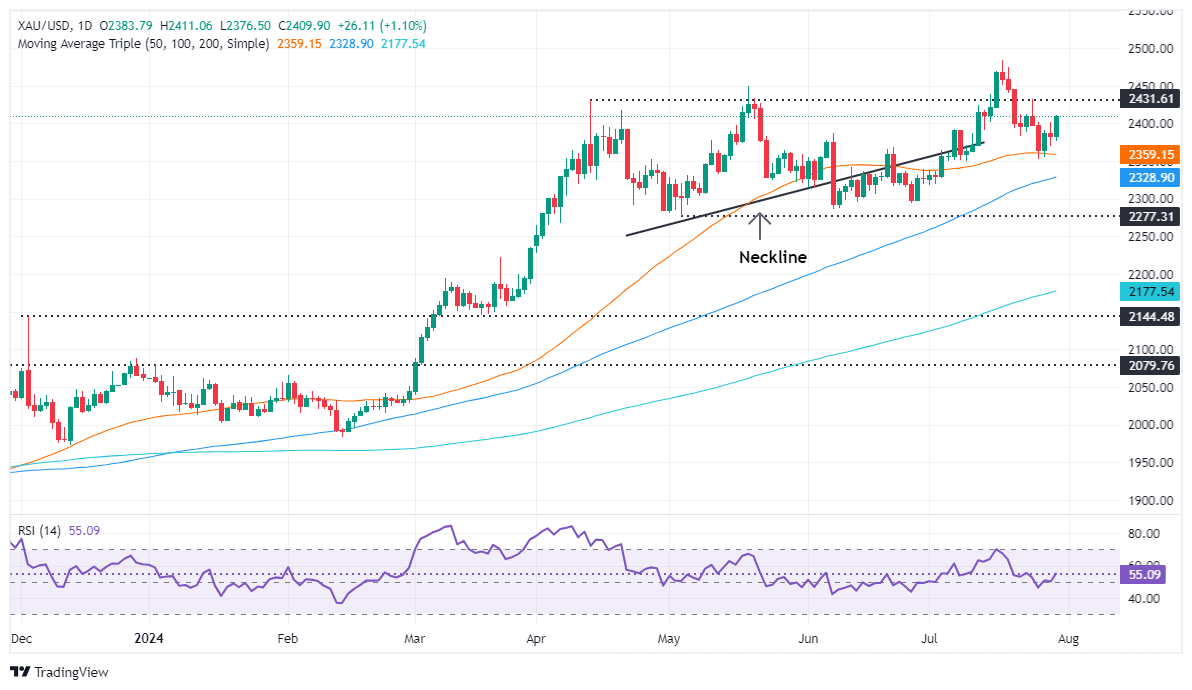
Technical analysis: Gold price climbs above $2,400
Gold price remains upwardly biased, and if it achieves a daily close above $2,400 that could pave the way for further upside. Momentum indicates the path of least resistance is skewed to the upside, yet the Fed’s decision or Powell press conference could drag prices lower.
If XAU/USD buyers reclaim the psychological $2,450 area, that could sponsor a leg up to challenge the all-time high at around $2,483, followed by the $2,500 mark.
On the flip side, if XAU/USD falls below $2,400, the next support would be the 50-day Simple Moving Average (SMA) at $2,358. Once cleared, further losses are on the cards.
The next support would be the July 25 daily low of $2,353. Once those levels are removed, the 100-DMA would be up next at $2,326, ahead of diving to the $2,300 mark.
Fed FAQs
Monetary policy in the US is shaped by the Federal Reserve (Fed). The Fed has two mandates: to achieve price stability and foster full employment. Its primary tool to achieve these goals is by adjusting interest rates. When prices are rising too quickly and inflation is above the Fed’s 2% target, it raises interest rates, increasing borrowing costs throughout the economy. This results in a stronger US Dollar (USD) as it makes the US a more attractive place for international investors to park their money. When inflation falls below 2% or the Unemployment Rate is too high, the Fed may lower interest rates to encourage borrowing, which weighs on the Greenback.
The Federal Reserve (Fed) holds eight policy meetings a year, where the Federal Open Market Committee (FOMC) assesses economic conditions and makes monetary policy decisions. The FOMC is attended by twelve Fed officials – the seven members of the Board of Governors, the president of the Federal Reserve Bank of New York, and four of the remaining eleven regional Reserve Bank presidents, who serve one-year terms on a rotating basis.
In extreme situations, the Federal Reserve may resort to a policy named Quantitative Easing (QE). QE is the process by which the Fed substantially increases the flow of credit in a stuck financial system. It is a non-standard policy measure used during crises or when inflation is extremely low. It was the Fed’s weapon of choice during the Great Financial Crisis in 2008. It involves the Fed printing more Dollars and using them to buy high grade bonds from financial institutions. QE usually weakens the US Dollar.
Quantitative tightening (QT) is the reverse process of QE, whereby the Federal Reserve stops buying bonds from financial institutions and does not reinvest the principal from the bonds it holds maturing, to purchase new bonds. It is usually positive for the value of the US Dollar.
Author
Christian Borjon Valencia
FXStreet
Markets analyst, news editor, and trading instructor with over 14 years of experience across FX, commodities, US equity indices, and global macro markets.