Gold trades higher on robust central-bank demand
- Gold edges higher as global central bank buying remains buoyant despite PBoC’s absence.
- Powell makes signs that the Fed is weighing a rate cut but is too shy to name a date.
- The uncertainty dampens volatility for the interest-rate-sensitive precious metal.
Gold (XAU/USD) is edging higher on Wednesday, continuing to recover after the PBoC-related sell-off on Monday.
This comes after data emerged showing that worldwide central bank demand for Gold remains buoyant. This has balanced out the negative impact of the news that the largest consumer of Gold, the People’s Bank of China (PBoC), stopped buying the precious metal in June – extending its parsimony for another month after it also closed its wallet in May – following an 18-month buying spree.
Gold rises despite Powell’s reluctance to name a date
Gold shrugged off Federal Reserve (Fed) Chairman Jerome Powell’s testimony to the Senate Banking Committee on Tuesday, in which he refused to give a date for a first interest-rate cut, saying instead that the Fed would adopt a data-dependent approach to interest rates.
Investors had been hoping for more concrete details of when the Fed would cut interest rates, and Powell’s mute retrenchment ought to have weakened Gold more than it did. The reason for this is that delays in cutting rates might mean borrowing costs stay elevated for longer – a negative for Gold as it keeps the opportunity cost of holding the precious metal high. Gold is a non-interest-bearing asset, which becomes less attractive to investors if they can earn higher interest elsewhere.
At the same time, Powell did make some statements that acted as an antidote. For example, he acknowledged progress had been made on inflation and discounted the possibility of rate hikes. He also said there was a balance of risks to waiting too long (to cut interest rates) or acting too soon, suggesting a finely balanced situation.
Gold stays bid on news other central banks are buying
Gold keeps its shine on Wednesday, trading in the $2,370s. The yellow metal finds upside momentum after it emerged that, despite the PBoC ceasing to increase its reserves, other major central banks were still buying substantial amounts of Gold.
“Other central banks continue to participate, with India's central bank buying more than nine tons of Gold in June, the National Bank of Poland increasing its Gold reserves by four tons and the Czech National Bank showing that its Gold reserves rose by some two tons in June. With these central banks continuing to build Gold positions, it is quite evident that the official sector is much broader than just the PBoC,” said Bert Melek, Head of Commodity Strategy at TD Securities.
To sum up, it is unlikely China’s absence from the market will prevent the commodity from rising to TD’s target of $2,475 in Q1 of 2025, according to TD’s Malek.
Technical Analysis: Gold continues slow recovery
Gold is recovering for the second day in a row after it formed a bearish two-bar reversal pattern (green-shaded rectangle in the chart below) at the top of the early-July move. This pattern forms after a long green-up day is followed by a long red-down day of a similar length and size. It can be a sign of a short-term reversal.
XAU/USD Daily Chart
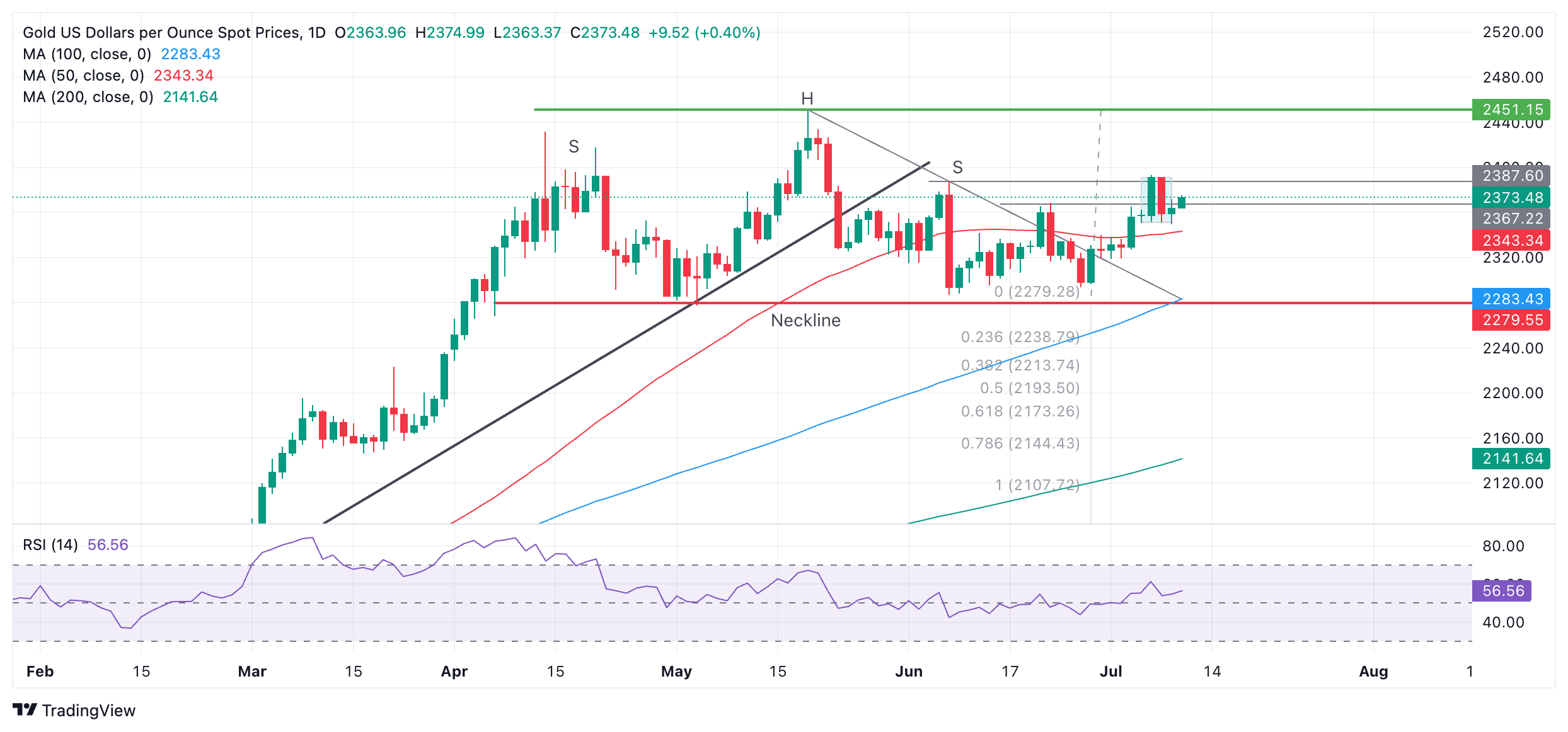
The outlook is unclear. There is a risk Gold could pull back to the 50-day Simple Moving Average (SMA) at $2,343.
That said, the break above the downward trendline on June 27 turned the tables for the precious metal, establishing a more bullish outlook.
If Gold breaks above Friday’s peak of $2,393, it will continue the sequence of higher highs and probably unlock the next target at the $2,451 all-time high.
The bearish Head & Shoulders (H&S) topping pattern that formed from April to June has been invalidated by the recent recovery. However, there is still a chance – albeit much reduced – that a more complex topping pattern may have formed instead.
If a complex pattern has formed in place of the H&S, and the price breaks below the pattern’s neckline at $2,279, a reversal lower may still be possible with a conservative target at $2,171, the 0.618 ratio of the height of the pattern extrapolated lower.
The trend is now sideways in both the short and medium term. In the long term, Gold remains in an uptrend.
Gold FAQs
Gold has played a key role in human’s history as it has been widely used as a store of value and medium of exchange. Currently, apart from its shine and usage for jewelry, the precious metal is widely seen as a safe-haven asset, meaning that it is considered a good investment during turbulent times. Gold is also widely seen as a hedge against inflation and against depreciating currencies as it doesn’t rely on any specific issuer or government.
Central banks are the biggest Gold holders. In their aim to support their currencies in turbulent times, central banks tend to diversify their reserves and buy Gold to improve the perceived strength of the economy and the currency. High Gold reserves can be a source of trust for a country’s solvency. Central banks added 1,136 tonnes of Gold worth around $70 billion to their reserves in 2022, according to data from the World Gold Council. This is the highest yearly purchase since records began. Central banks from emerging economies such as China, India and Turkey are quickly increasing their Gold reserves.
Gold has an inverse correlation with the US Dollar and US Treasuries, which are both major reserve and safe-haven assets. When the Dollar depreciates, Gold tends to rise, enabling investors and central banks to diversify their assets in turbulent times. Gold is also inversely correlated with risk assets. A rally in the stock market tends to weaken Gold price, while sell-offs in riskier markets tend to favor the precious metal.
The price can move due to a wide range of factors. Geopolitical instability or fears of a deep recession can quickly make Gold price escalate due to its safe-haven status. As a yield-less asset, Gold tends to rise with lower interest rates, while higher cost of money usually weighs down on the yellow metal. Still, most moves depend on how the US Dollar (USD) behaves as the asset is priced in dollars (XAU/USD). A strong Dollar tends to keep the price of Gold controlled, whereas a weaker Dollar is likely to push Gold prices up.
Author

Joaquin Monfort
FXStreet
Joaquin Monfort is a financial writer and analyst with over 10 years experience writing about financial markets and alt data. He holds a degree in Anthropology from London University and a Diploma in Technical analysis.