Gold rallies on dovish Fedspeak and simmering geopolitical tensions
- Gold rises for the fourth day in a row on Thursday as traders reach for safety.
- Underwhelming Nvidia earnings, talks about cutting interest rates from Fed speakers and Russia-nuke risks all impact.
- XAU/USD forms a bullish Three White Soldiers Japanese candlestick pattern.

Gold (XAU/USD) extends its recovery into a fourth day on Thursday, rising up into the $2,660s. An overall risk-off tone to markets due to disappointment at Nvidia’s results is weaning investors off stocks and catalyzing safe-haven flows into Gold.
Thursday’s mildly weaker US Dollar (USD) is a further tailwind for Gold since it is mostly priced and traded in USD. Continued haven flows from geopolitical fears relating to Russia’s lowering of the threshold for using nuclear weapons is another factor.
Capping gains for the precious metal, however, is competition from Bitcoin (BTC). According to Bloomberg News, a surge in Bitcoin Exchange Traded Fund (ETF) inflows in November – ETFs enable investors to own shares that track BTC’s price rather than owning the asset itself – has coincided with a similar surge in outflows from Gold ETFs. This suggests a direct pivot away from owning Gold and into Bitcoin.
Gold extends reversal after Nvidia earnings release
Gold is pushing higher on Thursday after the third quarter earnings release from Nvidia triggered a decline in stock markets. Although Nvidia’s Q3 earnings beat estimates and were initially met with euphoria, the stock itself slumped 3.0% following the release.
The unintuitive response was put down to the results not quite being good enough to match “the sky-high expectations for the AI colossus,” according to Forbes. The overall risk-off tone left in the wake of the disappointment led to a broad decline in investor sentiment, which for Gold and other safe-haven assets was positive news.
The US Dollar (USD), meanwhile, is edging slightly lower after surging on Wednesday. The Greenback appears to have been stopped in its tracks by commentary from Federal Reserve (Fed) speakers suggesting the Fed should push ahead with its plan to cut interest rates amid falling inflation. This goes surprisingly against the widespread view that inflation will rise under a Trump presidency.
Bank of New York President John Williams said he “sees inflation cooling and interest rates falling further,” in an interview with Barron's on Thursday. This followed similar comments from Federal Reserve Bank of Boston President Susan Collins, who said on Wednesday that more interest-rate cuts are needed, but policymakers should proceed carefully.
Technical Analysis: XAU/USD paints three white soldiers marching higher
Gold rises for the fourth consecutive day and paints a bullish “Three White Soldiers” Japanese candlestick pattern (green rectangle on the chart below) from last week’s lows.
XAU/USD Daily Chart
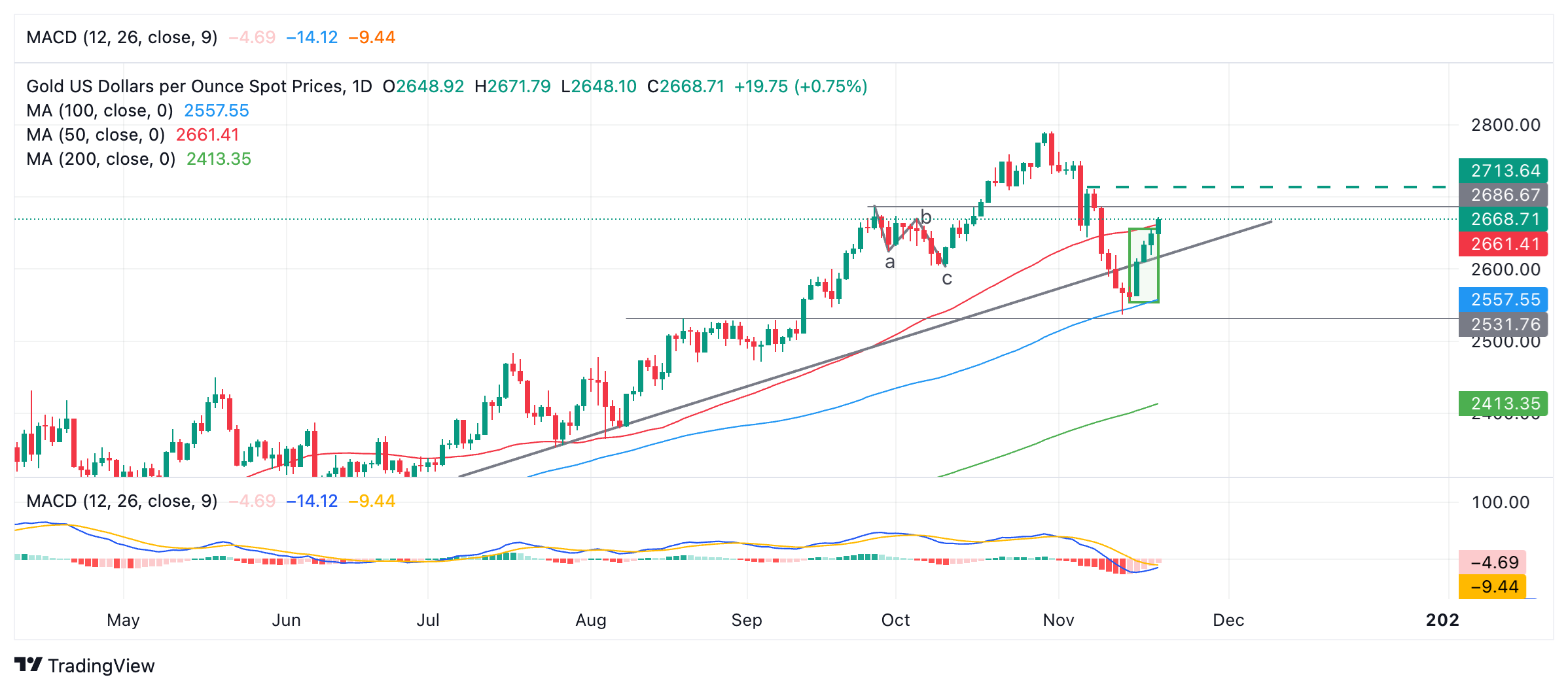
Gold has broken clearly back above a major long-term trendline and is attempting to break above the (red) 50-day Simple Moving Average (SMA) at $2,661. These are bullish signs.
The precious metal’s short-term trend is bullish, and given the maxim that “the trend is your friend,” the odds favor a continuation higher. The next target to the upside lies at $2,686, the September 26 high.
That said, the precious metal is in a downtrend on a medium-term trend, raising risks for the outlook. It is in an uptrend on a long-term basis, however, which supports the bullish shorter-term view.
Gold FAQs
Gold has played a key role in human’s history as it has been widely used as a store of value and medium of exchange. Currently, apart from its shine and usage for jewelry, the precious metal is widely seen as a safe-haven asset, meaning that it is considered a good investment during turbulent times. Gold is also widely seen as a hedge against inflation and against depreciating currencies as it doesn’t rely on any specific issuer or government.
Central banks are the biggest Gold holders. In their aim to support their currencies in turbulent times, central banks tend to diversify their reserves and buy Gold to improve the perceived strength of the economy and the currency. High Gold reserves can be a source of trust for a country’s solvency. Central banks added 1,136 tonnes of Gold worth around $70 billion to their reserves in 2022, according to data from the World Gold Council. This is the highest yearly purchase since records began. Central banks from emerging economies such as China, India and Turkey are quickly increasing their Gold reserves.
Gold has an inverse correlation with the US Dollar and US Treasuries, which are both major reserve and safe-haven assets. When the Dollar depreciates, Gold tends to rise, enabling investors and central banks to diversify their assets in turbulent times. Gold is also inversely correlated with risk assets. A rally in the stock market tends to weaken Gold price, while sell-offs in riskier markets tend to favor the precious metal.
The price can move due to a wide range of factors. Geopolitical instability or fears of a deep recession can quickly make Gold price escalate due to its safe-haven status. As a yield-less asset, Gold tends to rise with lower interest rates, while higher cost of money usually weighs down on the yellow metal. Still, most moves depend on how the US Dollar (USD) behaves as the asset is priced in dollars (XAU/USD). A strong Dollar tends to keep the price of Gold controlled, whereas a weaker Dollar is likely to push Gold prices up.
Author

Joaquin Monfort
FXStreet
Joaquin Monfort is a financial writer and analyst with over 10 years experience writing about financial markets and alt data. He holds a degree in Anthropology from London University and a Diploma in Technical analysis.