Gold price struggles to clear $2,400 and retreats on firm US Dollar
- Gold price drops from daily high of $2,403 to $2,377 as Greenback gains 0.20%.
- High retail prices dampen gold demand in Asia; China's economic concerns persist.
- Investors eye FOMC decision, JOLTS report, ADP data, and key US economic indicators this week.

Gold price dropped on Monday as the Greenback advances some 0.20% as investors brace for the Federal Open Market Committee (FOMC) monetary policy decision, which starts on July 30 and ends the next day, with the statement release and Federal Reserve Chair Jerome Powell's press conference. The XAU/USD trades at $2,377 after hitting a daily high of $2,403.
Wall Street depicts a slightly upbeat market sentiment, and a strong US Dollar keeps bullion prices pressured. Reports that Gold consumer demand in Asia was hampered due to high retail prices and China’s economic growth woes.
Meanwhile, geopolitical risks capped the golden metal losses after Hezbollah’s rocket strike on Israel, which threatens to escalate the conflict in the Middle East.
In addition, traders are eyeing the release of crucial economic data from the US. Investors are eyeing the release of the JOLTS Job Openings report, followed by ADP Employment Change data and the FOMC’s decision.
The Federal Reserve is expected to hold rates unchanged, yet market participants expect the US central bank to lay the groundwork for the beginning of the easing cycle. Traders had priced in a 100% chance for a quarter of a percentage interest rate cut at the September meeting via data from the CME FedWatch Tool.
Forex.com's market analyst Fawad Razaqzada wrote, "If the Fed confirms a dovish stance, predictions could escalate to potentially three cuts before the end of the year.”
In addition to the abovementioned data, the docket will finish the week with the release of the Institute for Supply Management (ISM) Manufacturing PMI and the Nonfarm Payrolls report, both July figures.
Daily digest market movers: Gold price depressed and might test 50-day SMA
- Last week’s US inflation data indicated continued progress towards the 2% target; however, inflation appears stickier than anticipated, as June's Core PCE figures exceeded estimates for both monthly and yearly numbers.
- Alongside the Fed’s decision, two other major central banks would feature monetary policy decisions: the Bank of Japan and the Bank of England.
- The BoJ, the outlier of the major G7 central banks, is widely expected to raise rates by 15 basis points at the upcoming monetary policy meeting.
- The BoE is foreseen to begin its easing cycle on August 1.
- Data by the Chicago Board of Trade (CBOT) shows that traders are pricing in 54 basis points (bps) of easing towards the end of the year, as shown by the December 2024 fed funds rate futures contract.
Technical analysis: Gold price retreats below $2,400
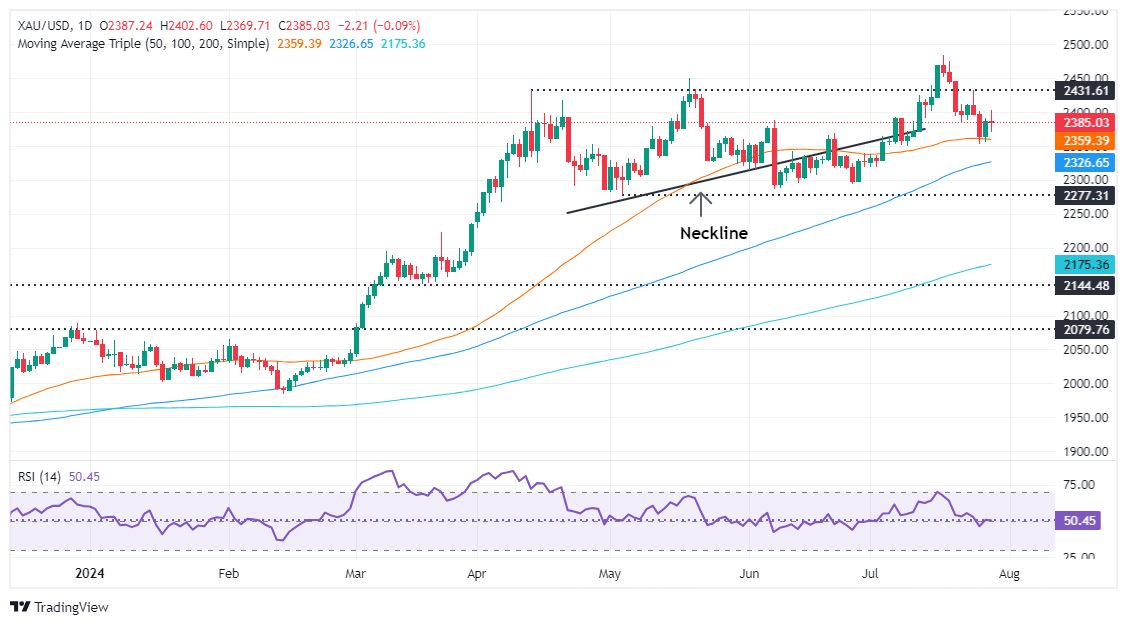
Gold price is upward biased, and despite forming a ‘bullish harami’, buyers failed to decisively clear the $2,400 figure, which exacerbated a drop toward the current spot price. Momentum depicts buyers taking a breather, as shown by the Relative Strength Index (RSI).
The XAU/USD is consolidating at around $2,370-$2,380, with little direction as traders prepare for the Fed’s meeting.
If XAU/USD buyers reclaim $2,400, that could push prices above the psychological $2,450 area. A breach of the latter will expose the all-time high (ATH) at around $2,483, followed by the $2,500 mark.
On the flip side, if XAU/USD continues to edge lower and drop below the 50-day moving average (DMA) at $2,358, further losses are on the cards. The next support would be the July 25 daily low of $2,353. Once those levels are removed, the 100-DMA would be up next at $2,326, ahead of diving to the $2,300 mark.
Gold FAQs
Gold has played a key role in human’s history as it has been widely used as a store of value and medium of exchange. Currently, apart from its shine and usage for jewelry, the precious metal is widely seen as a safe-haven asset, meaning that it is considered a good investment during turbulent times. Gold is also widely seen as a hedge against inflation and against depreciating currencies as it doesn’t rely on any specific issuer or government.
Central banks are the biggest Gold holders. In their aim to support their currencies in turbulent times, central banks tend to diversify their reserves and buy Gold to improve the perceived strength of the economy and the currency. High Gold reserves can be a source of trust for a country’s solvency. Central banks added 1,136 tonnes of Gold worth around $70 billion to their reserves in 2022, according to data from the World Gold Council. This is the highest yearly purchase since records began. Central banks from emerging economies such as China, India and Turkey are quickly increasing their Gold reserves.
Gold has an inverse correlation with the US Dollar and US Treasuries, which are both major reserve and safe-haven assets. When the Dollar depreciates, Gold tends to rise, enabling investors and central banks to diversify their assets in turbulent times. Gold is also inversely correlated with risk assets. A rally in the stock market tends to weaken Gold price, while sell-offs in riskier markets tend to favor the precious metal.
The price can move due to a wide range of factors. Geopolitical instability or fears of a deep recession can quickly make Gold price escalate due to its safe-haven status. As a yield-less asset, Gold tends to rise with lower interest rates, while higher cost of money usually weighs down on the yellow metal. Still, most moves depend on how the US Dollar (USD) behaves as the asset is priced in dollars (XAU/USD). A strong Dollar tends to keep the price of Gold controlled, whereas a weaker Dollar is likely to push Gold prices up.
Author

Christian Borjon Valencia
FXStreet
Markets analyst, news editor, and trading instructor with over 14 years of experience across FX, commodities, US equity indices, and global macro markets.

















