Gold price suffers from firm US yields, strengthens by hot US PPI data
- Gold price falls sharply on hot US PPI data for February.
- The US Retail Sales grew by 0.6%, failing to meet expectations.
- Higher US bond yields weigh on the Gold price.

Gold price (XAU/USD) drops sharply in Thursday’s early New York session as the United States Bureau of Labor Statistics (BLS) has reported a hotter-than-anticipated Producer Price Index (PPI) for February. The precious metal has come under pressure as fears of inflation remaining persistent have deepened.
The US February inflation data released on Tuesday came in hotter-than-expected. Now, a similar trend from the PPI data has escalated uncertainty over Federal Reserve (Fed) rate cut expectations for the June policy meeting. This has led yields on 10-year US Treasury bonds higher to 4.28%, resulting in a sharp increase in the opportunity cost of holding non-yielding assets such as Gold. The US Dollar Index (DXY) rises to 103.10, making the Gold price expensive for investors.
Meanwhile, the US Census Bureau has reported that Retail Sales grew slower than market expectations. Going forward, the major trigger for the Gold price will be the Fed’s interest rate decision, and the new dot plot, which provides interest rates projections. The last dot plot, released in the December meeting, indicated three rate cuts this year. due to firm US Dollar (USD) and bond yields
Daily digest market movers: Gold price slumps as US yields soar after hot US PPI
- Gold price falls to $2,160, pressured by higher US bond yields and firm US Dollar due to stubborn United States PPI data for February. Annual core PPI, which strips off volatile food and energy prices, grew at a steady pace of 2.0%, against expectations of 1.9%. The monthly underlying inflation data rose at a higher pace of 0.3% vs. expectations of 0.2% but remained lower than the prior reading of 0.5%.
- The monthly headline PPI grew strongly by 0.6% against expectations and the former reading of 0.3%. The annual headline PPI accelerated to 1.6% from the consensus of 1.1% and January's reading of 1.0%%. The PPI data shows the pace at which producers have increased or decreased prices of goods and services at factory gates.
- The stubborn US PPI data has impacted market expectations for Fed rate cuts in June. According to the CME FedWatch tool, the chances in favor of a rate cut in June have dropped to 63% from 69% after the release of the PPI data.
- Meanwhile, the US Census Bureau reported that monthly Retail Sales data grew moderately by 0.6% in February from expectations of 0.8%. In January, the data significantly contracted by 1.1%. Investors closely track the Retail Sales data to gain insights into household spending, one of the main growth drivers of the US economy.
Technical Analysis: Gold price drops to $2,160
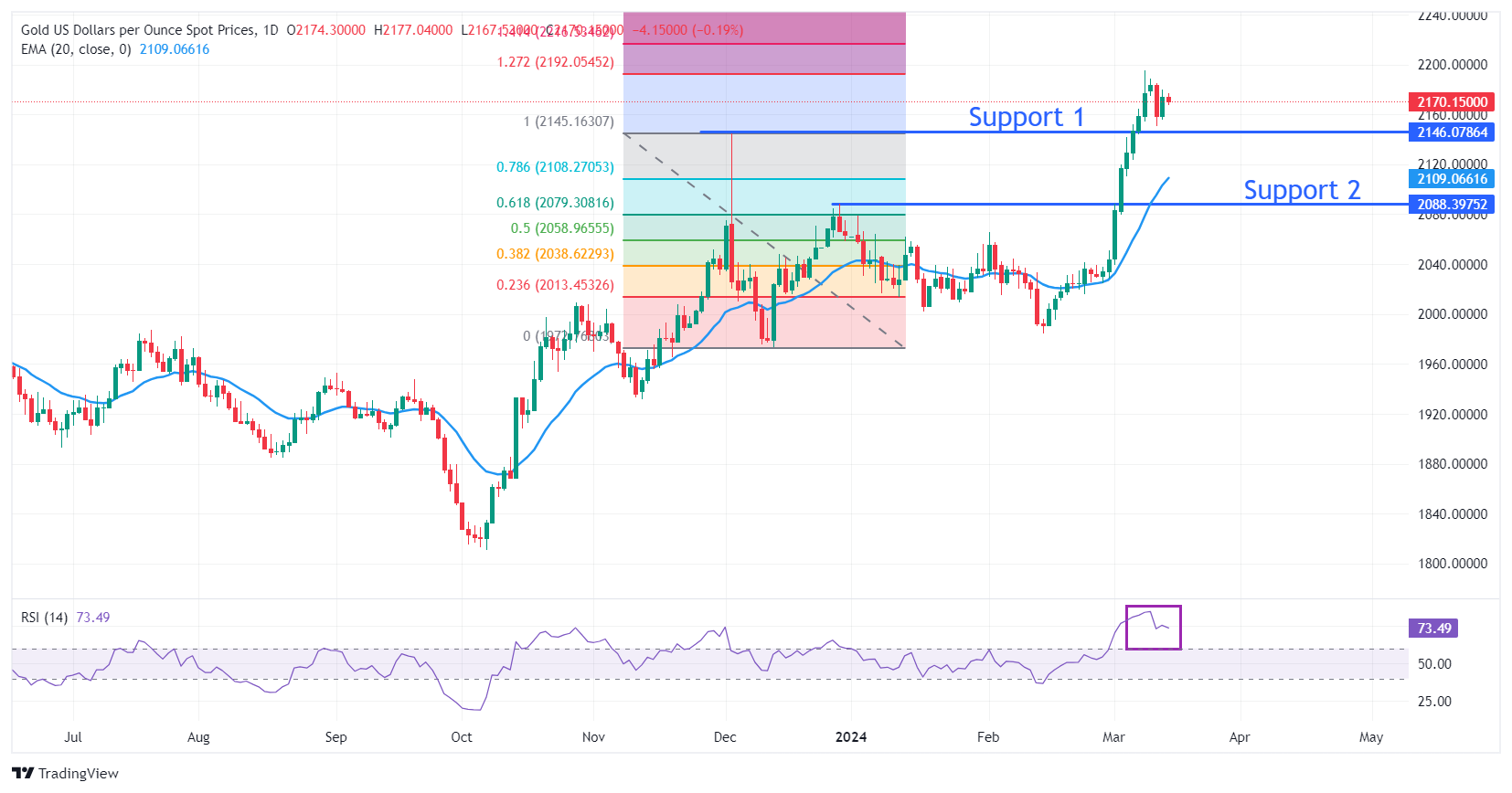
Gold price oscillates inside Tuesday’s trading range between $2,154 and $2,180. The precious metal is slowly entering a non-directional trend in which volatility gets sharply contracted. Earlier, the yellow metal dropped after printing a fresh all-time high near $2,195, which coincides with the 1.27% Fibonacci extension level (plotted from December 4 high near $2,145 to December 13 low at $1,973.3).
On the downside, December 4 high near $2,145 and December 28 high at $2,088 will act as major support levels.
The 14-Relative Strength Index (RSI) retraces from its peak near 84.50, although the upside momentum is still active.
Interest rates FAQs
Interest rates are charged by financial institutions on loans to borrowers and are paid as interest to savers and depositors. They are influenced by base lending rates, which are set by central banks in response to changes in the economy. Central banks normally have a mandate to ensure price stability, which in most cases means targeting a core inflation rate of around 2%. If inflation falls below target the central bank may cut base lending rates, with a view to stimulating lending and boosting the economy. If inflation rises substantially above 2% it normally results in the central bank raising base lending rates in an attempt to lower inflation.
Higher interest rates generally help strengthen a country’s currency as they make it a more attractive place for global investors to park their money.
Higher interest rates overall weigh on the price of Gold because they increase the opportunity cost of holding Gold instead of investing in an interest-bearing asset or placing cash in the bank. If interest rates are high that usually pushes up the price of the US Dollar (USD), and since Gold is priced in Dollars, this has the effect of lowering the price of Gold.
The Fed funds rate is the overnight rate at which US banks lend to each other. It is the oft-quoted headline rate set by the Federal Reserve at its FOMC meetings. It is set as a range, for example 4.75%-5.00%, though the upper limit (in that case 5.00%) is the quoted figure. Market expectations for future Fed funds rate are tracked by the CME FedWatch tool, which shapes how many financial markets behave in anticipation of future Federal Reserve monetary policy decisions.
Author

Sagar Dua
FXStreet
Sagar Dua is associated with the financial markets from his college days. Along with pursuing post-graduation in Commerce in 2014, he started his markets training with chart analysis.