Gold prices rise as US Dollar tumbles after Powell's speech
- Gold prices jump over 1% after Fed Chair Powell hints at upcoming rate cuts, expressing confidence in inflation nearing the 2% target.
- The US Dollar Index (DXY) falls 0.82% to 100.68, as Powell’s remarks push traders to bet on a 50 bps rate cut in September.
- US 10-year Treasury yields drop five basis points to 3.80%, supporting bullion's rise, as market eyes the August Nonfarm Payrolls report for further guidance.

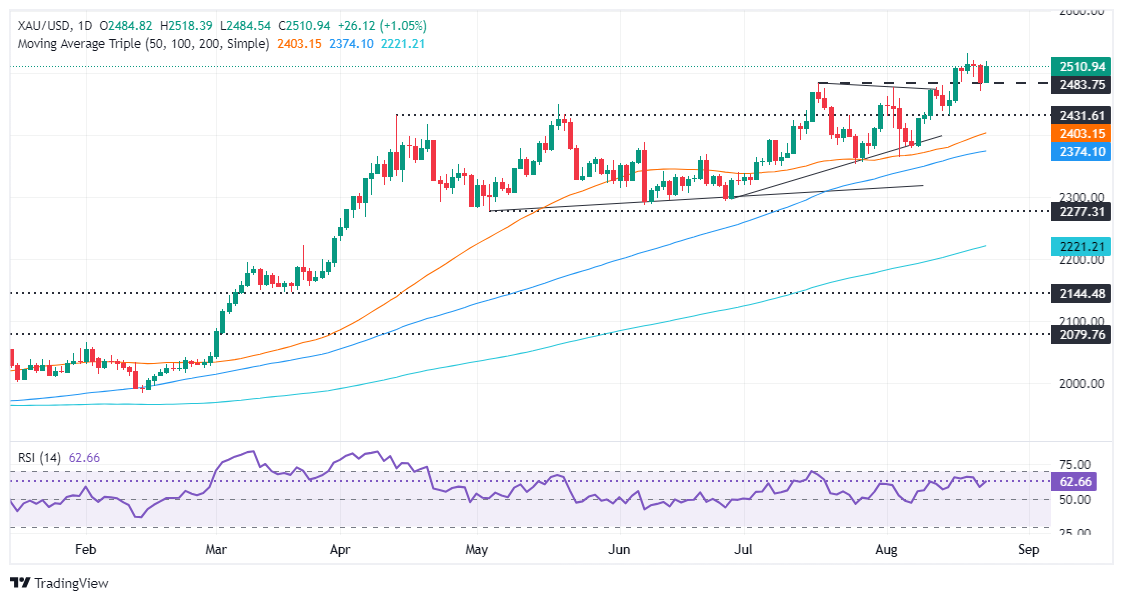
Gold price edges up over 1% on Friday as the Greenback and US Treasury bond yields dive following dovish remarks from Federal Reserve Chair Jerome Powell, who signaled he’s confident that inflation is edging towards the 2% goal and that rates should be cut. The XAU/USD trades at $2510 after bouncing off daily lows of $2484.
Bullion prices rose sharply as Powell said, “The time has come for policy to adjust. " He acknowledged that inflation is on the path to 2% and expressed that the Fed has shifted towards achieving the maximum employment mandate.
After those remarks, Gold reclaimed the $2500 figure, and the Greenback extended its losses. The US Dollar Index (DXY), which measures the dollar’s performance against a basket of six currencies, dropped 0.82% and traded at 100.68.
US Treasury bond yields immediately dropped, with the US 10-year benchmark note slumping five basis points to 3.80%. Traders increased their bets that the Fed would cut rates by 50 bps at the September meeting.
The CME FedWatch Tool shows that market participants had fully priced in a 25 bps cut, while odds for a larger size stand at 36.5%, up from 24% a day ago.
Now, with the Fed shifting towards the jobs market, the August Nonfarm Payrolls report would be the last piece of the puzzle to determine the size of the cut.
Daily digest market movers: Gold price advances ahead of next week’s US inflation report
- If US economic data continues to be soft, the Gold price uptrend will remain, which would increase speculation about a big-size rate cut.
- After Powell’s speech, other Fed officials made notable comments. Philadelphia Fed President Patrick Harker stated that the Fed needs to lower rates methodically. Chicago Fed President Austan Goolsbee added that monetary policy is currently at its most restrictive level, and the Fed’s focus is now shifting toward achieving its employment mandate.
- Next week, the US economic docket will feature Durable Goods Orders, the Conference Board (CB) Consumer Confidence index, Initial Jobless Claims data for the week ending August 24, and the Fed’s favorite inflation gauge, the Core Personal Consumption Expenditures (PCE) Price Index.
- Additionally, Fed speakers led by Christopher Waller and Atlanta’s Fed President Raphael Bostic would cross the wires to prepare the ground ahead of the September meeting.
Technical outlook: Gold’s uptrend intact as buyers eye $2,550
Gold's uptrend remains intact and might extend if buyers lift prices above the all-time high (ATH) of $2,531. A breach of the latter will expose the $2,550 mark, followed by the $2,600 mark.
On the flip side, if Gold achieves a daily close below $2,500, a re-test of the previous all-time high (ATH) of $2,483 is on the cards. If surpassed, Gold’s next support would be the May 20 peak of $2,450, followed by the 50-day Simple Moving Average (SMA) at $2,402.
Interest rates FAQs
Interest rates are charged by financial institutions on loans to borrowers and are paid as interest to savers and depositors. They are influenced by base lending rates, which are set by central banks in response to changes in the economy. Central banks normally have a mandate to ensure price stability, which in most cases means targeting a core inflation rate of around 2%. If inflation falls below target the central bank may cut base lending rates, with a view to stimulating lending and boosting the economy. If inflation rises substantially above 2% it normally results in the central bank raising base lending rates in an attempt to lower inflation.
Higher interest rates generally help strengthen a country’s currency as they make it a more attractive place for global investors to park their money.
Higher interest rates overall weigh on the price of Gold because they increase the opportunity cost of holding Gold instead of investing in an interest-bearing asset or placing cash in the bank. If interest rates are high that usually pushes up the price of the US Dollar (USD), and since Gold is priced in Dollars, this has the effect of lowering the price of Gold.
The Fed funds rate is the overnight rate at which US banks lend to each other. It is the oft-quoted headline rate set by the Federal Reserve at its FOMC meetings. It is set as a range, for example 4.75%-5.00%, though the upper limit (in that case 5.00%) is the quoted figure. Market expectations for future Fed funds rate are tracked by the CME FedWatch tool, which shapes how many financial markets behave in anticipation of future Federal Reserve monetary policy decisions.
Author

Christian Borjon Valencia
FXStreet
Markets analyst, news editor, and trading instructor with over 14 years of experience across FX, commodities, US equity indices, and global macro markets.