Gold advances modestly as traders eye Retail Sales, Fed’s decision
- Gold prices increase despite a slight rise in the US Dollar following mixed PMI data.
- Investors await the Fed’s interest rate decision and economic projections, expecting a 25 bps cut on Wednesday.
- The market speculates on the Fed's future monetary policy amid potential inflationary pressure from Trump policies.

Gold prices edge slightly higher during the North American session at the beginning of the week, up by 0.28%, as investors await the Federal Open Market Committee (FOMC) decision. At the time of writing, the XAU/USD trades at $2,643, above its opening price but off the highs of the day.
The US economic docket remains light with the release of S&P Global Flash PMIs for December, which came mixed. Business activity in the manufacturing sector weakened after improving last month, while the services sector printed its highest reading in 2024.
The data lifted the Greenback, which according to the US Dollar Index (DXY) rose 0.07% to 107.01. Meanwhile, Bullion dipped from daily highs of $2,664.
The Federal Reserve (Fed) will meet for the last time this year on December 17 and 18. Estimates suggest the Fed will cut interest rates by 25 basis points, but traders are eyeing the release of the Summary of Economic Projections (SEP) to grasp the path of interest rates in 2025.
Lower interest rates are usually a tailwind for the non-yielding metal. However, there is growing speculation that the Fed might adopt a gradual stance as the upcoming Trump administration hints at inflation-prone fiscal policies.
Gold prices tend to rise in lower rate environments and with higher geopolitical risk, which have both subsided of late.
The US economic docket will feature the release of Retail Sales, Industrial Production, the FOMC policy decision, and the release of the core Personal Consumption Expenditures (PCE) Price Index.
Daily digest market movers: Gold price holds firm near $2,650
- Gold prices plunged as US real yields are pressured, falling two basis points to 2.049%, a tailwind for the precious metal.
- The US 10-year Treasury bond yield drops two and a half basis points to 4.375%.
- The US Dollar Index remains firm at 107.05, virtually unchanged.
- S&P Global Manufacturing PMI for December dipped from 49.7 to 48.3, missing estimates of 49.8.
- S&P Global Services PMI for the same period expanded by 58.5, up from 56.1, above forecasts of 55.7.
- The CME FedWatch Tool suggests that traders had priced in a 96% chance of a quarter-point rate cut on Wednesday.
- For 2025, investors are betting that the Fed will lower rates by 100 basis points.
- Analysts at Goldman Sachs noted that China’s central bank “may even increase Gold demand during periods of local currency weakness to boost confidence in their currency.”
Technical outlook: Gold price retreats, sellers eye 100-day SMA
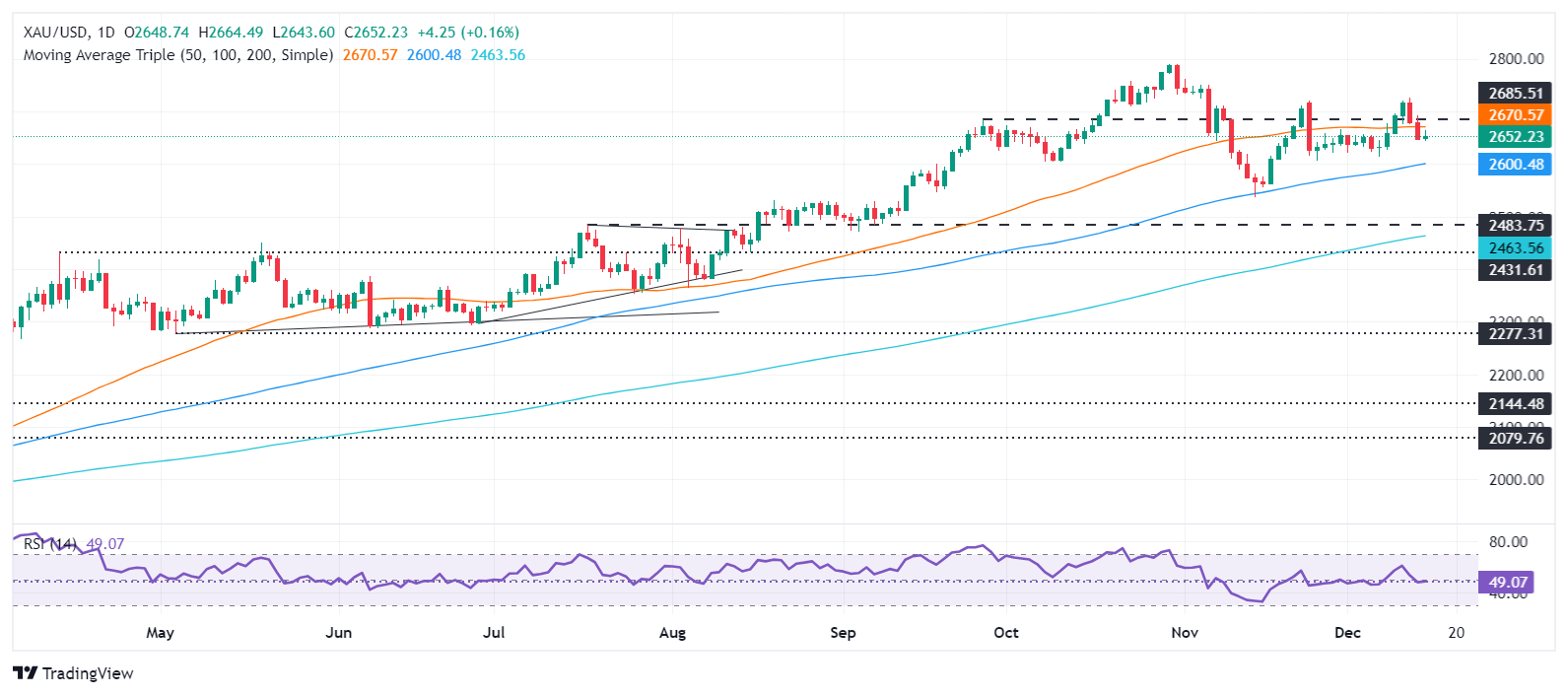
The Gold price uptrend remains intact, yet trades off last week’s lows beneath the 50-day Simple Moving Average (SMA) of $2,670. The Relative Strength Index (RSI) breached below its neutral line, indicating that sellers are in charge.
If Gold prices drop below $2,650, the next support would be the 100-day SMA at $2,600. On further weakness, the next stop would be the August 20 peak at $2,531. Conversely, if XAU/USD rallies past $2,650, the next resistance would be the 50-day SMA at $2,670, ahead of $2,700.
Fed FAQs
Monetary policy in the US is shaped by the Federal Reserve (Fed). The Fed has two mandates: to achieve price stability and foster full employment. Its primary tool to achieve these goals is by adjusting interest rates. When prices are rising too quickly and inflation is above the Fed’s 2% target, it raises interest rates, increasing borrowing costs throughout the economy. This results in a stronger US Dollar (USD) as it makes the US a more attractive place for international investors to park their money. When inflation falls below 2% or the Unemployment Rate is too high, the Fed may lower interest rates to encourage borrowing, which weighs on the Greenback.
The Federal Reserve (Fed) holds eight policy meetings a year, where the Federal Open Market Committee (FOMC) assesses economic conditions and makes monetary policy decisions. The FOMC is attended by twelve Fed officials – the seven members of the Board of Governors, the president of the Federal Reserve Bank of New York, and four of the remaining eleven regional Reserve Bank presidents, who serve one-year terms on a rotating basis.
In extreme situations, the Federal Reserve may resort to a policy named Quantitative Easing (QE). QE is the process by which the Fed substantially increases the flow of credit in a stuck financial system. It is a non-standard policy measure used during crises or when inflation is extremely low. It was the Fed’s weapon of choice during the Great Financial Crisis in 2008. It involves the Fed printing more Dollars and using them to buy high grade bonds from financial institutions. QE usually weakens the US Dollar.
Quantitative tightening (QT) is the reverse process of QE, whereby the Federal Reserve stops buying bonds from financial institutions and does not reinvest the principal from the bonds it holds maturing, to purchase new bonds. It is usually positive for the value of the US Dollar.
Author

Christian Borjon Valencia
FXStreet
Markets analyst, news editor, and trading instructor with over 14 years of experience across FX, commodities, US equity indices, and global macro markets.