Gold rally continues with buyers eyeing $2,400 as inflation recedes
- Gold price hits $2,390, its highest level in three weeks, gaining over 1%.
- US Treasury bond yields plunge, US Dollar Index drops to five-week low.
- April Retail Sales stagnate, while Fed officials express concerns about restrictive monetary policy.

Gold price extended its uptrend for the second straight day on Wednesday and hit a three-week high of $2,390 after data revealed by the US Bureau of Labor Statistics (BLS) showed inflation is ebbing, increasing the odds for a Federal Reserve (Fed) rate cut in 2024. Hence, US Treasury bond yields are plunging, while the Greenback tumbles to a five-week low as depicted by the US Dollar Index (DXY).
The XAU/USD trades at $2,384 and gains more than 1%. Despite standing above 3% on an annual basis, consumer inflation slowed in monthly figures, easing pressure on the Fed. US Treasury yields along the short and long ends of the curve are diving between 8 and 10 basis points.
Other data announced by the US BLS witnessed a deterioration in consumer spending, as Retail Sales in April remained unchanged at 0% MoM, below estimates of a 0.4% increase.
Elsewhere, Fed officials continued to make headlines. Minneapolis Fed President Neel Kashkari said that with higher government debt, it might take higher borrowing costs in the near term to achieve 2% inflation. He said he’s surprised by consumers' spending and added that the big question is “how restrictive monetary policy is.”
Daily digest market movers: Gold shines amid dropping US yields as rate cut expectations rise
- Gold prices are underpinned by lower US Treasury yields and a battered US Dollar. The US 10-year Treasury note yields 4.352% and is down 9 basis points (bps) from its opening level. DXY falls 0.66% to 104.33.
- On Tuesday, Fed Chair Jerome Powell commented that he expects inflation to continue heading lower but wasn’t as confident about the disinflation outlook as he had previously been.
- BLS reveals that April’s Consumer Price Index rose by 0.3% MoM, below estimates and March’s 0.4%. Core CPI rose by 0.3% MoM as expected but beneath the prior reading of 0.4%.
- Other data showed that Retail Sales missed estimates of 0.4% and came at 0% MoM, below March’s 0.6%. In the twelve months to April, Retail Sales grew by 3%, below the 3.8% increase of the previous reading.
- Further data will be featured during the week, led by Initial Jobless Claims and Industrial Production on May 16.
- The New York Federal Reserve released its monthly Survey of Consumer Expectations on Monday, showing that the year's inflation expectations increased to 3.3% vs. 3% in March. The data came after the University of Michigan Consumer Sentiment poll showed that inflation expectations for a one-year outlook rose from 3.2% to 3.5%.
- Interest rate cut expectations toward the end of the year edged up from 35 basis points on Tuesday to 42 bps, according to data provided by the Chicago Board of Trade.
Technical analysis: Gold price clears May 10 high, on its way towards $2,400
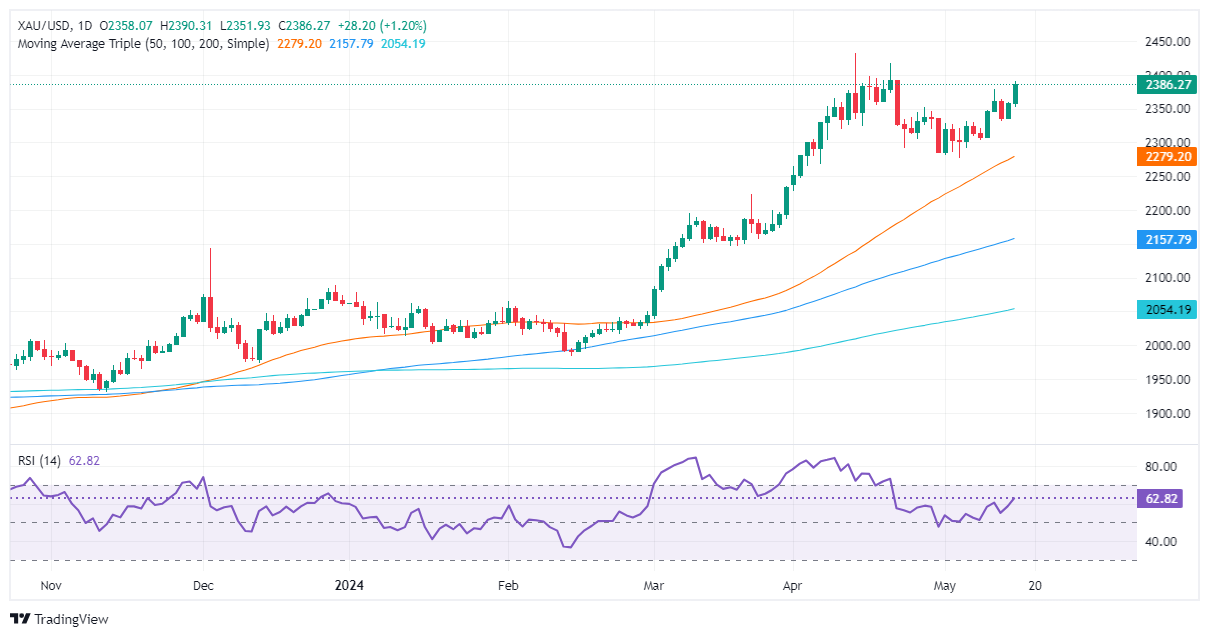
Gold price’s rally was prolonged for the second straight day, yet it was shy of challenging the $2,400 figure. Once buyers surpassed $2,378, the May 10 high paved the way for a new trading range within the $2,380 to $2,400 range.
Momentum favors buyers as the Relative Strength Index (RSI) remains bullish with readings above 60. Therefore, the path of least resistance is upward.
That said, the XAU/USD first resistance would be $2,400. Once surpassed, the immediate supply zone would be the April 19 high at $2,417, followed by the all-time high at $2,431.
Conversely, if sellers moved in and pushed prices below $2,359, that could sponsor a leg down toward the May 9 low of $2,306, followed by the $2,300 figure. Once surpassed, the next stop would be the 50-day Simple Moving Average (SMA) at $2,249.
Gold FAQs
Gold has played a key role in human’s history as it has been widely used as a store of value and medium of exchange. Currently, apart from its shine and usage for jewelry, the precious metal is widely seen as a safe-haven asset, meaning that it is considered a good investment during turbulent times. Gold is also widely seen as a hedge against inflation and against depreciating currencies as it doesn’t rely on any specific issuer or government.
Central banks are the biggest Gold holders. In their aim to support their currencies in turbulent times, central banks tend to diversify their reserves and buy Gold to improve the perceived strength of the economy and the currency. High Gold reserves can be a source of trust for a country’s solvency. Central banks added 1,136 tonnes of Gold worth around $70 billion to their reserves in 2022, according to data from the World Gold Council. This is the highest yearly purchase since records began. Central banks from emerging economies such as China, India and Turkey are quickly increasing their Gold reserves.
Gold has an inverse correlation with the US Dollar and US Treasuries, which are both major reserve and safe-haven assets. When the Dollar depreciates, Gold tends to rise, enabling investors and central banks to diversify their assets in turbulent times. Gold is also inversely correlated with risk assets. A rally in the stock market tends to weaken Gold price, while sell-offs in riskier markets tend to favor the precious metal.
The price can move due to a wide range of factors. Geopolitical instability or fears of a deep recession can quickly make Gold price escalate due to its safe-haven status. As a yield-less asset, Gold tends to rise with lower interest rates, while higher cost of money usually weighs down on the yellow metal. Still, most moves depend on how the US Dollar (USD) behaves as the asset is priced in dollars (XAU/USD). A strong Dollar tends to keep the price of Gold controlled, whereas a weaker Dollar is likely to push Gold prices up.
Author

Christian Borjon Valencia
FXStreet
Markets analyst, news editor, and trading instructor with over 14 years of experience across FX, commodities, US equity indices, and global macro markets.