Gold rises on soft US data, Middle East woes and Fed rate cut bets
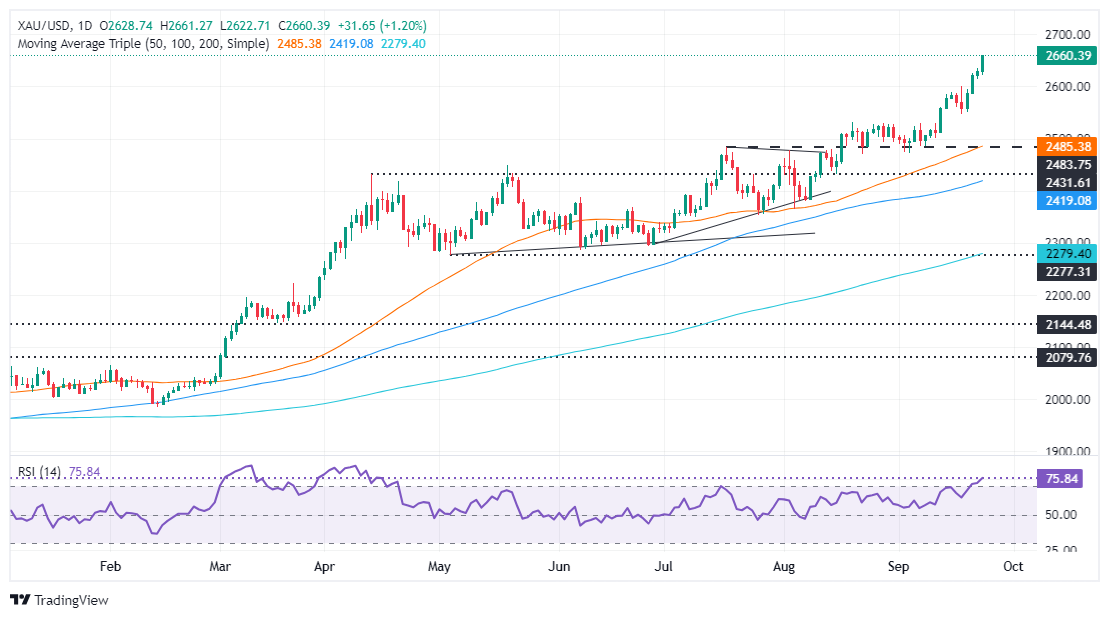
- Gold hits a new ATH of $2,664 amid declining US Consumer Confidence and weakening US Dollar, XAU/USD trades at $2,651.
- Fed Governor Michelle Bowman signals a cautious approach to rate cuts.
- Geopolitical tensions in the Middle East also fuel safe-haven demand for Gold, driving the precious metal to new heights.

Gold prices hit a new all-time high (ATH) during Tuesday's North American session due to a deterioration in Consumer Confidence in the United States (US), according to data provided by the Conference Board. This, along with a dip in US Treasury yields and US Dollar weakness, sponsored a leg-up in the non-yielding metal. The XAU/USD trades at $2,662 after reaching an ATH of $2,664.
The Conference Board revealed that Consumer Confidence declined in September, hitting its lowest level since August 2021, due to growing concerns about the labor market and the overall economic outlook.
After the data, US Treasury bond yields edged lower with the 10-year T-note yielding 3.73%, declining by two basis points. At the same time, the US Dollar Index (DXY), which measures the Greenback’s performance against a basket of six currencies, tumbled to a two-day low of 100.48, down over 0.42%.
Meanwhile, Fed Governor Michelle Bowman, a noted hawk, stated that risks to inflation remain significant, expressing her preference for "a measured pace of cuts" to prevent the risk of reigniting inflation.
Daily digest market movers: Gold price extends rally on soft US data
- The CB Consumer Confidence Index for September fell from 105.6 to 98.7, missing analysts' estimate of 103.8.
- Dana Peterson, chief economist at the Conference Board, said, “The deterioration across the Index’s main components likely reflected consumers' concerns about the labor market and reactions to fewer hours, slower payroll increases, and fewer job openings.”
- Tensions in the Middle East escalated as Hezbollah urged Iran to launch an attack against Israel, according to Axios.
- US data on Monday showed that Business Activity decelerated slightly, but it remains resilient as S&P Global revealed the Services PMI exceeded expectations. On the Contrary, manufacturing activity deteriorated further.
- According to the World Gold Council, global physically-backed Gold ETFs saw modest net inflows of 3 metric tons last week.
- Market participants are certain of at least a 25 bps rate cut by the Fed at November’s meeting, while the odds for a 50 bps cut stand at 56.2%, according to the CME FedWatch Tool.
XAU/USD technical outlook: Gold poised for further gains before retreating
The XAU/USD is upwardly biased, set to print continued record highs, even though the rally seems overextended, with traders eyeing the $2,700 figure. Momentum favors buyers even though the Relative Strength Index (RSI) has turned overbought. Hence, buyers should be wary that a pullback might be on the cards.
If XAU/USD extends its rally, traders could test $2,675, followed by $2,700. Up next would be the $2,750 level, followed by $2,800.
On the flip side, if XAU/USD drops below $2,650, look for a test of the September 18 daily high at $2,600. The following key support levels to test will be the September 18 low of $2,546, followed by the 50-day Simple Moving Average (SMA) at $2,481.
Gold FAQs
Gold has played a key role in human’s history as it has been widely used as a store of value and medium of exchange. Currently, apart from its shine and usage for jewelry, the precious metal is widely seen as a safe-haven asset, meaning that it is considered a good investment during turbulent times. Gold is also widely seen as a hedge against inflation and against depreciating currencies as it doesn’t rely on any specific issuer or government.
Central banks are the biggest Gold holders. In their aim to support their currencies in turbulent times, central banks tend to diversify their reserves and buy Gold to improve the perceived strength of the economy and the currency. High Gold reserves can be a source of trust for a country’s solvency. Central banks added 1,136 tonnes of Gold worth around $70 billion to their reserves in 2022, according to data from the World Gold Council. This is the highest yearly purchase since records began. Central banks from emerging economies such as China, India and Turkey are quickly increasing their Gold reserves.
Gold has an inverse correlation with the US Dollar and US Treasuries, which are both major reserve and safe-haven assets. When the Dollar depreciates, Gold tends to rise, enabling investors and central banks to diversify their assets in turbulent times. Gold is also inversely correlated with risk assets. A rally in the stock market tends to weaken Gold price, while sell-offs in riskier markets tend to favor the precious metal.
The price can move due to a wide range of factors. Geopolitical instability or fears of a deep recession can quickly make Gold price escalate due to its safe-haven status. As a yield-less asset, Gold tends to rise with lower interest rates, while higher cost of money usually weighs down on the yellow metal. Still, most moves depend on how the US Dollar (USD) behaves as the asset is priced in dollars (XAU/USD). A strong Dollar tends to keep the price of Gold controlled, whereas a weaker Dollar is likely to push Gold prices up.
Author

Christian Borjon Valencia
FXStreet
Markets analyst, news editor, and trading instructor with over 14 years of experience across FX, commodities, US equity indices, and global macro markets.