Gold climbs on Fed rate cut hopes ahead of NFP data
- Gold rises above $2,500, peaking at $2,523 before profit-taking ahead of key US economic data.
- Traders price in over 104 bps of Fed easing, expecting rate cuts to maintain labor market stability.
- Falling US Treasury yields and a weaker US Dollar support further upside in Gold prices.
Gold prices rallied sharply during the North American session, above the $2,500 figure on Thursday, yet remain shy of their daily peak of $2,523 as traders booked profits ahead of first-tier United States (US) data. At the time of writing, XAU/USD trades at $2,516, gaining over 0.80%.
In the early morning, US jobs data showed mixed readings, though it confirmed that the labor market is cooling, fueling speculation for a 50-basis-point (bps) interest rate cut by the Federal Reserve (Fed) in two weeks. On the other hand, the economy remains resilient as business activity in the services segment improved against projections of a slowdown.
However, Gold traders lifted the yellow metal above $2,500, as they priced in over 104 bps of Fed easing, according to the December 2024 Chicago Board of Trade (CBOT) fed funds futures contract.
What is almost certain is that the Fed may lower borrowing costs, according to San Francisco Fed President Mary Daly. She commented that the Fed needs to cut rates to keep the labor market healthy.
US Treasury yields fell after the data with the 10-year Treasury note down three basis points to 3.727%, undermining the buck. The US Dollar Index (DXY), a measure of the Greenback’s value against the other six currencies, tumbles over 0.21% to 101.05.
In the meantime, Gold traders are preparing for the release of the August Nonfarm Payrolls (NFP) report.
Daily digest market movers: Gold price surges ahead of US NFP data
- Figures of the ADP National Employment Change showed that private companies hired fewer people than expected, adding just 99K in August, well beneath the 145K expected and downwardly revised July figures.
- Initial Jobless Claims for the week ending August 31, hit 227K, below the 230K projected and the previous 232K.
- ISM Services Purchasing Managers Index (PMI), a measure of business activity, improved. The index hit 51.5 vs 51.4 in July and above the 51.1 projected by the consensus.
- August’s NFP figures are expected to rise from 114K to 163K, while the Unemployment Rate could dip, according to the consensus, from 4.3% to 4.2%.
Technical outlook: Gold price buyers reclaim $2,500
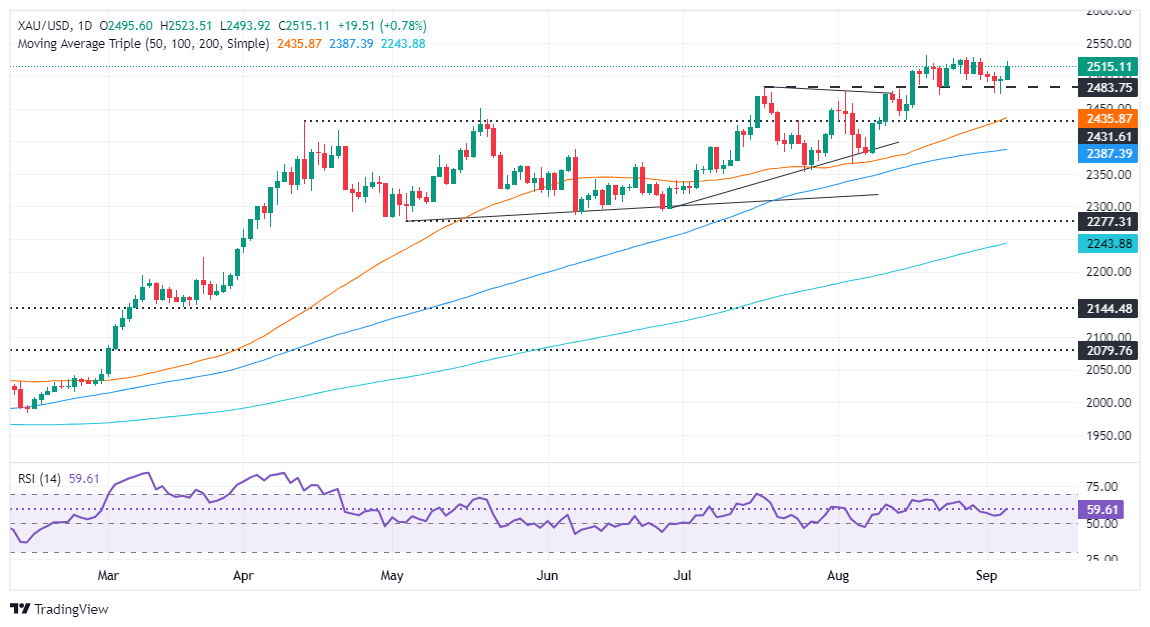
Gold prices had risen to new two-week highs above $2,500 before the NFP report's release. Price action shows buyers are gathering momentum as demonstrated by the Relative Strength Index (RSI), aiming for the upside in bullish territory.
That said, the XAU/USD path of least resistance is tilted to the upside, and it might challenge the year-to-date (YTD) high at $2,531. If surpassed, the next stop would be the psychological $2,550, followed by the $2,600 mark.
Conversely, if XAU/USD drops below $2,500, the next support would be the August 22 low at $2,470. Once cleared, the next demand zone would be the confluence of the April 12 high, which turned support, and the 50-day Simple Moving Average (SMA) at $2,435-$2,431.
Gold FAQs
Gold has played a key role in human’s history as it has been widely used as a store of value and medium of exchange. Currently, apart from its shine and usage for jewelry, the precious metal is widely seen as a safe-haven asset, meaning that it is considered a good investment during turbulent times. Gold is also widely seen as a hedge against inflation and against depreciating currencies as it doesn’t rely on any specific issuer or government.
Central banks are the biggest Gold holders. In their aim to support their currencies in turbulent times, central banks tend to diversify their reserves and buy Gold to improve the perceived strength of the economy and the currency. High Gold reserves can be a source of trust for a country’s solvency. Central banks added 1,136 tonnes of Gold worth around $70 billion to their reserves in 2022, according to data from the World Gold Council. This is the highest yearly purchase since records began. Central banks from emerging economies such as China, India and Turkey are quickly increasing their Gold reserves.
Gold has an inverse correlation with the US Dollar and US Treasuries, which are both major reserve and safe-haven assets. When the Dollar depreciates, Gold tends to rise, enabling investors and central banks to diversify their assets in turbulent times. Gold is also inversely correlated with risk assets. A rally in the stock market tends to weaken Gold price, while sell-offs in riskier markets tend to favor the precious metal.
The price can move due to a wide range of factors. Geopolitical instability or fears of a deep recession can quickly make Gold price escalate due to its safe-haven status. As a yield-less asset, Gold tends to rise with lower interest rates, while higher cost of money usually weighs down on the yellow metal. Still, most moves depend on how the US Dollar (USD) behaves as the asset is priced in dollars (XAU/USD). A strong Dollar tends to keep the price of Gold controlled, whereas a weaker Dollar is likely to push Gold prices up.
Author

Christian Borjon Valencia
FXStreet
Markets analyst, news editor, and trading instructor with over 14 years of experience across FX, commodities, US equity indices, and global macro markets.